Archive

Showing posts with label music analysis blog. Show all posts

1/12/21

"The Morning After" - Maureen McGovern, 1973

"The Morning After" or "The Song from the Poseidon Adventure" is one of many random 70's hits that made its way to the no. 1 position on the Billboard Hot 100.  In my analyses thus far, the 70's contributions have been real head scratchers.  Just a year before today's entry, Gilbert O'Sullivan sang about committing suicide after being stood up at the alter.  In 1971, the Bee Gees crooned softly about their own familial troubles.  The Carpenters sang a low key classic in 1970 and even Lionel Richie kept the slow dance moving with 1978's "3 Times A Lady."  Of this 6 songs I've analyzed from the decade, the average tempo has been 89 bpm.  Yes, I know the sample size is small and random, but I think this speaks to the fondness of ballads and easy listening that permeated the collective popular tastes.  

Maureen McGovern was a secretary who sang in a folk band.  When 20th Century Fox wanted a single version of a prominent song in the movie The Poseidon Adventure, McGovern eventually got the call. [1]  It worked out well for her, even if the music (and movie) are good examples of melodramatic cheese that 70's is now known for.  Despite an overall presentation that is quite forgettable, there are some interesting changes and melodies buried within the lush orchestral arrangement.  

August 4th - August 11th, 1973: "The Morning After" by Maureen McGovern sails at the no.1 position on the Billboard Hot 100 for 2 weeks!


One of the elements that both hurts and helps this song is the length.  It's quite short, so you never have enough time to be completely annoyed by it.  It's so short, however, that it's easy to forget.  There is no chorus, just three verses (and a coda) that use variations on the lyrical theme "there's got to be a morning after."  

The AABA form isn't too surprising for a song featured in a movie and written by TV and movie writers Al Kasha and Joel Hirschhorn.  It has a very "jazz lead sheety" vibe.  The song plods on with some thick arranging with a full orchestra that never really traverses too much ground.  Harmonically, it's jazzy as well, which features a bridge that eventually sets up a modulation for the final part of the tune (more on that in "Chord Progressions").  

The outro hammers home the hook several times with an impressive countermelody over the top.  As pleasant as some moments are, it's over as soon as it begins.  


Chord Progressions 

The opening chords tell you right away we are in for an easy listening  spectacular.  Harp glissando, soaring oboe, warm piano, oh my.

Intro

In the key of Bb, IV and V lead us, predictably, to I.  The Fsus to F change foreshadows a sequence that permeates the entire tune and happens on just about every V -I cadence throughout.  Once in the verse, strings lay down some lovely pads behind a moving piano and a surprisingly active bass line.

Verse 1 Score Redux


Bb    /  Fsus  F  D7    / Gmin   / EbMaj7  / C7         F   D      / Gmin   /  Eb    Ab  / Fsus   F
I       /    V         V/vi / vi         /  IV          / II (V/V)  V  V/vi / vi        /  IV     bVII/ V

The chromatic and stepwise bass motion takes center stage for me, with beautiful voicings forming around the moving line.  Included above are some of the moving string and piano parts that add to the overall texture.  Though the changes are fairly "normal," there are a few surprises like the C7/E and the Ab.  These moments, enhanced by a patterned vocal melody, do their best to help the song develop an identity (which it never really does).  

The repeated piano notes in m5 is, in a way, foreshadow the gnarly harpsichord part in verse 2:

Verse 2 Harpsichord

The notes shift in small increments, outlining the chord of the moment in a fashion not unlike the bassline stealthily moving through the changes.  Unfortunately, the harpsichord dates the sound in a major way.  (I'm personally glad modern pop music doesn't feature too many harpsichord call backs).

The bridge features a few harmonic twists that eventually lead to a modulation up a half step.  The first shift moves up a minor 3rd from Bb to Db major.  The ultimate function of this chord is V/V of the modulated target (B major), so perhaps C# is more appropriate?  Either way, we get shifting chord qualities with more stepwise motion in the supporting instruments.  After 3 1/2 measures, The bass comes off the Db pedal and sets up DbMaj7/Ab and Gb (F#) where the modulation fully comes into view.

Bridge Score Redux

  The Gb (F#) leads to E, where a ii-V change sets up the turnaround to the new key.  In these final measures before the return to A, we get a variation on the verse changes - ii-IV / Vsus V, instead of IV / ii V.  The use of the Vsus V resolution also leads the ear back to the A section.


Db (C#)            /  %  / % / Db  /Ab Gb(F#)   / E     / F#min  B      /  C#min  E  / F#sus  F#
bIII (V/V - B)/       /     /                V/IV (B) / IV  /  ii (E)    V (E)/  ii          IV/  V (B) 


 The A section repeats for a third verse and we hear the same changes, only up a half step.  The coda features a moving B chord, functioning similarly to the Db in the bridge with shifting lines that change the quality of the chord.  Here, they move trough the 6th and 4th.  Check out the bass in this section, ripping through some improv style lines of the constant B major tonality.  


Melody

Maureen McGovern delivers a strong performance belting out the melody.  Most phrases are concluded with a sustained note that she holds for the full rhythmic value.  Knowing that Maureen was singing in a folk band at the time, her style and delivery makes sense as I can almost smell the Appalachian valley on her breath.

Verse 1 Melody

If you look at the first and last notes of each melodic phrase, there is a nice shape that appears.  The first phrase centers around F, 5th of Bb.  She moves lower to D, 5th of G and major 7th of Eb.  She goes down even further to C (root of C7, 5th of F and 7th of D7) and lands on Bb, minor 3rd of Gminor.  She finished the final phrase with several roots and 5ths of the passing chords.  F-D-C-Bb-F  

While there is mostly stepwise motion at work, the leaps stand out and provide some interesting moments.  I especially like the descending minor 6th leap from Bb to D in measure 4.  The 5th/4th sequence in measure 7 is another nice moment.  

The bridge kicks in with a short and sweet vocal harmony (3rds).  The melody uses rhythmic variation of the verse melody, simplifying some of the busier phrases and syncopating what was previously straight.  Her phrases, here, begin centered around the 3rd, F.  Leaps of 3rds and 5ths lead to accentuating the 9th, Eb.

Bridge Melody

As the approach to the modulation kicks in, the melody shifts from the 3rd to roots and 5ths, a callback to the verse's melodic construction.  This bridge melody is by no means offensive to the ear, but maintains the theme of just kind of being there.

The third verse, in the key of B, reuses the established verse melody.  The 8th measure adds an additional phrase that sweeps into the coda in grand fashion.  The phrases starts on the 5th, leaps to the root and then approaches the root again 6, 7, 8.

Verse 3 melody to Coda

The coda brings back the vocal harmony, this time with a call and response variation on the main theme.  The contour of the two phrases is very different and this little melodic burst definitely peaks my interest in listening.  Unfortunately, the song is over before this part can really sink in.  Form wise, it happens at the most logical point in the song......too little, too late though.

Lyrics
 
On the surface, the lyrics tell the story of two lovers desperately trying to weather the hard times upon them.  They come off as impersonal with many analogies to nature (night, shore, storm, darkness, warm).  Upon further investigation, these lyrics are directly tied to the movie in which it is featured, The Poseidon Adventure.  They take on a new meaning in that context, with the subjects hoping to literally see the next morning and survive the impending doom of a sinking ship.

The verse uses the rhyme scheme ABCB while the bridge employs ABAB.  These lyrics aren't really offensive, but like the rest of the tune, they're just kind of there.

Common Threads

I am fascinated with common musical themes and elements present in a variety of no.1 songs through the decades.  In each round of analyses, I have attempted to identify these themes and track their presence in various decades.  Picking up from 1983's "Every Breath You Take," let's see how Maureen McGovern stacks up musically. 

Repetitive Melody - for such a short tune, there is quite a bit of repetition in the melody.  The verse phrases have similar contour and structure and are repeated 3 times throughout, plus the opening phrase again in the coda.  

Melody Utilizes Chord Tones - The melody consistently outlines chord tones, with a special fondness for roots and 5ths.  

Two Harmonic Sequences *- A and B represent two different chord sequences.  The modulation maintains the structure of the A chord changes.

Multi-layered Percussive Accompaniment - The drums float around in the background.  There are a few moderately interesting fills, but nothing to write home about.

Dense Arrangement - Here's a new one for this round of analyses.  The orchestral part is very dense with many moving parts and pads throughout.  Some of the pop songs in the 2000's have had a similar density, but don't come close in complexity and orchestration. 

Features Rap/Spoken Vocal - Maureen is a true trobairitz!

Melodic Bass Line - Though it's somewhat subtle and easily forgotten with the dense arrangement and, err, forgettable nature of the tune, this bass line is hip!  The lines run at the end are exceptionally fun. (In fact, transcribing this one was what pulled me out a two month long hiatus from this project.  Nothing like a 70's ballad to stop your progress on a music analysis project!)

Vocal Harmony - There are those brief spots in the bridge and then the call and response at the end.  Not super important, but it's there.

Non-Linear Form - AABA is a standard musical form.  Each section consists of 8 measure phrases. The coda does fade out, but it's balanced in the way the phrases are laid out.  

Chord Count: 18 - Bb, Fsus, F, D7/F#, Gmin, EbMaj7, C7/E; + their 1/2 step up counterparts; Dbmaj (several variations), F#min, C#min, Eb69.  

DRUM ROLL....We have a new winner for highest chord count.  Maureen McGovern wipes the floor with Gilbert O'Sullivan's "Alone Again (Naturally)" (1972) by 4 chords!  I'm not surprised this new record occurs in the 70's.  At this rate, the 1974 entry should be equally as complex in it's chordal construction. 

5/8....common threads....factoring in the new category, 6/9.  Not too shabby for song that leaves such a shallow impression.


Final Takeaways

hmmm, I'm not sure what to say about this one.  I don't hate the tune and have even found myself, as usual, blurting out the hook while going through my normal routines.  Aside from that, the tune doesn't resonate with me.  

In my research though, I have found this song apparently resonates with many.  First, Maureen McGovern , herself, appears in the 1980 comedy classic Airplane! as the singing nun!  How fitting that the movie that helped her song soar to number 1 was the very kind of disaster flick Airplane! set out to poke fun of in the first place.  

Also, this song has been used as the ubiquitous "cheesy love ballad" in several controversial cartoons - South Park [2] and Family Guy [3]!  I guess it's this type of forgettable content that writers look for to get their point across and accrue the lowest possible copyright fee?  Or they just hope no one will notice at all?  It's funny where the number 1 songs end up after their moment of the sun has ended.

Up next time, we head to the last stop in the journey "on the 3's."  The second week of August in 1963...

August 10th - August 24, 1963....a three week run at no.1 and the first appearance for this legendary artist.  "Fingertips" by Little Stevie Wonder gets the nod.  Stay tuned!


[1]https://www.stereogum.com/2039490/the-number-ones-maureen-mcgoverns-the-morning-after/columns/the-number-ones/

[2]https://southpark.fandom.com/wiki/The_Morning_After

[3]https://familyguy.fandom.com/wiki/The_Morning_After

10/11/20

"Crazy In Love" - Beyoncé featuring Jay-Z, 2003

 This is the third time Beyoncé has appeared in this project.  (Check out 2020's "Savage" and 2001's "Bootylicious")  If a random sampling of no.1 songs has her popping up thrice, you know she has to be a serious player.  Ans today's subject simply adds fuel to that fire.  2003's "Crazy In Love" is considered one of the greatest pop songs ever written.....at least in this millennium.  Hopefully, this analysis can shed a little light as to why.

"Crazy In Love" comes from Beyoncé's debut solo record.  It incorporates a few musical styles into one slick pop package.  It has won Grammys, topped charts and has earworms that, to this day, permeate dance floors and festive gatherings. [1] If my own highly biased opinion means anything to anyone, I rather enjoy this song.  It literally has a little bit of something for everyone.  Let's get in the weeds and see why this song is regarded so highly.

June 22nd - September 7th, 2003: "Crazy In Love" by Beyoncé, featuring Jay-Z, cements itself as a SCC with an 8 week run at no.1!


One thing that stands out right away is the form.  Going by the numbers, there's a little bit of quirk happening right up front.  The intro, comprised of the horn line, sampled from 1970's "Are You My Woman (Tell Me So)" by The Chi-Lites, [2] happens 3x times, is interrupted with a vocal hook, and then returns for one more 2 measure refrain.

The total length of the intro is 12 bars, but the arrangement of 6-4-2 is unusually asymmetrical.  After that, things even out and we get an 8 measure verse, an 8 measure chorus and a return to the 4 measure vocal hook.  The cycle then starts again, until....

The second statement of the chorus is 10 measures long, which is 2 measures longer than you would expect.  It's a cool little twist that brings in Jay-Z and his 3rd verse rap.  This verse is another great example of unusual grouping.  He raps for 8 measures on the verse feel. Then, there is a 2 measure interruption on the chorus changes.  It gets back to the verse feel for 8 more measures.  18 measures is a long time to rap for and thanks to that interruption, Jay-Z has no problem holding your attention.

Out of the rap, we get to the bridge.  This might be my favorite part of the song and features some ridiculous vocal arranging.  And, once again, the section clocks in at an unexpected number of measures.  We get 6 measures of the chorus changes followed by 4 measures of the verse change.  I love the way the horn sample (chorus) is chopped up into these uneven groupings, much like the original, where it used sporadically.  

The songs ends in somewhat predictable fashion, a double chorus followed by the horn riff fading out.  In terms of the form, this is how the songs elevates itself into the upper echelon of pop genius.  It has predictable elements (4 measure phrases) presented in an unexpected way.  Great stuff!


Chord Progressions

With so much going on in the form, it's not surprising that there are only a few changes happening.  The primary change, built on the sample, happens in the intro and choruses, with appearances in the bridge and rap.  It is driven by the horn line with a pulsing bass line underneath.

Horn Line with Bass

If you focus on this 2 measure riff alone, it doesn't really indicate a clear key center.  You might think Bb, indicating I-VI, which wouldn't be completely out of the question as far pop harmony is concerned.  I saw one analysis that called G7 the I chord, which also wouldn't be out of the question. [3]  This doesn't become clear until it finally resolves during the vocal hook:  Dmin/F.

The D minor chord, with an F in the bass, is the true feeling of home and puts the tune in the key of D minor.  With those parameters more clear, the opening chord change plays out to be:

Bb    /    G7    
bVI /    IV

While each of these chords are common in minor tonalities, they are not usually found back to back and as the primary pillars of the harmony.  The end result is a unique sound that, with the horns, helps this song stand out.  

While we're at it, the horn melody uses (almost) the same figure on both of the chords, a D minor scale over Bb and a D alt scale on G7, only going as high as the 5th of D.

Once the Dmin/F chord arrives, we hear another element of The Chi-Lites sample, a slamming drum part with a moving conga line:

Drums and Percussion

  As the song progresses, this part undergoes some variation, but this represents the foundation.  A solid 2/4 snare part with subtle bass drum hits lie perfectly underneath the 16th note conga assault.  It also contributes to the multiple flavors of musical style, another aspect that certainly sets the tune apart.  It's funky, it's poppy, it's rappy, it's Latin, it's Beyoncé, it's a damn good tune!


Melody

"Crazy In Love" features so many hooks and cool melodies that it's slightly mind boggling.  I will admit, I did not tackle every one, but tried to cover the most important ones.  The first vocal melody comes in the "hook."

Hook

 We see alternating motion from root to 5th.  The second time it gets repeated, the A gets bumped up to Bb and back, a hint at the opening harmony.  Super cool stuff.

Beyoncé's first verse starts low in her range, confirming the tonal center of D minor.  For the first 4 measures, she only touches on D, C and E, root, minor 7 and 2 of the key, all of which mostly resolve to D.  This line would also be R-2-3 in C major.  C major over D minor?  In the second 4 measures, she ventures up to G, quickly working her way down the scale to C.  The result is a C/D sound that is still D minor, but flavored to sound just outside of the tonality. 

Verse 1

Rhythmically, the phrases are similar and use 8th and 16th note syncopation.  Verse 2 follows suit with a few variations, but basically lives in the same space.

The chorus picks up with similar rhythm and syncopation, shifting the pitch up to F.  Here, the pitch moves between F, D and G, shared chord tones of Bb and G7 (save G on the Bb).  In measures 2 and 3, we get a background melody that uses C and A, min7 and 5th of Dminor.  This could also indicate C pentatonic.  Mixed in the arrangement, they don't sound "off," but provide a great color to the whole package.

Chorus - meas. 1-4

The second half of the chorus kicks things up another notch with some added harmony to Beyoncé's lines:

Chorus - meas.5-8

Added to the previous melodic theme are higher harmonies on the A note, established with the previous background vocal part.  It also creates some cool intervals over the moving melody notes.  In the last two measures, Beyoncé shifts up to a G and we get a Gminor chord in the vocal harmony.  This sounds especially cool over the G7 horn part, which eventually resolves to a G9.  Once again, it's all about the subtle color of the melody against the harmony.  

In the second chorus, there are some additional background lines that continue to add shades of brilliance.  Check out Beyoncé's contributions to the 10 measure chorus 2:

Chorus 2 extras

The triplet figure outlining a G7alt is totally hip.  Her next run, a D minor pentatonic thing, resolves on G, once again bringing in that color over the Bb chord.  She then goes completely high in her range, hitting F-D, firmly reestablishing the D minor tonality.  In the extra two measures she harmonizes up a 4th from the melody note, again touching on a new color, hinting at Dmin7, or even C7/G when you account for the other harmonies that are there.

The third chorus is filled with more stuff just like this, featuring B lay down some serious vocal work and color these harmonies with all the shades you don't expect.  

Jay-Z's third verse comes at the perfect time, acting almost like a bridge, giving us a few seconds to recover from the impressive vocals we just heard.  He starts by introducing not only a rhythmic theme, but a call back to the hook from earlier in the tune.

Verse 3 - meas.1-8


 Measures 1-4 use the same rhythm and then depart to more adventuresome syncopation in measures 5-8.  Jay-Z's flow is definitely unique.  He is way behind the beat, often entering just a 16th note after the downbeat.  His delivery is tonal, but maintains a spoken character.  He is also good at creating temporary rhythmic displacement, like in measure 6 when he sprinkles in the triplet feel.  He knows just when to vary the pitch to keep the momentum going forward and make his cadences seem logical.

Measures 9-10 are the return to the horn line and he uses that feel change to change up his flow the second half.  His new theme comes in measure 11.  Here we see a new rhythmic pattern plus new pitches.  

Verse 3 - meas.9-18

 He briefly returns to his initial feel in measures 13-14 which ties things together.  The last four measures are the most different, and actually take me out of the rap a little bit. He reverts to mostly speaking and again returns to shades of the triplet feel.  After that, it's several 16th note assaults as he places his finishing blows.  This rap sort of cleans the harmonic slate we have been given and just punches you in the face with rhythm.  It is the perfect contrast for what comes next, the bridge.

Beyoncé returns with a 4 note melody; D, A. G and F.  Like the verses and chorus, she keeps her phrases similar in rhythm and pitch.  We do get some added harmony, once again resulting in some close intervals and decided G7 chords.  Measure 6 ventures the furthest away with a run that moves C-G, a similar harmony to the very end of chorus 2.      

Bridge - meas.1-6

After 6 measures of the bridge melody over the horn riff, the harmony slams on the D minor feel from the verse.  Here, we get the climax of the tune and some KILLER vocal arranging.


Bridge - meas.7-10 +1

The melody clearly moves to D minor with full harmony supporting the chord.  Similar syncopation and repeated phrases make the part flow naturally and the drama of the stop rhythm just makes this section so powerful.  

In the last measure of the bridge, we get a countermelody that directly borrows from the vocal hook from way back when.  That lies underneath Beyoncé once again hitting the high F, this time descending to D through the E, emphasizing D minor once more.

 The final chorus goes on to include many more melismatic adventures that lead the tune off into the sunset.  The bridge, though, is definitely the climax and highlight of the song.


Lyrics

 Many songs lose it for me in the lyrics department.  While "Crazy In Love's" lyrics are not groundbreaking or transcendent, they are fun and filled with lots of Easter eggs.

Beyoncé's verses are standard fare, offering rhyming couplets where she admits and partially questions her infatuation with the song's protagonist.

The choruses repeat the hook twice and then subtly alter it.  There's even a nostalgic reference of "got me hoping you'll page me right now."  The words are fun to say in succession, an intangible "it" factor of good lyrics.  The statement "got me looking so crazy right now" is intriguing on its own and when put in the frame of reference with another's love, it takes on a new dimension.  

Jay-Z's rap is filled with references.  He drops several self references ("Hova," "R.O.C." and "Big Homie") and affirms his credibility with comparisons to other heavyweights, like Tony Soprano.  The Lyric Genius page will explain all of it better than I can.  It's an entertaining read!   

The bridge is not only the musical climax of the song, but is the lyrical turning point as well.  Here, Beyoncé gives up on questioning the infatuation and just lets it all hang out:

And baby you're making a fool of me
You got me sprung and I don't care who sees

When we get back to the final chorus, we know it's too late for her and she is totally "Crazy In Love."


Common Threads

What are the common musical threads no.1 hit songs share?  In each round of analyses, I try to answer this question by observing like musical elements and investigating their presence in other songs.  In this round, "on the 3's," I have started somewhat fresh, using my last analyses, "Blurred Lines," as the starting point.  Using those common threads, let's see what "Crazy In Love" adds or subtracts to the mix.

Repetitive Melody - There is so much repetition happening here.  We see repeated pitches, rhythms, phrases and counter melodies.  Many sections include references to previous parts of the song.  

Polytonal Melody - the melody definitely ventures outside of pure Dminor.  This is partially due to non-diatonic chords, but the verses are both Dminor and C major.  

Single Repeated Chord Sequence - Two Harmonic Sequences - There are two prominent harmony sections: the horn riff and the verse riff.

Multi-layered Percussive Accompaniment - Congas float over the top during the verses.

Features Rap/Spoken Vocal - My first Jay-Z transcription!  I am a fan so far.

Melodic Bass Line - The bass plays three notes in the entire song :(  

Vocal Harmony - With a bullet!  I may possibly even add in Vocal Countermelodies 

Non-Linear Form - I'm not sure how I want to word this one, but it's worth mentioning the form has some stats you may not expect. There are some groupings outside the standard 4, 8 or 12 count.  

Chord Count - 3 - Bb, G7 and Dmin/F - not an unusual number for chords, but unique in that these three chords are displaced over two different sequences.


Final Takeaways

"Crazy In Love" stands the test of time.  It is a damn good pop tune.  It has non-diatonic harmony that is approachable and funky as hell.  It has melody that stretches the limits of our ear and adds colors you don't normally see in pop music.  It also has all the elements you expect to hear in pop music from repeated lines, powerful vocals and lyrics that you can relate with.  

I have played this song for years in various bands.  I never minded it, even when I was in the throws of rejecting popular music.  There is something about it that I always liked, even though the bass line I was playing was just about as simple as it gets.  Maybe it's because the song is clearly minor, but it doesn't feel minor?  It's poppy but funky?  It's predictable but edgy?  In any case, this is a keeper for me and I'm sure I will encounter Beyoncé in this project again!

Up next time, continuing "on the 3's," we head to 1993.  July 24th - September 4th, 1993.  "Can't Help Falling In Love" by UB40 goes on a 7 week rampage at no.1.  I remember hating this song back in the day and I am confident I will find some musical value in it almost 30 years later.  Let the reggaetone take effect!


[1]https://www.nme.com/blogs/nme-blogs/beyonce-crazy-in-love-best-song-why-2316762  

[2]https://www.whosampled.com/Chi-Lites/Are-You-My-Woman%3F-(Tell-Me-So)/ 

[3]https://www.hooktheory.com/theorytab/view/beyonce/crazy-in-love-ft-jay-z 

10/4/20

"Blurred Lines" - Robin Thicke featuring T.I. and Pharrell, 2013

As we begin the journey "on the 3's" of no.1 hits on the Billboard Hot 100, through the decades, we encounter the most controversial song yet.  "2013's "Blurred Lines" has gone under the knife of scrutiny in several different arenas.  The song has been banned by several UK universities and the racy video was even removed from YouTube.  The lyrics are considered misogynistic and raunchy.  Countless articles have been written about these topics.  Here are a few I read, all coming to the same general conclusion. [1] [2] [3]

Oh yeah, AND there was a lawsuit filed against the song for copyright infringement against Marvin Gaye's "Got To Give It Up."  It lost.....Robin Thicke paid big time.

So, in spite of all this negative criticism, is the song any good?  Is there any merit to the composition?  It was no. 1 for 12 weeks...... now we all know "controversy creates cash," but is the song itself fitting of the no.1 label?  That's precisely what I hope to find out.  (spoiler.....musically, this song is interesting, catchy and funky.....no.1 material....the lyrics.....they haven't aged well.)

 June 22nd - September 7th, 2013: "Blurred Lines" by Robin Thicke, featuring T.I. and Pharrell slays the no.1 position for 12 weeks!


The form of "Blurred Lines" looks more complex than it really is.  Verse-prechorus-chorus, or ABC, is repeated twice.  That is followed by a third verse and bridge, which combined, feels like a long bridge.  It ends with a verse and final chorus.  The intro bookends the song as an outro.  

Each section has predictable numbers, grouped in 8's.  This cut and dry data is actually telling into the minimalistic approach of the chord progression.  This simplicity certainly gets overshadowed by the multi-layered vocals and risqué subject matter.   


Chord Progressions

"Blurred Lines" is built upon a repeated 8 bar segment that uses only 2 chords!  Those chords are G and D and last four measures each:

G  / G  / G  / G  / D  / D  / D  / D
I                       / V

On it's own, it's not the most exciting progression and certainly doesn't seem like a feasible pattern to last the entire song, until you bring in the bass!

Bass Ostinato

This highly syncopated bass line drives the song.  In fact, this may be its most redeeming quality.  The bass sticks to G roots for the first 4 measures with 2 notable departures.  In measure 2, it plays a short C, hinting at the IV chord, brief as it may be.  In measure 3, the bass approaches the G from a 5 to min7 walk up, hinting at a G7 sound.  It then sticks to D roots for 3 measures before the classic octave descending line D-C-B-A, leading perfectly back to G.  This is an excellent bass line and makes the most of minimal harmonic information.

The bass is not alone though.  The drums provide a rhythmic bed for all that syncopation to lay on.  Bass, snare and high hat lay the funky foundation and are accompanied by a cowbell part for the ages.

Percussion Ostinato

The (4)+ accents shine through with snare and open high hat or bass drum kicks.  They compliment the bass syncopation and keep this funky groove moving forward the entire time.  

The keyboard part is relatively far back in the mix and keeps things really simple, falling in line with the upbeat syncopation theme.
Keyboard Ostinato 

There are a few moments where the rhythm cuts out completely for a few beats.  When this happen, it just strengthens the groove when it returns.

This entire track is a good example of how minimalism can work in pop music.  Granted, there are layers upon layers of melodic and percussive vocal lines to add to the mix, but the pure instrumental tracks are few.


Melody

With such sparse harmonic information, the melody must be complex?  I would say yes.  This marks the first analysis I have done to feature significant use of chromatic motion.  Robin Thicke starts off with a very high register G major melody, moving between root, 2nd and 3rd in the key.  Then, we get the chromatic theme.

Verse 1

Here, he hinges on D, approaching it from a half step below.  This "half step below to a chord tone approach"  will dominate the melody.  He ends the phrase with a G minor lick, touching on Bb and F natural, giving the sparse harmony a little color for a bar.

Speaking of colors, verse 2 gets shaded a little more.  It starts with a new rhythmic and melodic pattern, compared to verse 1, a decidedly G pentatonic thing, reaching that insanely high D.  Measure 4 has a crazy harmony that outlines a G7, reinforcing the bass line approach in measure 3.

Verse 2 - meas. 1-4


The rest of verse 2 is similar to the back half of verse 1.  Both verses are immediately followed by the pre-chorus.

Pre-Chorus 1


Here, we see more chromatic approaches to chord tones.  Eventually, he goes up the G pentatonic scale to usher in the chorus.  The second pre-chorus features additional harmony:

Pre-Chorus 2


The "uh huh" backgrounds in measures 5-8 are doo-wopy and add an interesting color to the mix, reinforcing the Dmajor chord tones.

It's worth mentioning that the intro, verse and chorus are filled with repeated vocal lines that thicken the texture all the way through.  Usually happening over the D chord in the second half of the 8 measure progression, those parts consistently feature:

Vocal Extras

These spoken parts, mixed with more chromatic approaches to chord tones definitely fills in any gaps left by simple harmony.

The chorus is a 16 measure festival of repeated melodies and thick(e) harmony.

Chorus

 The first "good girl" includes a nice descending melisma in G minor, a cool color against the major chord in the keys.  We then get a definite G major lick in the "I know you want it" repeats in alternating octaves.  The next "good girl" gets there with, you guessed it, chromatic approaches!  When then hear 3 similar phrases moving between A-B-C, giving a D7 feel for the first time.

Those 8 measures are more or less repeated with different words and a different ornament on "blurred lines."  Keep in mind, all of this is accompanied by "woos," "hey's," "everybody get ups" and a bunch of other vocal filler.  The end result is a damn catchy chorus.

Verse 3 takes a totally different approach than the other verses and features a rap by T.I.  Like many raps, it features repeated rhythmic themes that come and go over the course of 16 measures.

Verse 3 - meas. 1-8

A repeated rhythmic figure is the 8th-16th-16th group that ends many phrases.  It has a certain cadence to it that makes this rap feel like one cohesive verse instead a bunch of lines spoken quickly.  There are a few moments of melody that seem to naturally emerge.  Both of these themes continue in the next 8 measures.

Verse 3 - meas. 9-16 

There is a slight break in measure 13 which uses some heavy delay.  It gives just enough space before the final assault of 16th notes finishes off the section.  In that section, it's worth noting he rhymes "pimpin" with "pimpin" three times....more on that in the lyrics section.

There is also an 8 measure bridge, which breaks things down a bunch, coming right out of this rap.

Bridge

We get shades of the high verses, now outlining G7, leaving a lot of space in between.  It ends with familiar material before sliding into another epic melisma.  This one, again outlining G minor, is a little more involved than the others and lasts more than a measure.  


Lyrics

This is the least redeeming quality of this song.  I'm not going to comment too much because I disagree with the general sentiment.  Thicke has defended the lyrics as "tongue in cheek" and Pharrell has condemned them.  They are, in a way, a glimpse into the dark side of human desire and hint at the egotistical intentions of someone who won't relent until they've got what they've come for.  

The lyrical flow is filled with near rhymes ("say" and "page"; "close" and "animal") and rhymes words with themselves a few times ("hug me").  At least the vocal performance is well done.

I would remised if I didn't draw the parallel between "Blurred Lines" and another controversial song to make no.1 in 2020, "WAP."  Both songs are sexually charged and cross the line of decency repeatedly.  Both songs also claim their message is one of "empowerment."  I'm sure there can be arguments made, but those arguments leave me scratching my head.  I think back to some of my personally beloved music with inappropriate lyrics, namely, Cannibal Corpse and other death metally "shock rock."  While those lyrics can be disturbing, I think most are so fantastic they leave the sphere of real world application.  "Blurred Lines" and "WAP" hit close to popular culture and are very much a real concern.....    


Common Threads

As I begin this set of analyses, "on the 3's," I will keep this list simple and specific to "Blurred Lines," for now.  As I get to other songs through the decades, it will be amended.  I am trying my best to start these common threads fresh each time and not fall into conclusions I've already drawn.  I'm not sure it's possible to be unbiased, but I will try my best to allow for a free flowing thought process to, hopefully, lead to new insights.

Repetitive Melody - There are several repeated melodic patterns throughout the song both in rhythms and intervals.  The chromatic approach to chord tones and the general cadence of the eighth note patterns spring to mind.

Single Repeated Chord Sequence - 8 measures, 2 chords

Multi-layered Percussive Accompaniment - the traditional drum set, the cowbell and the vocal effects create a bed of percussive layers

Features Rap/Spoken Vocal - this may prove irrelevant when we get closer to the 80's, but it's worth noting.

Melodic Bass Line - while it does follow the roots, this bass line has a few melodic moments.  

Vocal Harmony - lots of cool harmonies created in this one!

Chord Count - 2 - G and D.... 

I have the feeling this list will change, but some of these are new and I'm curious to see where this line of thinking will lead.


Final Takeaways

From a compositional standpoint, I think "Blurred Lines" is a slamming track.  It's super funky and cashes in on "less is more."  I used to play the tune in a cover band back in 2013 and I always enjoyed playing this bass line.  Throw that on top of the percussion matrix and it's a one way trip to Funky Town.  Aside from these musical aspects, the song has not aged well.

The lyrics, though open to some interpretation, and defended as "tongue in cheek" by Thicke himself, are uncomfortable to hear.  I wouldn't feel comfortable having my daughters listen to it, which is a short measuring stick, but a litmus test none the less.  The music video fails this litmus test with flying colors.  Director Diane Martel has defended it as an expression of female empowerment, but seven years later, it doesn't quite translate the same.

Regarding the copyright lawsuit, there are certainly similarities in the feel. The cowbell part is there, though not as busy.  The falsetto voice is present, but sings different words and  a different melody.  The chord progression is also different.  I'm surprised Marvin Gaye's victory hasn't opened Pandora's box on borrowing feels and chord progressions in songs.  It's virtually impossible not to rip off some aspect of some song in the 1200 year history of notated music, never mind the 160 year history of recorded music.  

Next time, continuing with the journey "on the 3's," we head to 2003.  July 12th - August 30th, 2003, 8 weeks at no.1, "Crazy In Love" by Beyoncé, featuring Jay-Z.  Ah yes, another song I have played in a cover band and quite enjoyed.  This will also be Beyoncé's 3rd appearance in this project!  Check out 2001's "Bootylicious" and 2020's "Savage."  Let the good times roll.     


[1]https://www.theguardian.com/music/2013/nov/13/blurred-lines-most-controversial-song-decade

[2]https://www.latimes.com/entertainment/music/la-et-ms-blurred-lines-notebook-pharrell-williams-robin-thicke-marvin-gaye-20150306-column.html

[3]https://www.newstatesman.com/culture/music-theatre/2019/10/how-blurred-lines-scandal-changed-pop

9/27/20

"Circles" - Post Malone, 2019

 Spoiler alert: I know nothing about Post Malone, other than his appearances in beer-alternative commercials and that slick Nirvana tribute he did.  Apparently, Post Malone is a genre bending hip hop artist that has had some massive chart success.  If you listen to his 2019 single, "Circles," that vibe does not clearly come across.  I found many reviews of the song that all praise it for its catchiness, but almost dismiss it due to it departure from Post's normal musical stylings. [1]

Vocal Media's Sean Patrick comes in a bit hotter with his take: "Circles" is a perfect pop song. [2]  He makes some salient points in his article, many of which I agree with.  As someone who had never heard this song prior to analyzing it, I am very impressed.  Not only is this a well crafted pop song with a simple and relatable message, there is some clever musical composition happening under the surface.

November 30th - December 7th, 2019 and January 11, 2020 - "Circles" by Post Malone logs in 3 weeks at the no.1 position!


The form of "Circles" is one of the most simple and effective pop song forms I have analyzed. It starts with an extended 16 measure intro.  The first 8 establish the intro melody and chord progression.  Bass, drums and vocals enter in the next 8 to round out the 16 bar section. 

Then, there's a little color by numbers action happening.  Verse 1 (A) is 16 measures long.  It is immediately followed by the 16 measure chorus (B).  He repeats both sections with the same length.  We do get an 8 measure bridge (C), which is followed by one more 16 measure chorus to end the song.  ABABCB.  This is almost the pop music equivalent to rondo form.  What's interesting is that there is some variation in the performance, especially in the verses. 

Most importantly, the song thrives on this simplicity.  The ultra pop presentation is enhanced by simplistic elements such as the overall structure.  The lesson here may be less is more.  For this song, it certainly seems true, as we will see with the chord progression and aspects of the melody. 

Chord Progressions

"Circles" utilizes the same chord progression throughout.  You could say the same chords keep running in circles?  If this was the intention, Post Malone is taking word painting to another level.

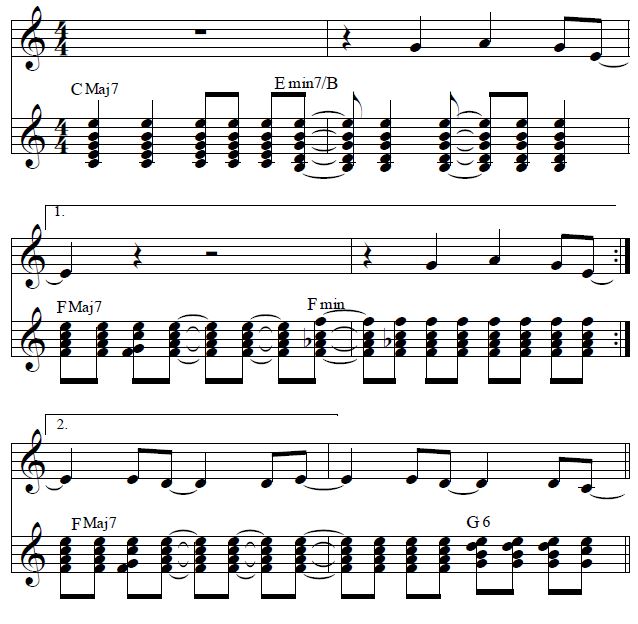
The intro gives us the chord progression right away with a strumming acoustic guitar accompanied by another guitar/synth combo with a melody on top:

Intro - meas. 1-8 (guitar melody and rhythm)

CMaj7 starts off with two strong downbeats and leads into the very cool Emin7/B chord.  Out of the 5 notes, 3 stay the same while the other two resolve down a half and whole step.  It's an interesting and eerie sound that gives this tune its atmospheric sound.  Notes continue to move in small intervals resulting in Fmajor7: E stays while B and G move up a half and whole step, respectively to form the F major chord.  Then, in a wild move, F major7 moves to F minor, seeing the E move up a half step to F and the A move down a half step to Ab.  Super cool voice leading!

The first 3/4 of the progression repeats and instead of Fminor the second time, it stays on F and then plays two beats on a G6 with the E string continuing to ring out.  Also note the quick open G string during the firs Fmaj chord.  It provides the slightest bit of movement in the progression, even when the melody note isn't happening.

Speaking of the melody, it basically outlines C pentatonic, visiting the 6th.  This will quickly become a vocal theme as well as a background melody during the chorus.  The diatonic Cmajor choices over the non-diatonic Fmin result in a continuation of the unique vibe this song puts forward.  

The bass part, which comes in for the next 8 measures of the intro, plays a G over the Fminor chord, resulting in a temporary Fmin/G:

Bass Line

That's basically it.  In the key of Cmajor, the chords flow as follows:

CMaj7  / Emin7/B   / FMaj7  / Fmin   / CMaj7   / Emin7/B  /  FMaj7   /    G6
I           /   iii            / IV          / iv         /  I             /  iii            /  IV          /      V

As seen in several songs, iii - IV is a common progression, as is IV-V, as is iv-I.  I love how these common combinations are combined in an uncommon way.  


Melody

The melody of the song is diatonic to Cmajor, despite some non-diatonic chords.  Again, we see this in the intro melody, first played instrumentally and then sang by Post himself.

Intro - meas. 9-16 (bass and vocal)

Scale intervals 5-6-5-3 are repeated and lead to 3-2-2-3 with the instruments finishing 2-R.  It's a pleasant, mostly stepwise melody that presents a predictable start to the song.  

Post enters with verse 1, using similar syncopation to the intro guitar ostinato.  

Verse 1 - meas.1-8

He starts on a B, the major 7 of C and the 5th of Emin.  That resolves up a half step to C.  In measure 4, he sings the A natural, 6th of Cmajor and major 3rd against the Fmin chord.  While this should clash, it doesn't.  There is almost an audio illusion going on where our ear retains the F major and because the Fmin is far back enough in the mix, and exists from two contrary half step resolutions (E↑F; A↓Ab).  It doesn't come off as a wildly new chord either, it's more of a pivot.  When we hear the same melody in measure 8, the chord remains on F major, so it sounds completely correct.

After these 8 measures, the rhythmic theme continues with new pitches.  He moves his primary pitch to E, now major 3rd of C and root of the Emin.  When we get to Fminor, once again, he sings a "wrong" note.  The E over the Fminor results in a Fmin-maj7 chord, a classic mysterious sound.  It's short lived though and we return to chord tones.  The last measure of the verse banks on the D, 5th of G, even though it's not sounding, and resolves to the tonic.

Verse 1 - meas.9-16


Verse 2 is very different from verse 1.  The empty measures from verse 1 are filled in and for 8 measures, the syncopation borrowed from the guitar part, is abandoned.  The notes change as well, exploring a G in the first 8 and a C in the second 8.   If you account for both verses, his primary pitches are B, E, G and C....he covers each note in the CMajor7 chord.  Too cool!

Verse 2

The second 8 measures introduce a rhythmic theme borrowed from the chorus and augmented in rhythm.  "Special," "sex though," and "echoes" are reminiscent of the "run away" syncopation in the choruses.  In looking at the Fminor measures (4 and 12 above) he avoids harmonic clashes in this verse.  In measure 4, he rests and in measure 12, he sings a C, part of the F minor chord.  

The end of this verse uses a figure we will see in the bridge as he, once again, uses C pentatonic to rise 6-R-2-3.  This verse, like verse 1, and the chorus, and the bridge, uses diatonic pitches to fill out the melody.  

Let's dissect the chorus.  Here's what Post sings in the chorus:

Chorus - Melody Only

The first 6 bars present a line that descends from E to B, bumps back to C and finishes with A-G.  It's all diatonic and, once again, outlines notes of C pentatonic.   In measure 7, he changes the pattern and employs some syncopation on the the repeated "run aways," which eventually passes through F (not C pentatonic) and up to the G.

Measures 8-11 use similar patterns and transition with measure 12, more musings in C major.  Measures 13-16 combine the first 6 measures with the middle "run aways," recylcing themes and getting melodies stuck in your head!

On top of this great melody, there is some substantial vocal harmony added.  a higher part that begins a 4th apart from the melody eventually works its way into 3rds.  As the melody progresses, a lower voice comes into the mix, a third lower than the melody.  

Chorus with harmony

In measures 9-12 of the chorus, we actually hear a reprise of the intro melody figure, played by a keyboard.  The last 4 measures pick up with familiar harmony.  While transcribing this chorus, my ear was definitely playing tricks on me.  Harmonic overtone, studio effect or sang harmony?  Some of the time, I wasn't completely sure.  In the last 2 measures though, I definitely got both higher and lower parts accompanying Post's melody.

The entire chorus is comprised of diatonic melodic passages that are almost all derived from C pentatonic.  When the F pitch is introduced, it coincides with the F or G6 chords, making perfect sense for the cadence and resolves to the C in some fashion.  

There is a bridge, once again built upon the same harmonic foundation.  Here, Post lays down more diatonic C major passages and hinges on the F-E motion a bit more than before.  Rhythmically, he sticks to some of the same patterns, he just more phrases together.  The section, in turn, moves along at a quicker pace, helping to feel like a proper bridge, which is marginally succeeds at, in part thanks to the rhythm section backing off a bit.

Bridge

There is some interesting symmetry with the line "it's only me," happening in measures 3 and 7.  He ends the bridge with the familiar "let it go" flourish from verse 2.  

  
Lyrics

"Circles" tells the story of someone trapped in the negative cycle of  relationship.  The lyrical content here is certainly relatable to many.  Post Malone is good at making powerful statements in plain speak.  (There are plenty of articles about the meaning of this song, so take my analysis for what it is.  Here's a similar, but alternate take to consider [3]).

We couldn't turn around 'til we were upside down
I'll be the bad guy now, but know I ain't too proud

The two parties can't walk away from the relationship until it's completely upside down, though they likely knew it would end up there in the first place.   Post Malone decides he will initiate the break up, becoming the bad guy, even though he's not proud of it.

He goes on to lament about the struggles of the relationship and makes a bold and honest statement that, once again, is relatable to many.

You thought that it was special, special
But it was just the sex though, the sex though

The chorus has one of my favorite lines and sentiments of the song.  It sees Post Malone, knee deep in the struggle of ending this relationship for good, going on the passive aggressive offensive:

I dare you to do something
I'm waiting on you again, so I don't take the blame

I love the image of him daring this person to do something, knowing that if he makes the next move, he will most certainly be to blame.  He did already admit to being the bad guy, though........

There's also the sweeping refrain of "let it go" that appears at the end of verse 2 and in the bridge.

In the end, these two keep "feeding the flame" and this negative cycle continues to run them around in circles.  Easily understood, relatable lyrics that are clever, personal and honest.  


Common Threads

Repeated Melodic Motifs - rhythmic motifs are repeated, with varying pitches, all over the place.  We also see phrases within the sections repeated.  Repetition is key in this one.

Diatonic Melody - despite non-diatonic chords, the melody stays diatonic.  Moving largely in steps and through the C major pentatonic scale.

Texture Changes - there are a few textures here, mostly driven by the presence or absence of drums and bass.  The song actually ends with the sparse texture presented in the intro. 

Vocal Harmony - the vocal harmonies add an ethereal quality to the melody and occur in each chorus.

Song Title Used In Hook - "running in circles...."  "run away" is arguably more prevalent, but "circles" makes it in regardless.

Singular Chord Progression - Not sure if this one will endure as a common thread, but it's worth mentioning.

Chord Count - 5 - CMaj7, Emin7/B, FMaj7, Fmin, G6

5 chords throughout the song is slightly higher than the average chord count of the time, as I have analyzed.  That being said, the fact that the 5 chords are spread over one chord progression is even more impressive.


Final Takeaways

I really like "Circles."  The musical composition is sneaky good, even if the overall presentation is uber poppy.  I actually listened to Post Malone's record, Hollywood Is Bleeding.  My first impression was actually exactly what I expected from an artist who gets labeled as "pop/rap."  He didn't do too much rapping, but there were several guests who did.  "Circles" features a little bit of Post's "billy goat" vibrato, thankfully.  It comes off much more prominently on the recorder.   At first I though it was an effect, but watching some live videos, he's definitely part goat.  It's a cool effect, but like most pop music, gets tiresome after a while. 

Pop records end up having this glossy finish that makes every song sound the same.  I determined this is mostly do to the drum sounds and syncopated cymbal patterns that permeate modern pop.  Hollywood Is Bleeding has plenty of that, but a few songs did stick out as sounding different.  "Circles" was certainly one of them.  I'm glad I took a moment to become acquainted with Post Malone and though I like this song, his other stuff isn't really that appealing to me.  Not to say in the future I wouldn't check something out, but for now, I came, I saw and I'm moving on.

What do you think of "Circles?"  Did you pick up on any of the nuanced details or did they get swallowed up by the poppyness?  Leave me a comment!

Up next time, we star the journey "On the 3's!"  Let's kick things off, keeping in the past themes, with the song that was number 1 in the first week of August, 2013.     June 22nd - September 7th, 2013 - A massive 12 week run at no.1..."Blurred Lines" by Robin Thicke, featuring T.I. and Pharrell, reigns supreme.  Reading the no.1 hit songs in 2013 is like a time warp.  I was playing in a cover band at the time and played many of these popular songs, including "Blurred Lines."  Hopefully the nostalgia factor will kick in and make this one interesting!

[1]https://vulturehound.co.uk/2019/09/post-malone-circles-single-review/
[2]https://vocal.media/beat/song-review-circles-by-post-malone-is-pop-perfection
[3]https://justrandomthings.com/2019/08/31/post-malone-circles-lyrics-review-and-song-meaning/