Archive

Showing posts with label 2020. Show all posts

9/27/20

"Circles" - Post Malone, 2019

 Spoiler alert: I know nothing about Post Malone, other than his appearances in beer-alternative commercials and that slick Nirvana tribute he did.  Apparently, Post Malone is a genre bending hip hop artist that has had some massive chart success.  If you listen to his 2019 single, "Circles," that vibe does not clearly come across.  I found many reviews of the song that all praise it for its catchiness, but almost dismiss it due to it departure from Post's normal musical stylings. [1]

Vocal Media's Sean Patrick comes in a bit hotter with his take: "Circles" is a perfect pop song. [2]  He makes some salient points in his article, many of which I agree with.  As someone who had never heard this song prior to analyzing it, I am very impressed.  Not only is this a well crafted pop song with a simple and relatable message, there is some clever musical composition happening under the surface.

November 30th - December 7th, 2019 and January 11, 2020 - "Circles" by Post Malone logs in 3 weeks at the no.1 position!


The form of "Circles" is one of the most simple and effective pop song forms I have analyzed. It starts with an extended 16 measure intro.  The first 8 establish the intro melody and chord progression.  Bass, drums and vocals enter in the next 8 to round out the 16 bar section. 

Then, there's a little color by numbers action happening.  Verse 1 (A) is 16 measures long.  It is immediately followed by the 16 measure chorus (B).  He repeats both sections with the same length.  We do get an 8 measure bridge (C), which is followed by one more 16 measure chorus to end the song.  ABABCB.  This is almost the pop music equivalent to rondo form.  What's interesting is that there is some variation in the performance, especially in the verses. 

Most importantly, the song thrives on this simplicity.  The ultra pop presentation is enhanced by simplistic elements such as the overall structure.  The lesson here may be less is more.  For this song, it certainly seems true, as we will see with the chord progression and aspects of the melody. 

Chord Progressions

"Circles" utilizes the same chord progression throughout.  You could say the same chords keep running in circles?  If this was the intention, Post Malone is taking word painting to another level.

The intro gives us the chord progression right away with a strumming acoustic guitar accompanied by another guitar/synth combo with a melody on top:
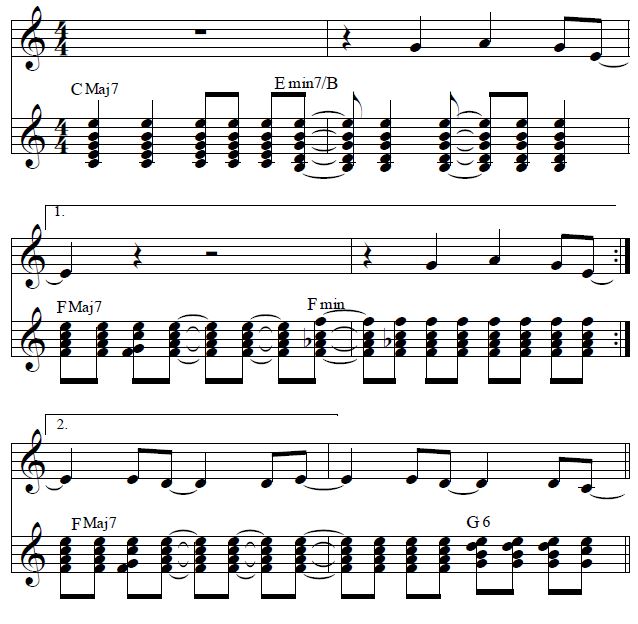
Intro - meas. 1-8 (guitar melody and rhythm)

CMaj7 starts off with two strong downbeats and leads into the very cool Emin7/B chord.  Out of the 5 notes, 3 stay the same while the other two resolve down a half and whole step.  It's an interesting and eerie sound that gives this tune its atmospheric sound.  Notes continue to move in small intervals resulting in Fmajor7: E stays while B and G move up a half and whole step, respectively to form the F major chord.  Then, in a wild move, F major7 moves to F minor, seeing the E move up a half step to F and the A move down a half step to Ab.  Super cool voice leading!

The first 3/4 of the progression repeats and instead of Fminor the second time, it stays on F and then plays two beats on a G6 with the E string continuing to ring out.  Also note the quick open G string during the firs Fmaj chord.  It provides the slightest bit of movement in the progression, even when the melody note isn't happening.

Speaking of the melody, it basically outlines C pentatonic, visiting the 6th.  This will quickly become a vocal theme as well as a background melody during the chorus.  The diatonic Cmajor choices over the non-diatonic Fmin result in a continuation of the unique vibe this song puts forward.  

The bass part, which comes in for the next 8 measures of the intro, plays a G over the Fminor chord, resulting in a temporary Fmin/G:

Bass Line

That's basically it.  In the key of Cmajor, the chords flow as follows:

CMaj7  / Emin7/B   / FMaj7  / Fmin   / CMaj7   / Emin7/B  /  FMaj7   /    G6
I           /   iii            / IV          / iv         /  I             /  iii            /  IV          /      V

As seen in several songs, iii - IV is a common progression, as is IV-V, as is iv-I.  I love how these common combinations are combined in an uncommon way.  


Melody

The melody of the song is diatonic to Cmajor, despite some non-diatonic chords.  Again, we see this in the intro melody, first played instrumentally and then sang by Post himself.

Intro - meas. 9-16 (bass and vocal)

Scale intervals 5-6-5-3 are repeated and lead to 3-2-2-3 with the instruments finishing 2-R.  It's a pleasant, mostly stepwise melody that presents a predictable start to the song.  

Post enters with verse 1, using similar syncopation to the intro guitar ostinato.  

Verse 1 - meas.1-8

He starts on a B, the major 7 of C and the 5th of Emin.  That resolves up a half step to C.  In measure 4, he sings the A natural, 6th of Cmajor and major 3rd against the Fmin chord.  While this should clash, it doesn't.  There is almost an audio illusion going on where our ear retains the F major and because the Fmin is far back enough in the mix, and exists from two contrary half step resolutions (E↑F; A↓Ab).  It doesn't come off as a wildly new chord either, it's more of a pivot.  When we hear the same melody in measure 8, the chord remains on F major, so it sounds completely correct.

After these 8 measures, the rhythmic theme continues with new pitches.  He moves his primary pitch to E, now major 3rd of C and root of the Emin.  When we get to Fminor, once again, he sings a "wrong" note.  The E over the Fminor results in a Fmin-maj7 chord, a classic mysterious sound.  It's short lived though and we return to chord tones.  The last measure of the verse banks on the D, 5th of G, even though it's not sounding, and resolves to the tonic.

Verse 1 - meas.9-16


Verse 2 is very different from verse 1.  The empty measures from verse 1 are filled in and for 8 measures, the syncopation borrowed from the guitar part, is abandoned.  The notes change as well, exploring a G in the first 8 and a C in the second 8.   If you account for both verses, his primary pitches are B, E, G and C....he covers each note in the CMajor7 chord.  Too cool!

Verse 2

The second 8 measures introduce a rhythmic theme borrowed from the chorus and augmented in rhythm.  "Special," "sex though," and "echoes" are reminiscent of the "run away" syncopation in the choruses.  In looking at the Fminor measures (4 and 12 above) he avoids harmonic clashes in this verse.  In measure 4, he rests and in measure 12, he sings a C, part of the F minor chord.  

The end of this verse uses a figure we will see in the bridge as he, once again, uses C pentatonic to rise 6-R-2-3.  This verse, like verse 1, and the chorus, and the bridge, uses diatonic pitches to fill out the melody.  

Let's dissect the chorus.  Here's what Post sings in the chorus:

Chorus - Melody Only

The first 6 bars present a line that descends from E to B, bumps back to C and finishes with A-G.  It's all diatonic and, once again, outlines notes of C pentatonic.   In measure 7, he changes the pattern and employs some syncopation on the the repeated "run aways," which eventually passes through F (not C pentatonic) and up to the G.

Measures 8-11 use similar patterns and transition with measure 12, more musings in C major.  Measures 13-16 combine the first 6 measures with the middle "run aways," recylcing themes and getting melodies stuck in your head!

On top of this great melody, there is some substantial vocal harmony added.  a higher part that begins a 4th apart from the melody eventually works its way into 3rds.  As the melody progresses, a lower voice comes into the mix, a third lower than the melody.  

Chorus with harmony

In measures 9-12 of the chorus, we actually hear a reprise of the intro melody figure, played by a keyboard.  The last 4 measures pick up with familiar harmony.  While transcribing this chorus, my ear was definitely playing tricks on me.  Harmonic overtone, studio effect or sang harmony?  Some of the time, I wasn't completely sure.  In the last 2 measures though, I definitely got both higher and lower parts accompanying Post's melody.

The entire chorus is comprised of diatonic melodic passages that are almost all derived from C pentatonic.  When the F pitch is introduced, it coincides with the F or G6 chords, making perfect sense for the cadence and resolves to the C in some fashion.  

There is a bridge, once again built upon the same harmonic foundation.  Here, Post lays down more diatonic C major passages and hinges on the F-E motion a bit more than before.  Rhythmically, he sticks to some of the same patterns, he just more phrases together.  The section, in turn, moves along at a quicker pace, helping to feel like a proper bridge, which is marginally succeeds at, in part thanks to the rhythm section backing off a bit.

Bridge

There is some interesting symmetry with the line "it's only me," happening in measures 3 and 7.  He ends the bridge with the familiar "let it go" flourish from verse 2.  

  
Lyrics

"Circles" tells the story of someone trapped in the negative cycle of  relationship.  The lyrical content here is certainly relatable to many.  Post Malone is good at making powerful statements in plain speak.  (There are plenty of articles about the meaning of this song, so take my analysis for what it is.  Here's a similar, but alternate take to consider [3]).

We couldn't turn around 'til we were upside down
I'll be the bad guy now, but know I ain't too proud

The two parties can't walk away from the relationship until it's completely upside down, though they likely knew it would end up there in the first place.   Post Malone decides he will initiate the break up, becoming the bad guy, even though he's not proud of it.

He goes on to lament about the struggles of the relationship and makes a bold and honest statement that, once again, is relatable to many.

You thought that it was special, special
But it was just the sex though, the sex though

The chorus has one of my favorite lines and sentiments of the song.  It sees Post Malone, knee deep in the struggle of ending this relationship for good, going on the passive aggressive offensive:

I dare you to do something
I'm waiting on you again, so I don't take the blame

I love the image of him daring this person to do something, knowing that if he makes the next move, he will most certainly be to blame.  He did already admit to being the bad guy, though........

There's also the sweeping refrain of "let it go" that appears at the end of verse 2 and in the bridge.

In the end, these two keep "feeding the flame" and this negative cycle continues to run them around in circles.  Easily understood, relatable lyrics that are clever, personal and honest.  


Common Threads

Repeated Melodic Motifs - rhythmic motifs are repeated, with varying pitches, all over the place.  We also see phrases within the sections repeated.  Repetition is key in this one.

Diatonic Melody - despite non-diatonic chords, the melody stays diatonic.  Moving largely in steps and through the C major pentatonic scale.

Texture Changes - there are a few textures here, mostly driven by the presence or absence of drums and bass.  The song actually ends with the sparse texture presented in the intro. 

Vocal Harmony - the vocal harmonies add an ethereal quality to the melody and occur in each chorus.

Song Title Used In Hook - "running in circles...."  "run away" is arguably more prevalent, but "circles" makes it in regardless.

Singular Chord Progression - Not sure if this one will endure as a common thread, but it's worth mentioning.

Chord Count - 5 - CMaj7, Emin7/B, FMaj7, Fmin, G6

5 chords throughout the song is slightly higher than the average chord count of the time, as I have analyzed.  That being said, the fact that the 5 chords are spread over one chord progression is even more impressive.


Final Takeaways

I really like "Circles."  The musical composition is sneaky good, even if the overall presentation is uber poppy.  I actually listened to Post Malone's record, Hollywood Is Bleeding.  My first impression was actually exactly what I expected from an artist who gets labeled as "pop/rap."  He didn't do too much rapping, but there were several guests who did.  "Circles" features a little bit of Post's "billy goat" vibrato, thankfully.  It comes off much more prominently on the recorder.   At first I though it was an effect, but watching some live videos, he's definitely part goat.  It's a cool effect, but like most pop music, gets tiresome after a while. 

Pop records end up having this glossy finish that makes every song sound the same.  I determined this is mostly do to the drum sounds and syncopated cymbal patterns that permeate modern pop.  Hollywood Is Bleeding has plenty of that, but a few songs did stick out as sounding different.  "Circles" was certainly one of them.  I'm glad I took a moment to become acquainted with Post Malone and though I like this song, his other stuff isn't really that appealing to me.  Not to say in the future I wouldn't check something out, but for now, I came, I saw and I'm moving on.

What do you think of "Circles?"  Did you pick up on any of the nuanced details or did they get swallowed up by the poppyness?  Leave me a comment!

Up next time, we star the journey "On the 3's!"  Let's kick things off, keeping in the past themes, with the song that was number 1 in the first week of August, 2013.     June 22nd - September 7th, 2013 - A massive 12 week run at no.1..."Blurred Lines" by Robin Thicke, featuring T.I. and Pharrell, reigns supreme.  Reading the no.1 hit songs in 2013 is like a time warp.  I was playing in a cover band at the time and played many of these popular songs, including "Blurred Lines."  Hopefully the nostalgia factor will kick in and make this one interesting!

[1]https://vulturehound.co.uk/2019/09/post-malone-circles-single-review/
[2]https://vocal.media/beat/song-review-circles-by-post-malone-is-pop-perfection
[3]https://justrandomthings.com/2019/08/31/post-malone-circles-lyrics-review-and-song-meaning/

8/11/20

"cardigan" - Taylor Swift, 2020

 Taylor Swift released her 8th studio album in the July 24th, 2020.  The lead single, "cardigan," debuts on the Hot 100 at no.1, August 8th, 2020.  

The track was co-written and produced by Aaron Dessner, of the National, and is not what I would expect from the pop singer, though I am hardly the person to make T-Swift recommendations.  Her new album, Folklore, seems fantastic and well regarded by many.  After reading this Insider.com track by track review, my interest is peaked! [1]  After transcribing most of the lead single though, I'm afraid I won't be as jazzed as those authors.  

There are elements of this song that I do like and there are clear similarities between "cardigan" and other no.1 songs through the decades.  In the end though, the song is just there.  The no.1 status makes me think that the curiosity factor of a surprise Taylor Swift song helped it rocket to the top.  If it manages to stay another week, I will be surprised and impressed.  This Slate.com article eventually agrees with me and hypothesis why the song reached no.1. [2]  Never the less, I will try and set opinions aside and focus on the musical attributes of the song.

August 8th, 2020: "cardigan" by Taylor Swift debuts at no.1 on the Billboard Hot 100.  


There are a few surprises in the form.  The intro features a wind noise and a faint shaker evolving into a neat hand drum/body percussion sample.  Then, all of a sudden, the piano chimes in with verse 1.  This "intro" is a total of ten 8th note beats, equal to 1.25 measures.  This might be the most challenging part of the song, as the accents in the drum sample don't quite indicate where beat 1 ends up landing.  

We then go through a verse/chorus/refrain sequence.  The first statements of the chorus and refrain work together and are only separated at the very end, justifying different labels.  The third chorus, though, ditches the refrain and gets an extra 4 measures, which are different from the first 4.  Each chorus also features different lyrics, furthering the overall story of the song.    

The "refrain," in this case, houses the title phrase and is repeated 3 times in total.  The closing statement gets a cool treatment with alternate chords, taken from the bridge.  

Speaking of bridges, there are two of them.  The first begins with 4 measures of an instrumental followed by 4 measures of melody built over new chord changes.  The 2nd bridge uses recycled chord changes and features a brand new melody, making it more than a third verse.

There is lots of added production to the entire track ranging from noises, to string samples to a Mellotron part.  All of these sounds, combined with the slow tempo certainly create an tangible mood.    

Chord Progression


Before looking at any notation, the song utilizes swing 16th notes.  This swing feel only occurs with groups of two sixteenth notes and not with two 8th notes.  If you feel the micro beat (8th notes), it has the same effect as swung eighth notes.  

"cardigan's" opening chord progression is set up by the piano in the first verse:

Piano - Opening

In the key of Eb, this plays out to be:

Fmin   /   Bb  /  Ab   /  Bb

ii       /   V     /  IV    / V

The chorus delivers the I chord and a familiar chord sequence:

Eb  /  Bb  / Ab  /  Bb

I   /  V    / IV   / V

The refrain uses the verse changes, above.

The first bridge features a different chord progression, which is also used over the final refrain:

Ab  /  Cmin  /  Bb   /  Ab

IV  / vi        / V     / IV

There is a very slight variation used during the second half of the third chorus, which carries over to the second bridge.  There, we see the first Bb chord get an F in the bass.  This slight shift gives that chord a much different feel when following the Eb.

Melody

The verses share a similar melody, built on two syncopated figures, sang low in T-Swift's range:

Verse 1
Measures 1,2, 5 and 6 use a motif built around note groupings Ab, G, Bb and Bb, C and F.  Each chunk fits into the 16th-8th-16th syncopation beginning on beat 2.  

Measures 3,4, 7 and 8 use a triplet theme, which will reoccur throughout the song.  Repeated three note groupings of G, F and Eb (3-2-1 in Eb) are borrowed from the piano riff that floats above each section.

The first verse leads directly into the chorus, carrying over both rhythmic entrances and syncopation.  The chorus leans on repeated 16th notes, a staple in Swift's melodic arsenal.  Each of the two phrases ends with a melisma on Eb-G-F-Eb, the same pitches used in the piano line and the verse triplet figure.

Chorus 1 and Refrain
   

After 4 bars of chorus, the chords shift back to the verse progression for the refrain.  Here, once again , the triplet rhythm is used, this time descending through the Eb pentatonic scale.  The word "cardigan" uses a brand new rhythmic figure and is followed by familiar syncopation.  At the tail end of the refrain, we hear a guitar riff which will also reappear throughout the tune and is repeated in verse 2.

Basic Guitar Riff
 

Verse 2, chorus 2 and the 2nd refrain rehash melodic material from previous iterations.  After the second refrain, we head into the first bridge with 4 measures of instrumental plodding.  The piano riff retains its rhythmic placement but shifts notes to support the impending C minor chord (C, Eb, F, G, C).  When Taylor comes in, we hear:

Bridge 1 - meas. 5-8

Rhythmic entrances shift to beat 4, instead of beat 2 and the dotted eighth-sixteenth figure is used repeatedly.  The first half uses C and G, which resolve down to Eb on the C minor (minor 3rd).  The second half shifts those notes down a whole step to Bb and F, retaining the ending descending line.

At this point in the song, we have heard each primary section twice, gotten a brief instrumental interruption and new melody with the bridge.  Now, we head into the back half, which picks up the pace.  Out of bridge 1 comes the third chorus, an 8 measure variation on the original 4 bar melody:

Chorus 3

The first 4 bars are like the previous choruses with different lyrics and a harmony added up a third.  The last 4 measures start like the chorus proper, but veer off course in measure 6, going lower over the new chord, Bb/F.  The last two measures borrow the triplet line from the verse and refrain, only with a new note grouping: Eb, C and Bb.  

These last 4 measures create a very subtle shift to the natural minor sound and blend melodic and rhythmic themes used previously.  The 8th measure of this chorus (above) is the pickup to the second bridge, a mammoth 12 measure section that expands upon rhythms and melodies presented in the first bridge:

Bridge 2 - meas. 1-6

The entrances in this bridge are similar to the last bridge; 8th-16th syncopation on beat 4.  Each entrance is followed by descending 16th notes, Ab, G, F, Eb, and lead directly into an additional statement of the phrase.  Bb and F become melodic focal points in between and the chord progression shifts to include more Bb/F chords. 

Bridge 2 -  meas.7-12

After 8 measures, the chord progression shifts back to verse changes and the pacing slows down.  We get 4 repeats of "you'd come back to me," which feel spacious after all the repeated 16th notes.  The piano strays from its original feel and the guitar riff weaves in and out.  

A returning piano riff sets up the final refrain, this time utilizing the bridge changes.  The guitar riff ends the song, repeating the last two notes, played over an Ab chord.  There is an "outro" consisting of a faded 3 measure chunk of NIN-esque noise.  

Guitar - final melodic statement
  

Musical Sticking Points

There is certainly an evolution of musical ideas throughout the song.  While this is most obviously driven by changing lyrics, the chord progressions sneak in and out.  The song is built on, essentially, 5 chords: Fmin, Bb, Ab, Eb and C minor.  While the chord progressions vary in chord order, intensity and inversion, they do end up settling into the same harmonic feel.

The melody is crafted well, constantly borrowing rhythms and motifs from itself.  The third chorus has a nice mix of several parts and the second bridge logically develops a melody seen earlier in the tune.  All of these moments are great, but there is a lot of repetition before we see any development.  

The drum part is unique for a pop song.  The opening groove is very sparse and sounds like clapping and patting on someone's legs.  Eventually, we hear the familiar kick and snare, but they don't play a standard beat.  Below is an approximation of the opening/first verse drums feel compared with the chorus feel:

Drum approximations - Verse 1 vs Chorus 1

Both versions play off of the swing 16th feel and syncopation present in the vocal melodies.  

The overall arrangement is pretty slick.  On my first few listens, I had trouble distinguishing the parts.  This was due, in part, to ever changing lyrics, but also due to borrowed themes.  When I wrapped my head around what was actually happening, I could see the quality craftsmanship.  Unfortunately, this is not overwhelmingly positive.  The dreamy atmosphere can work against itself and create this gray blob of sound that all feels the same.


Lyrics

Taylor Swift is a master at painting vivid portraits with words.  She writes these lyrics from the perspective of "Betty," a character featured on the album "Folklore."  There is a lot to unpack in these lyrics, and I recommend taking a peek at the Lyric Genius annotations. [3]

The verse uses the rhyme scheme AAB CCB, with B being a refrain, of sorts, "when you are young they assume you know nothing."  The chorus reverses this pattern with ABB ACC, this time with A as a refrain of "I knew you."  

Bridge 1 is comprised of internal rhymes resulting in (AA)B (AA)B.  The second bridge moves through 4 sets of rhyming and/or near rhyming couplets ("long" and "young"; "expired" and "light").

The refrain also uses a near rhyme with "cardigan" and "bed."

Overall, the lyrics are well crafted and contain some cool imagery and lots of "Easter Eggs," which Taylor has become known for.  


Common Threads

This has been an epic round "on the 0's" with data points from 1960, 1970, 1980, 1990, 2000, two songs from 2010 and now, four songs from 2020.  For each song, I have compiled a list of common musical elements present and then see where the analysis in question figures in.  Adding "cardigan" into the mix, we see:

  • Repeated melodic motifs - this song expertly reuses themes in each section.  This song is right up there with "Rain On Me" in the way melodic motifs are recycled and repackaged.  
  • Strong harmonic motion from V to I  -While there is a strong pull to V, it doesn't actually function like V.  The pull from IV to I is noticeable.  
  • Background singers contribute to melodic/harmonic texture - I'm not ready to cross this one out due to the presence of the vocal harmonies from the first bridge through the end of the tune.  They are not, however, such and important contributing force to the melody or the overall textural presentation.  The instrumental arrangement is far integral in that picture.
  • Modulation -  
  • New material presented at the end - technically, there is not new material at the end.  There is however, is different twist on something we already heard: the refrain lyrics and melody combined with the bridge chord progression.
  • Hook that uses the title of the song   - I'm not even sure what the hook is, or if there is a hook.  I chose "you put me on and said I was your favorite" because it was the one part I could easily sing along with, it stayed lyrically consistent and featured a melody used elsewhere in the song.  Any way you slice, it doesn't use "cardigan" in the most singable part of the melody.  
  • Contains a lyrical refrain  This could get triple points, as there are several lyrical refrains: "when you are young they assume you know nothing," "I knew you," and "when I felt like I was an old cardigan...."   
  • Evolution of musical elements -  The melodic development and ending chord rearrangement qualify this for sure.
A solid 3/8 common threads and 2 near hits for "cardigan."  The end of round wrap up will hopefully flush out some of these elements and see what musical trends have been seen in no.1 hits through the decades.

Final Takeaways

After this entire analysis, I'm still not sure where I land on "cardigan."  On paper, I love it.  I think the way the melody and chord changes seamlessly move between and play off one another is genius.  The lyrics are rich with description and references to provoke the imagination of any listener.  The whole song has a vibe that can't be denied and I found this song affecting my mood.

Listening to it, though, is not as fun as talking about it.  It's so slow and all of the similar melodies blend together, resulting in forgettable melodies.  The hook in this song is hard to pin down, which for a pop tune, is a very surprising.  

All of that being said, I would be happy to hear or play an acoustic rendition of the tune.  I actually started thinking about how this song would translate with just chords and melody.  Well, Taylor must have thought that too, because there is a lovely acoustic version.  When the production is taken away, you can hear the song for what it is, a lovely ballad.  All of this is fine, it's just not what I would expect from a no.1 hit song, even if it has some great musical elements at work.

I will be very curious to see if this song lasts another week at no.1 or if its popularity is largely due to the curiosity factor.  2020 has seen a lot of 1 week reigns at no.1, which I'm willing to bet has happened before, through the decades.  Perhaps I should take comfort in the adventurous taste of music consumers.  Taylor did not have to rap about her wealth or romantic prowess to make it to no.1  Instead, she wrote a beautiful song that people want to hear.  

What do you think of "cardigan?"  Am I missing something, or is kind of boring?  If you read this before August 15th, 2020, do you think it will make another week at no.1?  Leave me a comment!

Up next time, the "on the 0's" recap round, where I will look at all the songs analyzed and see if there is any definitive common ground between musical elements.     


[1]https://www.insider.com/taylor-swift-folklore-review-tracklist-breakdown-2020-7

[2]https://slate.com/culture/2020/08/taylor-swift-folklore-sales-cardigan-billboard-hot-100.html

[3]https://genius.com/20429809

8/7/20

"Savage" - Megan Thee Stallion Featuring Beyoncé, 2020

 I am hoping this entry will unlock some of the mysteries that have me perplexed regarding how a song becomes no.1 on the Billboard Hot 100 chart.  "Savage" is first released by Megan Thee Stallion in March, 2020.  The song becomes popular, largely spurred by a Tik Tok dance and accompanying video by Stallion herself, but doesn't chart very high on the hot 100.  

Somewhere along the lines, BeyoncĂ© hears the track and decides to do a remix.  She takes the base track and gives the tune a major overhaul, essentially turning out a completely different song.  The end result is a record setting no.1 hit for both ladies. [1] 

Herein lies the mystery.  In my opinion, "Savage" is the epitome of bad pop music, banking on a simple backing track, limited melodies and cringe-worthy lyrics that play exclusively to pop culture's lack of sophistication and dignity.  It is, however, damn catchy.  Even after hearing the original Megan Thee Stallion version, and being very unimpressed, I came away with the hook stuck in my head.....a hook that is devoid of melody.  What is going on in this song then?  Why is it so popular?  Hopefully this analysis can shed some light on that mystery.

May 30th, 2020: "Savage" by Megan Thee Stallion, featuring Beyoncé, hits no.1 for one week!


After analyzing several songs from 2020, a clear trend in simple forms is seen.  This one goes verse-chorus, verse-chorus, bridge, verse-chorus.  There is a nice wrinkle in BeyoncĂ©'s verses, 12 measures versus Megan Thee Stallion's 8 measures.  

The 4.5 measure intro looks strange, but the .5 accounts for a 2 beat pickup that leads to BeyoncĂ©'s opening lines.  

The bridge feels like a verse, featuring vocalizations from both singers that are similar to their previous contributions.  The structure sets it apart.  It begins with 4 measure of MTS rapping, which leads into melodic singing from BeyoncĂ©.  After 4 measures, MTS takes the reigns again before we get a final verse from Queen B.  

There is a natural evolution embedded in the form.  MTS primarily handles the first verse and chorus.  BeyoncĂ© takes verse two and contributes a little more on the second chorus.  The bridge is double booked and Bey gets the third verse.  The final chorus is also a double feature.  This form is a good example of evolution of a song, or hearing the same thing without hearing the same thing.


Chord Progressions

The entire song is based on two alternating chords:

Base Chord Progression


These two chord are played on a keyboard sounding synth in very close voicing.  The ninth on top with the minor 7th in the mix makes them very dense.  Because of this, they key, and even tonal center, is hard to pin down with certainty.  

Sometimes, the song feels like it's in the key of Ebmin, in which case this progression is: i bii

From a melodic standpoint, it aligns closer with Bb minor, moving the progression to: iv bv

The relative major of Eb minor is Gb major, moving the progression to: vi bvii

The relative major of Bb minor is Db major, moving this progression to: ii biii

No matter how you slice it, it's two alternating chords.  We never get any more harmonic clues to cement us firmly in any camp.  I am reminded of Drake's "In My Feelings" (2018) where there were two alternating half steps, but the melody was clearly rooted in a key.  As we will see, the melody of "Savage" strongly indicates Db major and Bb minor triads, with pentatonic lines, hence the key choice of Bb minor.  


Melody

"Savage's" melodic content ranges from spoken rap segments to full on singing and several moments somewhere in between.  BeyoncĂ©'s opening 4 measures foreshadows elements we will here for the remainder of the tune:

She begins with a melodic motif that moves between F and Eb, sitting very low in her range, almost spoken, but undeniably on a pitch.  F against Ebmin9 serves as the 9th and the Eb against the Emin9 is a major 7th, which further adds to the dense dissonance of that chord.  She introduces the bulk of the rhythmic content in the song, strings of 16th note syncopation.   We also get a preview of the background/production elements.  There are some high harmonies appearing intermittently as well as the echoing "okay" and "yeah."  The 4th harmonies here will also carry through most of the tune.

Megan Thee Stallion follows up Bey's intro with the rap laden first verse:


Verse 1 - MTS

Megan's verse contains elements foreshadowed in the intro.  We see many 16th note combinations.  Throughout the verse we get vocal responses reminiscent of the into, as well as some harmonic enhancements to words in the rap.  

The chorus is certainly the focal point of the song and home to the catchy hook "I'm a savage...."  Each time the chorus happens, it is presented differently.  The first time features MTS following up on her rapped verse.  The second and third times feature additional background vocals/noises and responses from BeyoncĂ©.  The third time even features a very low vocal mixed over the spoken rap, reinforcing the natural high/low flow of the spoken part.  The following is a representation of most of the combined elements across the three statements of the chorus:


Chorus - combined elements


 The chorus has much more melodic space than the verses.  The harmonic elements generally occur on "I'm a savage," strengthening the title hook.  We also see the vocal responses grow in frequency and complexity as the chorus moves along.  Noteworthy too, is the overall structure, a repeated 4 bar segment based off a repeated 2 bar phrase.  The chorus is very repetitive and predictable, possibly accounting for mass appeal.  

*Check out the third chorus, which features a building "ooh" from BeyoncĂ©.  She builds a chord with Eb, F and Ab, creating this Ebmin11 (or Fmin / Ebmin) sound that is very compelling.  

After the first chorus, BeyoncĂ© gets the 2nd verse and truly begins to transform the song.  All of the elements foreshadowed in the intro, first verse and chorus are enhanced even further with this 12 measure verse.

Verse 2 - Beyoncé - meas.1-4

The first 4 measures are spoken and develop 16th note rhythmic themes with varying entrances (beat 2 and beat (1)+), eventually getting faster with 32nd note syncopation.  We continue to see harmonized and response background vocals, usually incorporating the parallel 4th sound.  The vocalizations in the opening bars outline a Bb minor/Db major arpeggio.   

The next four measures expand the rhythmic adventure, throwing in 16th/32nd note syncopation.  We also see a return to a theme from the intro, the repeated F and Eb pitches.  In the 4 measures below, the bottom staff represents a new synth element that toggles between Eb and Bb.  There is also a rhythmic vocal in this line, occurring on all the upbeats, that reminds me of something out of the "Lion King" or "Moana."  

Verse 2 - Beyoncé - meas.5-8

The final 4 measures return to mostly straight 16th notes and give a clear key indication in the last two measures.  There, we see a Bb minor pentatonic line, complete with parallel 4th harmonies.  
Verse 2 - Beyoncé - meas. 9-12

BeyoncĂ©'s 3rd verse is along the same lines as this verse and uses many of the same conventions: 16th note rhythmic passages with harmonized words and sang responses.  

The bridge, which is an honorary verse, begins and ends with Megan Thee Stallion.  She comes in rapping hard about her impending credibility, courtesy of Bey.  She also ends the bridge by rapping 4 measures that were included in the original version of "Savage."  Aside from the chorus, this is the only part from the original that makes it into the remix, for better or worse.

In between MTS's bridge work, Beyonce interjects what may be the most interesting part of the song.  It is different enough to warrant calling this section a bridge, and is even labeled as such in the YouTube Video lyric description

Bridge - Beyoncé - meas.5-8

Notably, the entire section is sung on a pitch, separating it from the rapped verses.  The opening melismas are centered around Bb minor pentatonic, getting us closer to a tonal center.  We also hear plenty of harmonized 4ths throughout this short section, so though different, it ties in close to previous material.  

Musical Sticking Points

The musical element that sticks out to me most is the evolution of the track from beginning to end.  It starts sparse with just the piano.  The drums trickle in and eventually add the bass tones.  This eventually falls apart, giving way to another synth or vocal element before returning later on.  The textural landscape of the song is ever changing, despite the static harmonic elements.  

There is some nice complimentary syncopation happening between the primary piano line and the drums and bass.  


developed drums/ base harmonic progression

The drum programming is very deep and there are even claves hiding in there.  At various times, accents stick out in the drum programming, mostly revolving in the higher frequencies and cymbals.  The above accents can be heard in the first chorus on the high hat.  Perhaps it's these slight nuances that keep your attention throughout the song, though I would imagine this is subconscious.  

The melodic content in the song is, generally speaking, not very strong.  Rhythmically, it is very complex, but melodically is touch and go.  I am reminded of "Love the Way You Lie" by Eminem and Rihanna (2010).  In that tune, the choruses had a strong melody while the verses housed the rhythmic rapping.  There was a little something for everyone.  This tune has that, but it's mixed in a little here and there. 

 Consider this analogy: If music was like a Thanksgiving dinner, Rihanna provides the melodic meat and potatoes while Eminem throws in all the favorite side dishes, on a separate plate.  BeyoncĂ© is the meat and potatoes, but they are mixed up with some of the side dishes, and then Megan Thee Stallion throws her side dish right onto the same plate, then they start to mix it all together.  Obviously this is a tasty concoction, but sometimes I just want to enjoy the elements individually, or at least with less confusion.


Lyrics

Here's where I really lose it with this song.  I generally get turned off from songs that are braggadocious for the sake of being braggadocious.  The remix lyrics, while offensive in many respects, are actually a step up from the original, which is not intended to be a compliment.  Both versions feature lyrics that hype up the singers to the nth degree of hype.  

When reading these lyrics, I had many questions....what does bougie mean?  What does ratchet mean?  Why is she so proud to be a savage?  Here's what I found

Bougie: Aspiring to be a higher class than one is. Derived from bourgeois

Ratcheta slang term in hip hop that, in its original sense, referred to an uncouth woman, and may be a Louisianan regiolect version of the word "wretched" or a variation of the word "ratshit."

I think the consensus is that while she is classy and aspires to reach beyond her current means, she is, at the core, streetwise.  This article sheds a little light on the situation. [2]  Megan actually says it best in her verse:

Hood, but I'm classy, rich, but I'm ratchet 

BeyoncĂ©'s verse are laced with advertisements.  She references Tik Tok, "demon time" and "Fans Only" in her verse, as well as her own clothing line, Ivy Park.  she also references her famous hips and gives a shout out to her mother, Tina Knowles (sadly not Tina Turner, who I assume is admired by current pop singers for her contributions?)[3]

While I am not a fan of the lyrical content, they are crafted very well.  Internal rhymes are all over the place and perhaps best seen in the chorus:

I'm a savage, classy, bougie, ratchet

Sassy, moody, nasty 

 Common Threads

This round "on the 0's" has more data points than any round to date!  I have analyzed one song from 1960, 1970, 1980, 1990 and 2000; two songs from 2010 and this marks the third song from 2020.  For each of these 10 analyses, I have kept a list of common elements present.  Here is how "Savage" fits into this puzzle.  

  • Repeated melodic motifs 
  • Strong harmonic motion from V to I  -This song could be the least harmonically sensible song analyzed in this project....
  • Background singers contribute to melodic/harmonic texture - the background vocals set the remix far apart from the original.  They are integral to the texture of the song.  
  • Modulation -  
  • New material presented at the end 
  • Hook that uses the title of the song   
  • Contains a lyrical refrain  - "I'm a savage" could be considered a lyrical refrain as it appears in the hook, at the very end of the song and gets callbacks in the verses. 
  • Evolution of musical elements This common thread has been eluding this list and has been an important element present in multiple songs.  

5/8 elements is a good showing for this song, in a musical sense.  In the wrap up (potentially the next entry), these elements will be analyzed and flushed out a little further, trying to uncover musical elements present in no.1 hit songs, regardless of the decade.


Final Takeaways     

This is a tough one.  Part of me really likes this song.  It has attitude, which earns it a point when scoring with my anti-authority side.  The rhythmic hook is easy to reproduce, especially considering you can speak the words and not be bound to any sense of pitch.  The background vocals and harmonies are cool and the 4th sound is very appealing to me, especially against the minor half stepping progression.  

Another part of me can't stand that this song is so popular.  The lyrics are not good and generally offensive, at least when it comes to playing it for my kids.  The music, while appealing to me, is kind of boring after a while.  I generally gravitate towards good changes and this one just doesn't deliver.  

Then there's Tik Tok.  I do not use Tik Tok but have a general knowledge of how it works.  In viewing YouTube videos, I get instantly hot when I see comments that say "only like if you didn't come from Tik Tok."  First off, who cares?  It's music.  Tik Tok is only 15 seconds long, which is not remotely enough time to really make a true assessment of any song.  Secondly, why does it matter if you are familiar from Tik Tok or not?  I don't like to stand on a soapbox about frivolous social fads, but this one leaves me scratching my head.   

What do you think of "Savage?"  Is it possible to like the song for the song, or do you need to do the dance?  How does the original compare to the remix?  Leave me a comment!


Up next time:  If "Rockstar" remains at no.1 for the week of August 8th, 2020, I will compile the data into a round 3 wrap up.  If there is a new song at no.1, I will analyze that and then complete the round 3 wrap up.  Whew, what a round!


[1]https://www.wmagazine.com/story/beyonce-megan-thee-stallion-savage-number-one/

[2]https://www.songmeaningsandfacts.com/savage-by-megan-thee-stallion/

7/30/20

"Rain On Me" - Lady Gaga & Ariana Grande, 2020

I am increasingly curious about the music of 2020.  As we are only just halfway through the year, I think it would be prudent to get an entire year of no.1 hits analyzed.  Last time, I checked out "Rockstar" by DaBaby, featuring Roddy Ricch.  What did that song beat out to slide into the no.1 position?

June 6th, 2020 - "Rain On Me" by Lady Gaga &Ariana Grande DEBUTS at no.1 on the Hot 100.  In addition to that impressive stat, Lady Gaga and Ariana G both have slews of other chart topping accolades that are worth looking into. [1]  Unfortunately for Gaga and Grande, they only last one week, a trend throughout the spring of 2020.

The song came into existence after the singers bonded over persevering through loss and heartbreak.  The song is certainly reflective of two strong women proclaiming their power despite negative forces against them. [2]  Impressively, the two share writing credits on the track, along with the several others.   


This one has a logical form:  Verse (A) followed by a pre-chorus (B), then the chorus (C) then a post-chorus (D).  This 1-2-3-4 punch keeps the song feeling varied, despite the (essentially) same chord progression throughout.  

The bridge comes in at the most opportune time, truly bridging the first ABCD statements with the ending, a final statement of the chorus and an outro section, which is an inventive variation on the chorus (hence B').  The song ends as it begins, with Gaga providing the melody.

Stylistically, this is an upbeat dance tune with disco elements.  There are layers upon layers of synth accompanied by drum programming you would expect for the genre.  The bass pops and slaps some funky lines that help keep one foot in the highly produced dance world and the other in the organic music realm.  


Chord Progressions

The entire song consists of only 4 chords, relying primarily on a 2 chord sequence.  We hear the base progression up front, in the first verse, played by a guitar and synth combo:

Opening - base progression

In the key of C# minor, this plays out to be:

C#min7     Amaj9  / (Amaj9)      /  C#min7   Amaj9  /  (Amaj9)  Badd4
i                  (b)VI  /  (bVI)          /   i             bVI      /   (bVI)       bVII

For the third analysis in a row we see a minor i to bVI progression carrying the song.  Popular progression indeed! 

As the pre-chorus flows out of the verse, we hear additional syncopated synth elements (1st and 3rd measures), as well as a transition chord to get into the chorus: 

Pre-chorus rhythm

The F#min11 chord, or iv, happens quickly, yet offers a different tone color to get back to i.  In examining all the chords, the unifying pitch would be B, as is serves as the minor 7 of C#min, 9th of A and 11th of F#minor.  

The bass comes in on the prechorus, holding down sustained roots.  In the chorus, the bass moves to this syncopated line:


chorus 1 and 2, verse 2 and (last 4 of) bridge bass

When the post-chorus kicks in with all its disco glory, the bass goes full on, adding in octave pops:

post chorus, chorus 3 and outro bass


There are two places with slight variation to this main 4 bar loop.  (1) The ends of the chorus stays on Amaj9 instead of returning to the C#min7 in the second half of the 2nd measure.  (2) The bridge features a harmonic rhythm variation:  two and half measures on C#min7 followed by a measure and a half of Amaj9, which is followed by 4 complete measures of C#min7 before returning to the base 4 bar progression.  (see bridge "Melody").  


Melody

Though the entire song is based on the same chord progression, each section has a unique vocal presentation.  As sections repeat, they feature much melodic variance.  This type of evolution, a hallmark in many no.1 hits, is clearly exemplified throughout "Rain On Me."  You hear the same sections multiple times without ever hearing exactly the same thing.  

Lady Gaga begins the song with the first verse, introducing a melodic motif that starts on repeated B's, beginning on the + of beat 1.  She then descends a 5th to E, followed by a minor 3rd to C#, singing through the C#min7 arpeggio, excluding the 5th.  She ends the phrase by repeating the previous 2 notes and going down one note further to B.  Her second and fourth phrases repeat this, extending the ends to complete the C#min7 arpeggio.  
Verse 1

Compare Gaga's verse to Grande's verse.  Here, we see similar rhythmic entrances, on the + of beat 1.  Ariana chooses different notes, beginning the first and third phrases on G# and working only as low as E, in stepwise motion.  Her second and fourth phrases are more sparse, using only F# with varied endings.     

Verse 2

This evolution of melody also occurs in the pre-choruses.  In the first, Lady Gaga sings solo, laying out in every other measure.  She introduces a new rhythmic theme, answering the synth part established while she rests.  Her melody covers the G#min7 arpeggio and concludes with a definitive return to the C#min7 with the minor 3rd, E.   


PreChorus 1

When this section comes around again, Ariana fills in the previous spaces with similar syncopation.  Her notes cover the C#min7 arpeggio while Gaga sticks with the G#min7 arpeggio, allowing each singer to occupy a slightly different melodic space.  

PreChorus 2

The choruses also follow suit in their melodic evolution.  Lady Gaga sings the first chorus solo, another outline of the C#min7 chord.  Her entrance is higher than her verse, starting on an E before working her way down to B and then back up to E.  Her repeated "rains" constitute the hook.  She ends the choruses with spoken "rain on me."  


Chorus 1

The second and third choruses feature Grande adding close harmony.  Starting off a third lower and getting as close as a 2nd apart, the different timbres keep it consonant and it flows together nicely.  The ending features Ariana interjecting some powerful C#'s (roots) between Gaga's spoken passages.  

Chorus 2

The post chorus creates a lot of space and features repeated "rains," first introduced in the chorus.  This section also includes a funky E major guitar line.  Like the other sections, the post chorus ends up being different the second time around, featuring some diva-esque ad-libing from the ladies. 

Post Chorus 1

The bridge slows things down in the first four measures with affected traded vocals.  We also see the change in harmonic rhythm and pacing.  Then, we get Gaga speaking all her lines with Grande joining in singing, every other bar.  Most of these melodic passages are in the C# minor space, introducing the 9th at the end of the tenth bar.  The section ends with Grande climbing high to the sustained G#.
Bridge

The outro of the song, a new melody, borrows from the chorus.  The first measure, the chorus harmony alone, evolves into a variation on the chorus syncopation.  This part also contains the highest notes in the song, an exuberant "woooooo hoo" provided by Gaga.  Not to be outdone, Grande answers with a melisma on the C# minor pentatonic.  The song ends, fittingly, with Gaga's spoken secondary hook "rain on me."  

Outro

Musical Sticking Points

This entire song is an illustration of musical evolution.  For three minutes, the same four chords are contorted in five different ways.  Not only that, vocal melodies are repeated and varied to get the most out of a small amount of musical information.  

To me, the bridge is the most creative part of the tune.  Here, we see a brand new harmonic rhythm on the same harmony feels completely different.  The first four measures augment the rhythm, stretching things out and delaying the switch to Amaj9.  Then, it stays on C#min7 for four entire measures, the longest stretch on that chord, before switching back to the original progression.  It effectively breaks up the song without adding additional base material.

The production is also second to none.  There are layers of swirling synth parts, percussive elements and sounds that sit way back in the mix to create atmosphere.  The drums are well done, leaving plenty of space and readily changing the texture with their presence (or absence).  

The melodic content is varied just enough.  It changes, but never feels out of place.  The two singers compliment each other well and even flaunt their differences when Gaga speaks in low tones against Grande's lines.  They each have the ability to add nuance and variation in their lines, allowing the same melody to feel different on each repeat.  While neither do anything technically crazy, they play their strengths well.  

Lyrics

As mentioned, this song is about persevering through the heartbreak.  The rain, an analogy for all the bad juju, is taken on bravely.  The pre-chorus says it best:

It's coming down on me
Water like misery
It's coming down on me
I'm ready, rain on me

In Gaga's commentary on the song [2], she offers some insight into the line "I'd rather be dry but at least I'm alive," equating the word dry to being sober and how tough times often result in the use of alcohol to "numb the pain."  I like the multiple layers and room for lyrical interpretation.

Overall, the lyrics are fine.  The verses are competent and the delivery in the other sections makes up for the overall sparse content and minimal approach (55ish repeats of "rain").

Common Threads

In this round, "on the 0's," I have compiled a list of common musical elements present in no.1 hits across decades.  Let's see how many boxes "Rain On Me" checks.

  • Repeated melodic motifs - Absolutely!  This song does a great job of borrowing melodic and rhythmic ideas from different sections and reusing them in a new way....just look at the outro!
  • Strong harmonic motion from V to I  - No V-I motion, but this is the third song in a row to bank on i - bVI - bVII as part of the primary progression.  In the wrap up, this point will have to be flushed out.     
  • Background singers contribute to melodic/harmonic texture - These two women are not singing backup for one another, but they certainly contribute to the texture throughout, especially in the combined spoken/melodic parts.  
  • Modulation -  
  • New material presented at the end 
  • Hook that uses the title of the song   
  • Contains a lyrical refrain  - Potentially, "rain" could be considered a refrain, as it appears in each post-chorus section.  

5/7 common elements are present in "Rain On Me."  It's not surprising.  This song is a stereotypical pop song, for better or worse.  It has that "no.1 song" sound, and after analyzing the music, it's clear as to what that might mean.  

Final Takeaways

This song is fine.  I like it.  I don't love it and will probably not go out of my way to listen to it, unsolicited.  That being said, it's very well done.  The vocal performances are excellent and the composition of the song is worthy of study (the bridge is compelling).

I don't really know much about Ariana Grande and this is her only song I could name.  I am a fan of Lady Gaga and like many of her other songs better than this one.  When I mentioned this song to my wife, she even commented that this is not "prime Gaga material."

What do you think of "Rain On Me?"  How do the artists' other songs stack up to this one?  Leave me a comment!

Next time.....couple of things in the hopper.  First, I have finished my song inspired by lessons learned in this project.  I plan to present that in the next entry.  

I am still officially awaiting the charts for August 8th to cement my "first week in August" plan for this round "on the 0's."  While waiting for that, I checked into all the no.1 hits, so far, in 2020.  I think I will slowly make my way through them, which will be an interesting set of data points on their own.  So much music to cover and I am looking forward to it!