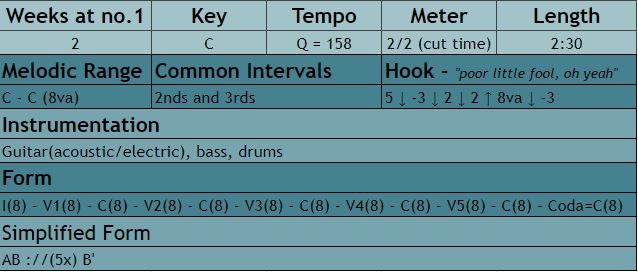
Elvis is certainly an iconic figure in music. I admittedly don't know much about him, outside of the previously mentioned tunes, so I was eager to come across this gem from 1959. As an interesting note, Elvis joined the US Army on March 24, 1958. In June of that year, he managed to squeeze in a recording session, his last before discharge in 1960. [1] In that session, we would get this no. 1 hit:
August 10 - 17, 1959: "A Big Hunk O' Love" by Elvis Presley and the Jordanaires lasts two weeks at no.1!

At it's core, this song is a 12 bar blues. We have seen 12 bar blues in no.1 hits before ("Roll With It" by Steve Winwood in 1988). Like many no.1 hits, we hear something familiar, like a 12 bar blues, then get a slightly altered version to keep things interesting.
Most notable about "A Big Hunk O' Love" is length of the verses. Verse 1 sticks to the standard 12 bar blues. Verses 2 and 3 use a modified 12 bar blues, extended to 14 bars. Verse 4 further modifies the form with a 16 bar version (more on that in Chord Progressions).
The verses are interrupted with a standard 12 bar blues bridge, which are instrumental solos! There have not been too many improvised solos seen throughout this analysis project. It's exciting to hear both a piano and guitar soloing in this song. Both seem organically improvised and fit perfectly with the blues/rock&roll styling of the tune.
The song ends with a tag of the refrain, "just a big-a big-a big-a hunk O' love, will do." We finally get a proper refrain, a repeated lyric line that occurs in each verse. This line is very catchy and got stuck in my head throughout my analysis. For me, the surprising quality of this song gives Elvis a little more credibility, in light of my limited experience with him.
Chord Progressions
As mentioned above, this song is a 12 bar blues in the key of C. 12 bar blues generally follow the sequence below. In "A Big Hunk O' Love," we hear this in verse 1, as well as behind both solos.
 |
| 12 bar blues - verse 1 and solos |
 |
| 14 bar blues - verses 2 and 3 |
 |
| 16 bar blues - verse 4 |
The end of the song "tags" the final 4 bars, repeating the refrain lyrics 3 times before fading out.
Within the blues progression, there are few funky chord extensions. The I chord (C) is often heard as a C6, or C with an added A. In addition to that, we hear the #9, or D# (Eb) on top, giving it that dirty blues feel. The result is a C13#9 sound. This occurs in the opening bars:
 |
| opening rhythm section |
Melody
"A Big Hunk O' Love" has 4 verses with 2 different melodies throughout, tied together with the repeated title refrain.
The first verse kicks things off with a melody we only get once:
 |
| Verse 1 |
Starting on beat 3+, Elvis hits the 5th of the chord and then works down a C minor triad. The repeated "no's," outline the 6th and #9 and lead to the IV chord. Over F, Elvis uses the same melodic content, typical of blues based melodies, and outlines the minor triad of the I chord. In the final 4 bars, we hear the refrain, an outline of the G triad with some chromatic motion to get to the root of the IV chord. He settles back into the tonal center of the tune with the C on "will do."
The second and third verses, a 14 bar blues, change things up a bit. Here, he starts on the #9 (minor 3rd), dipping down to the root to cement the bluesy flavor. The rhythm section play call and answer with a nifty blues scale riff.
 |
| verse 2 - bars 1-6 |
In the second half of this verse, we hear the background vocalists, the Jordonaires. They were present during the first verse, but stuck to the chord roots, tightly blending with the bass. Here, we get some annunciated words answering Elvis's calls.
 |
| Verse 2 - bars 7 - 14 |
Speaking of verse 4, it starts like verses 2 and 3. The rhythm section call and answer is reduced and they take a little longer in their rhythmic build up. Elvis takes a little longer to get to the "no's" as well. Before he finally gets to the IV chord, he bumps up, every so slightly, to the E natural, bringing back the C7 sound before we hear more familiar material to lead to the F.
 |
| Verse 4 - bars 1 - 9 |
Musical Sticking Points
Sometimes less is more. That's exactly what Elvis gives us throughout this song. He sings and the rhythm section or vocalists answer him, that's basically it. In the first verse, we get it with eighth note guitar attacks. In the rest of the verses, the singers reply with words. The length of verses gets varied, but it's really just the same thing, only different.
I love the simplicity of the instrumentation and overall arrangement. Guitar bass and drums handle all of the instrumental load. Elvis's powerful voice is complimented perfectly with the smooth singing of the Jordanaires. The instrumental solos a refreshing element in pop music and at the time, pop was not so far removed from jazz and blues traditions.
Lyrics
Elvis really wants a kiss from the woman he is singing to. His lyrical premise of "hey baby, I ain't asking much of you (A).....just a big hunk O' love will do (B)," sets the tone from the start.
The first verse follow blues lyric construction: AAB. The second and third verses feature 3 extra lines with rhyme scheme aab. This is followed by the AB lines established in the first verse. The fourth verse adds 4 extra lines with the rhyme scheme abcb before going back to the familiar AB. The c line above also uses an internal rhyme "you know I'd have all the things these lucky charms could bring."
Once again, we see something that is relatively simple get transformed into something much more complex with a little variation.
Common Threads
Picking up from the previous list, we see these commonalities with Elvis and the others songs analyzed "on the 9's."
- Hook that uses the title of the song
- Repeated melodic elements
- Texture changes
The texture changes in "A Big Hunk O' Love" are not achieved the same way as other tunes. Here, the rhythm section provides the changes with some stops, call and answer patterns and solos. In the other tunes, instrument parts changed the texture with a synth part here or a horn part there.
The biggest common thread, though, is the idea of repeated material carrying the song. This one is probably closest to "In the Year 2525" (1969) in form (all verses). It shares a little bit with "Bad Girls" (1979) in the way the background vocals answer the lead vocal with repeated musical themes. It shares the element of instrumental solos with 'Right Here Waiting" (1989).
Comparing Elvis with "Genie In a Bottle" (1999), "I Gotta Feeling" (2009) and "Old Town Road" (2019), we see the use of a refrain (albeit in slightly different terms), reliance on repeated chord progressions and the use of texture changes and slight variation to keep things moving.
Final Takeaways
When I recently explained this project to someone, they asked "what are you really looking for?" My answer was "common musical themes that emerge in no.1 hit songs, regardless of when they were written." I think that statement is proven relevant in this particular analysis. If someone asked me what Elvis and Christina Aguilera had in common, prior to this, I might have only been able to answer "they are singers."
The recurring theme in this round of analyses has been repetition with subtle variance to keep things evolving. Every song has used a significant amount of repeated material. There has not been much harmonic variation. Vocal variation has been running rampant, but harmony has remained largely static.
So where to next? A recap common threads found in round 2, compared with common threads found in round 1. This is what it's all about! What do these songs, the height of popularity in their decade, have in common with one another? What musical elements help make a song popular? Stay tuned to see what musical themes emerge from decades of hits!
[1]https://biography.elvis.com.au/