Archive

Showing posts with label 1990 - 1999. Show all posts

10/26/20

"Can't Help Falling In Love" (from "Sliver") - UB40, 1993

Chances are you don't remember the plot of the movie "Sliver," starring Sharon Stone, William Baldwin and Tom Berenger.  You do, however, probably remember the song "Can't Help Falling In Love With You."  What lineage....a French love song, "Plaisir D'Amour," composed by a German composer, Jean-Paul Egide Martini (!?!?) in 1784, rewritten in 1961 by George Weiss and company ("Lion Sleeps Tonight," "What A Wonderful World") and recorded by Elvis Presley, only to make it to no.2 on the Billboard Hot 100 in February of 1962.  [1]

Fast forward to 1993.  On the heels of many other popular versions of the tune, UB40's pop-reggae version climbs to no.1 in the U.S., the British group's second no.1.  [2]  The path of this song's no.1 journey is interesting and is reflected in the musical analysis.  This is the oldest source material I can recall appearing on the Hot 100.  George Weiss, a master songsmith, brings this melody to life in an accessible way for pop audiences.   

July 24th - September 4th, 1993: "Can't Help Falling In Love" by UB40 lasts 7 weeks at no.1!  


The form to this song is very peculiar, in terms of standard pop music forms.  The intro is really a statement of the "verse" and "chorus," or A and B.  We get an 8 measure verse with vocals and organ laying down the chords.  We then get an instrumental statement of the 5 measure "chorus."

The "verse" and "chorus" don't quite feel like traditional because each verse contains the lyrical refrain: "I can't help falling in love with you."  The verse is better labeled as an A section and is the primary repeated motif throughout the tune.  The "chorus" is only labeled as such due to repeated lyrics.  It fills the role of a B section, or contrast to the A section.  There is no bridge, so this section almost pulls double duty as repeated "chorus" material as well as the bridge like function, contrasting the A section.

This B section is also an unusual 5 measures long.  It doesn't sound out of place though and the chord resolutions feel natural.  

The final measures tag the refrain and then fade out.  The repetition of the hook to close out the song helps give the song a classic shape, even if the other sections fall outside of that shape earlier in the song.  


Chord Progressions

George Weiss successfully took an antique melody and gave it a makeover with contemporary harmony.  

The intro outlines a straightforward chord progression:

D  A / D  A / G  D / A   / G  A / D  G / D  A  / D
I    V/  I  V/ IV  I / V   /  IV V/  I  IV / I   V  / I 

Lots of I-V resolutions with plenty subdominant color added in.  

When we get into the verse, the bass line colors this progression up a bit more:

Verse - Bass Line

Aside from all the slash chords, the only real change is an E minor replacing the G.   Subbing out a vi for a IV is common sub. I do love this bass line.  It is a solid example of the reggae style and features some great root motion through the slash chords.  

The bassline is accompanied by several layers that fill out the harmony.  Synthy pads lay out the chords over the top while the piano/guitar plays a classic reggae upbeats rhythm pattern.

Chord Rhythm


The chorus takes the standard progression and swerves quite a bit.

F#min  B / F#min  B / F#min   B / Emin11/A / G  A7
iii    VI   /  iii        VI/   iii       VI / ii               / IV  V

The motion from iii to VI gives this section a completely different feel, taking us out of the diatonic realm by one note (D#).  The turnaround back to D blurs the tonality with the Emin11/A.  The chords chunk out Emin while the horns add in A, B and D, over the bass A.  

To further intensify this, the bassline plays C# over the F#min chord and changes the rhythmic approach, adding in these syncopated drops in the first three measures.  In the last two bars, more consistent rhythm propels things right back into the verse.   

Chorus - Bass Line

The tag ends the song on the last 4 bars of the verse.  


Melody

When I first listened to the tune, I remember thinking "this should be a fairly cut and dry melody transcription."  Man, was I wrong.  The pitches were mostly easy to pin down, but the rhythm presented a real challenge.  Ali Campbell's vocal delivery is so loose and relaxed that he is often way behind the beat.  This causes off beat syncopation to come off as triplets, further confused by the fact that he sings purposeful triplets some of the time.  

We get a feel for this right at the top with the organ and voice duet:

Intro (Verse) - meas. 1-8

The entire melody features chord tones, except for bar 6.  This is the bar that becomes E minor after the band kicks in, pronounced by the bass.  E minor and G, of course, are basically the same chord.  Without the bass though, it feels like a G here in the intro.

Ali Campbell seems to be a fan of the whole step above resolving to chord tone, which happens 3 times (meas. 2 3, and 7).  

During the following verses, the melody is harmonized. The harmony jumps around a bit, covering a 3rd higher, then a 4th, then moving in parallel 5ths.  The differing timbres and intervals result in a pleasant sound filled with character.  A cool ornament happens in measure 5, another example of the rhythmic fluidity the singers wade through. 
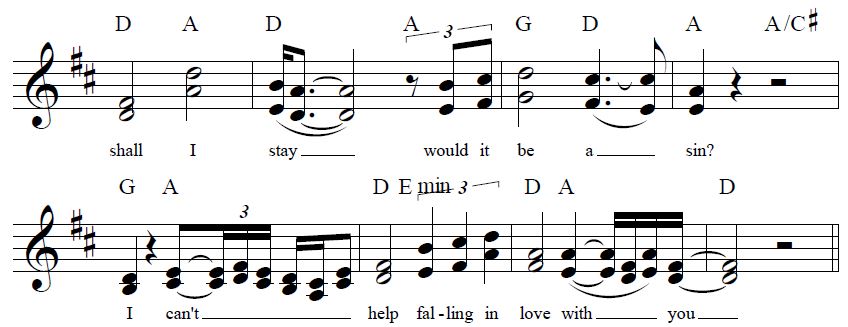
Verse 2

The final verse before the tag has a stuttered vocal figure that may or may not have been purposeful.  Either way, it varies the repetitive verse and helps makes the last, repeated verse feel slightly different.

Verse 3, second time, meas. 1-4

The chorus melody, like the chord progression, takes a wide left turn and we get some completely different conventions.

Chorus Melody with Horns

The rhythm is very choppy on the 16th upbeats, outlining an F# min arpeggio, 5th-R-3rd-5th, with the C# resolving to the root of the next chord tone, B.  The phrase is repeated three times, pushing the momentum forward until the last two bars where things slow down and the cadence evens out and resolves back to D.  The feel here is very relaxed and behind the beat, blurring the rhythm a little bit.  This is particularly strong in the penultimate bar.  The three eighth notes almost feel like a triplet across the bar line, with "be" arriving just after beat 1.  It's completely innocent when listening causally, but proved a head scratcher for me when transcribing.  

The bottom staff, above, represents the horns.  Aside from bars 4 and 5 in the intro statement, this is the first prominent horn feature.  In bars 1-3, we hear similar figures on (3)+ that outline F# min with varying intervals.  The last two measures feature some great arranging with overlapping parts hitting all the signposts of the Emin11 chord.  The rhythm here shifts to being on the beat, another trick to help masque the 5 bar phrase with a clean resolution.  

The horns come back hard in the tagged ending.  Here, they borrow a riff from bass line and deliver some fast staccato double tongue action:
Tag Ending - Melody and Horns

The horns certainly fill up the space left by the vocals.  The thirty second note figure almost answers the triplet vocal melody in fast succession.  They stay on the A, holding back the D major resting place until the next bar.  There, they double the bass line.  After hearing that bass line throughout the entire tune, it sounds natural when the horns double it, even though the line is very busy and highly syncopated.  It ends the tune in grand fashion as it fades out.  

Lyrics

"Can't Help Falling In Love" is high up on the list of greatest love songs.  The lyrics, however, may not as be sweet as you think.  

"Wise men say, only fools rush in
But I can't help falling in love with you"

The narrator is admitting his own stupidity by his inability to stay away from the antagonist love interest.  In the second verse, he even questions his motives, asking "shall I stay, would it be a sin?"  It certainly makes me wonder what else this guy has going on his love life.....

The chorus doesn't give away the resolution to this guy's struggles:

"As the river flows gently to the sea
darling so it goes
Some things were meant to be" 

The river flows to the sea and then disappears?  The river flows into the sea and they become one?  The fate of the protagonist is unclear.  Thanks to the Words And Music And Stories blog for bringing some of these points to light.....it will certainly help me think twice about this song the next time I hear it at a wedding. [3]  

Aside from the mixed messages, the rhyme scheme is non existent.  In the verse, none of the lines rhyme.  Instead, there is some vowel consonance on "wise" and "I," and not as lined up with "fool" and "you."  Coincidentally, the first and second verses have the same vowel construction with "say" and "stay," and "in" and "sin."  The third verse does not follow suit.  

The chorus follows an ABAB rhyme scheme with: "flows; sea" and "goes; be."  

It is a little surprising how few lyrics there actually are.  Excluding the tag, there are 131 syllables in the main body of "Can't Help Falling In Love.".  34% of them are made up of "I can't help falling in love with you."  If you take the repeated tag into consideration, that goes up considerably.  It's amazing that more than 1/3 of the entire lyrical content is the hook.

Common Threads

What are the common musical threads no.1 hit songs share?  In each round of analyses, I try to answer this question by observing like musical elements and investigating their presence in other songs.  So far  this round, "on the 3's," I have analyzed 2013's "Blurred Lines" and 2003's "Crazy In Love."  Will UB40 amend the list with their 1993 contribution?  

Repetitive Melody - Absolutely.  The refrain checks this box in bold.

Polytonal Melody - Melody Utilizes Chord Tones - Unlike the previous hits "on the 3's," this one relies on chord tones.  There is that E min bar where this facet could be challenged, but the rest of the song sticks to chord tones.

Single Repeated Chord Sequence - Two Harmonic Sequences - another song with only two differing chord sequences.  

Multi-layered Percussive Accompaniment - The drums are just kind of "there."

Features Rap/Spoken Vocal - I suspected as we got deeper into the timeline this element would disappear. 

Melodic Bass Line - I love this bass line.  It's not only melodic but percussive as well, almost filling that mutli-layered percussion element all on its own.

Vocal Harmony - Indeed.  I like how the harmony in this one doesn't follow the same intervallic route but jumps around a little bit to create some interest. 

Non-Linear Form - The 5 measure chorus qualifies this category.  I'm still feeling this element out, but "Can't Help Falling In Love's" form gives it a little credence.  

Chord Count - 7 - D, A, G, Emin, F#min, B and Emin11.  The function of the Emin11 (chorus) is different than the Emin in the verse, so I felt it should be counted twice.

5/8 shared elements with "Crazy In Love," which is a surprising stat, considering how different the two songs really are.  The elements that stick out to me are melodic bass line, vocal harmony and non-linear form.  Repetitive melody, as I have noted in every song before this, is either a gimme or a hard requirement for no.1 songs.  The other elements are less prevalent, but happen to be shared by every tune "On the 3's" so far.

Final Takeaways

 When this song came out in 1993, I remember despising it.  Granted, I was just starting out on a lifelong obsession with heavy metal, in particular, Megadeth.  In my early days of watching MTV, I remember watching this video and desperately hoping for something with more edge to follow.  With fresh ears, I like this song quite a bit.  

I read one review that slammed the production and it seems UB40, in general, gets a bad rep as "reggae light," which on its face, shouldn't be a criticism.  Every musical genre has extremes and though the pop elements of UB40 add to that misconception, the bass line in this song alone will quickly challenge that assertion.  I think the band did a great job at bringing out the charm and simplicity of the melody while adding their own voice to it.  Obviously someone agrees, or I wouldn't be talking about it.  7 weeks is a strong showing for any song to last at no.1    

Up next time, "on the 3's" rolls on with a stop in 1983.  July 9th - August 27th, 1983.  8 weeks at no.1...."Every Breath You Take" by The Police dominates the no.1 position on the Billboard Hot 100.  Awesome.  I am a big admirer of The Police and Sting, in particular.  I also know this song made a resurgence in the 2000's.  This should be a fun one.  Stay tuned!  


[1]https://www.songfacts.com/facts/elvis-presley/cant-help-falling-in-love   

[2]https://ig.ft.com/life-of-a-song/can't-help-falling-in-love.html

[3]https://wordsmusicandstories.wordpress.com/2019/03/27/cant-help-falling-in-love-2-analysis/

9/14/20

"This Used To Be My Playground" - Madonna, 1992

Good old Madonna.  Singer, actress, provocateur and pop icon.  She was busy forging her reputation as such in 1992, working on her acclaimed record Erotica.  She also co-starred in a blockbuster movie, A League of Her Own.  The combination of these two elements produced the subject of today's analysis, "This Used To Be My Playground."

Madonna was asked to contribute a song to the movie.  Upon this request, her collaborator Shep Pettibone, wrote a demo for Madonna to work with.  The recording of the final product was tumultuous, and required a quick rewrite of the score while the orchestra waited in the recording studio, threatening a huge price tag. [1]  In the end, we get a no.1 hit single, but it got there in an unlikely manner.

Due to some contract limitations, "This Used To Be My Playground" does not appear on the League of Her Own soundtrack.  Instead, you would have found it on the Barcelona Gold 1992 Olympic soundtrack!?! [2]  Despite this limitation, Madonna hit no.1, breaking her tie with Whitney Houston to become the female with the most no.1's, at the time.

August 8th, 1992:  "This Used To Be My Playground" by Madonna slides into no.1 for 1 week!


The form of this one is simple, yet not without a few quirks.  The intro, led by a keyboard melody, is 8 measures in 4/4 followed by a single measure of 2/4, hence the 8.5 label.  We get cooking right away with the chorus, which for the first two iterations, is immediately followed by a 4 measure post-chorus (PC).  When we hear the chorus later on, we get the 8 measure version, repeated three times in a row with alternate lyrics.

The verses are an unusual 14 measures in length.  They consist of a repeated 4 bar section followed by 6 additional bars.  The bridge is a hybrid of the verse and chorus, using familiar combinations of chord sequences under a string soli.  The song ends definitively with a 4 bar section of new-ish material.  

Breaking this down to a simplified form, it's really just ABAB, interrupted by a short C, followed by repeats of the A section.  This is easy enough to comprehend and a sensical song structure to build from.  As mentioned, it seems to have been tracked live, at least in the strings, which puts it in slightly different air when listening, at least for me.  


Chord Progressions

Like a good thesis statement, the intro provides us a context for all of the harmonic sequences to come. The keyboard presents some thick harmony with a melodic line harmonized in 6ths.  G minor tonality is recognized right away, moving between Gmin and F/G, yielding some lush ballad chords.  

Intro - meas. 1-4

The progression takes us to unexpected territory in measure 4, a place we never return to, going to the parallel G major.  The first 4 measures work out to be:

Gmin  F/G    /  -%-  / EbMaj7   Dmin7   /  Gsus   G
i       bVII    /            / bVI             v          /  I

The next 4.5 measures traverse the same ground, bringing in an additional chord to close things out.  We also see some of the melodic lines shift lower in measure 6, below.

Intro - Meas. 5-9

The progression for measures 5-9 here works out to be:

Gmin  F/G    /  -%-  / EbMaj7   Dmin7   /  Cmin11
i       bVII    /            / bVI             v          /  iv  (vi/Eb)

The chorus emerges out of the 2/4 measure, blurring the tonal center with Ebmaj7.  As Madonna's vocal enters, the pacing slows down briefly before picking up again, weaving in and out of G minor.  

Ebmaj7  /   -%-  / D7sus  / Gmin  /  Gmin7/C   / F  F/Eb   / Bb/D   /  Gmin
bVI       /           /   V        /    i         /   iv (V/F)     / bVII       / III (v)  /   i

There are a couple of lush chords that help provide an atmosphere.  D7sus, D-G-A-C, is a very open sound, functioning like V7 and giving less of a pull to Gmin with 2 common tones (G and D) while A and C both want to resolve to Bb.  There's also Gmin/C, which similar to D7sus, functions like a C7sus, C-F-Bb-D-G...

The C7sus, then, functions like V of F, which is where we end up.  Once there, we get a nice descending line F-Eb-D.  On the D, the Bb triad on top now acts like a D7#9b13, D-Bb-F, which leads back to G minor.  The slow tempo, sparse melody and lush keyboard and string arrangement masque some of the complexity.  In any case, it flows nicely.

The chorus leads directly into a post-chorus, the additional 4 measures after the first two chorus sections.  Here, we retread some progressions just heard and introduce a new cadence.  The C7sus sound of Gmin7/C leads to F, followed by the descending bass line once again.  This time, the D7 hangs in the balance, waiting to resolve back to Gmin....

Gmin7/C   /  F   F/Eb  /  D7    /  -%-
iv  (V/F)   /  bVII       /  V7    /  

As the verse drops, the D7 proves to be deceptive, as we once again return to Ebmaj7.  The 14 measure verse takes a couple of twists and turns, visiting some old patterns and introducing more new sequences.  The first four measures repeat, maximizing descending chord roots G-F-Eb-D:

Ebmaj7 / D7sus  Dmin7 /  Gmin  /  Bb/F   ://
bVI       /  V          v         /  i          / III

In measure 9, things start of similarly before the pacing changes and we get to D7sus two beats early:

EbMaj7  D7sus /  D7sus  Dmin7 /  Cmin11  Cmin7  /  Cmin9  Cmin /  Gmin  F/G  /  -%-
bVI        V        /   V           v        /   iv                         /                          /   i        bVII   /

 The descending note theme returns again, this time on Cmin where the piano plays F-Eb-D-C through the shifting Cmin harmony.  The last two measures return to the opening of the intro, something familiar yet slightly unexpected.  

There are a few spots where the basic harmonic patterns are altered even further.  During the bridge string solo, we see:

EbMaj7  /  -%-  /  D7sus  /  Gmin  /   Cmin11  Cmin9  /  F  F/Eb /   Bb/D /  Gmin
bVI        /          /   V        /    i          /    iv             (v/F)   /  bVII     /  III (v) /    i

The outro also features one last new sequence - Ebmaj7 - Dmin7 - each chord last two measures.  It's an interesting move to end on the minor v chord which gives the song a contemplative and melancholy feeling, perfect for the lyrical content and overall vibe.  


Melody

Despite the altered chord voicing and surprising resolutions, Madonna's melody is straightforward and repetitive.  Chorus phrases consistently begin on (2)+ and use similar rhythms and pitches.  The primary sequence of G-D-C-Bb make up a bulk up these phrases, with each resolving to a chord tone, all shared by Gminor.  Even in measure 6 when she sings repeated A's over the F chord, she ends the phrase on a Bb, -3/Gminor.  She finished off the chorus with a final phrase of D-C-Bb, 5-4-3 in Gminor, now an established melodic sequence.    

Chorus + Post-Chorus 1

The post chorus feels very different, entering on beat 1 and settling on C, a first for the vocal melody up to this point.  That is followed by an ascending G minor lick, leading to D.  The final measure is another G minor phrase, this time higher, G-A-Bb-A-G or R-2-3-2-R.  

The chorus undergoes a mutation the second time around.  We get a short countermelody in measures two and three as well as the addition of harmony, similar to the intro piano line, in 6ths.  
Chorus + Post-Chorus 2

There are a couple of cool spots here, including measure 6 where the harmony gets a whole step apart (C/Bb), both chord tones of F/Eb.  The last measure of the post chorus harmony is buried in the mix but hinges on the familiar D-C-Bb grouping.  

The third chorus marks the start of the long ending, repeated 8 measure chorus sections without the post-chorus.  The words change but the harmony remains, thickening the voicing of the counter melody in the second measure.  The last measure takes the familiar note grouping and syncopates it, giving it a sense of momentum leading into the next 8 measure repeat.  

Chorus 3

 The fourth chorus is similar to the third with additional lyric changes.  As it heads into the fifth and final chorus, we see additional vocals added to the mix.  Included with the moving 9th over EbMaj 7, we get another flash of the intro with the descending line Bb-A-G-F; 5-4-3-2 of Eb.  The sustained F is the minor 3rd of D, furthering the case for the function of D7#9b13 where we see D7sus.
Chorus 4 into Chorus 5


Moving ahead to the verse, we see some similarities with the chorus.  The big phrases enter on beat 3 and using short 8th note runs that resolve on chord tones.  The opening notes, D and F are higher than the start of the chorus.  She then returns to the familiar G-A-Bb-A-G lines we saw in the chorus.  That line is repeated, in part in the next measure, leaving off on D-F, like the opening measure.  Like the chords, the next four measures of melody repeat.  

Verse 1

  In measure 10, we hear a descending line, almost opposite of what came in measure 2 of the post-chorus.  This is repeated again in measure 12, ending on a G in measure 13 as the keyboard takes over, revisiting the feel of the opening measures.  

Verse 2 is very similar to verse 1 and like the second chorus, adds in harmony vocals.  The harmony here follows the theme, a 6th lower.  Some of the entrances are slightly different to accommodate changing lyrics.  The last two measures also feature variations by Madonna, singing Bb-A-G over the last Gminor chord and adding a new melody on "I'll never say," similar to the countermelodies used in the chorus.  

Verse 2

The outro features one additional vocal melody before the song ends.  Chorus 5 uses the syncopation seen at the end of chorus 3, adding in a harmony for "free" on Eb chord tones.  She ends with a descending figure, G-F-D-C, bumping back up for D-C.  The last note, C, is minor 7 of Dmin, a sound we have not head sustained during the same for long periods of time.  
Chorus 5 into Outro

The only other section that hasn't been formally mentioned is the bridge which features the strings playing the melody.  Here, we see some familiar melodic groupings (G-A-Bb) presented with new rhythms and articulation over several chords.  The bulk of the melodic content here centers around these familiar notes and is enhanced with added harmonies and arranging between strings and piano.  It works well as a bridge, breaking up the first half of the vocal sections before we get 3 repeated choruses and the outro.

Bridge


Lyrics

Nostalgia is a strong force.  These lyrics attempt to conjure that feeling in the listener.  In the context of aged baseball players reminiscing about their glory days, it succeeds.  Madonna sets the premise up quite clearly: "this used to be my playground," expanding the description by telling us how it was a safe haven of sorts.  As the verses kick in, she puts emphasis on "used to be," desperately trying to hold on to the past, making us question her current situation. 

The chorus rhyme scheme follows ABCB with the post chorus using its own AAB theme.  The verse consists of 3 sets of ABB rhymes, though the second verse deviates from that in the first stanza.  

The line that may best sum up the lyrical content happens in the 2nd verse:

say goodbye to yesterday
those are words I'll never say

While she is attempting to move on and acknowledge the past is gone, she can't bring herself to do it.  This is certainly a relatable sentiment for most people.  We get a little more context to the entire meaning of the song in the outro with the closing lines of the piece:

The best things in life are always free
wishing you were here with me

In 1990 like year before and years to come, people can easily relate to songs about lost love and friendship.  This last line eloquently and simply states this point.


Common Threads
 
What common musical elements do no.1 hits through decades share?  That's one of the mission statements of this project.  After I complete each analysis, I attempt to find some of these common threads.  So far, I have used songs from 2011, 2001, 1991, 1981, 1971, 1961, 1962, 1972 and 1982 to inform this list.  Let's see how Madonna's 1992 contribution stacks up to that list of common musical elements.

Repetitive Melody -  This could be one of the poster children for this category.  She uses many similar note groupings to construct her melodies and these note groups reoccur in multiple sections and within the same section.  This melody, in other words, is very repetitive.  

Hook that Uses Title of the Song - Probably the most identifiable melodic component of the song, for sure.

Stepwise Motion Common in Melody - Lots of 2nds in this one.  There are a few minor thirds at work in the verse, but 2nds are the dominant interval.

+ Use of Vocal Harmony - the harmony and countermelody are important elements of the melodic presentation.

+ New Material at the End - though short, the outro does include a new chord sequence and melody.  It has been a few analyses since this element has shown up!

- Texture Changes - The entire tune uses similar texture throughout.  Yes, there are background vocals and arrangement elements that come and go throughout the song.  There is, however, this hue surrounding the general production that never lifts.  If anything, the intro has its own unique feel, but that never returns.  

- Strong motion of V- I - While there are several V-i resolutions, the quality of the V chord is ever changing.  When we finally do get a solid D7, it resolves EbMaj7.  Therefore, this doesn't quite make the cut. 

Chord Count: 12 -  Gmin, F/G, Gmin7/C EbMaj7, D7sus, Dmin7, D7, Bb/D, Bb/F, F, F/Eb, Cmin.  There would be more if I had counted all the variations on Cmin.  Either way, 12 chords is a lot to hear in a pop song.  Many of these though, are alterations on a base chord, but serve different functions in the grand harmonic scheme.  


Final Takeaways

  Like so many songs I have worked with, I did not like this one during the first few listens.  The keyboard sounds dated it and the over the top orchestra sound puts it in a sonic landscape I don't readily identify with.  I kept listening though.  What I found was a well crafted song with a surprisingly repetitive melody that works over multiple chords qualities.  

I'm not a Madonna scholar by any stretch of te imagination and had little to no recollection of this song.  Her singing did not blow me away and it's very different from some of the more iconic names I have analyzed in the same time period (Mariah Carey, Christina Aguilera , Brandy & Monica).  Despite all of this, I do like the song.  It has a palpable vibe and the hook is enduring, even if nothing else is particularly memorable.  My wife, my litmus test for many songs, somewhat accurately was able to hum the main hook on a cold ask, guided only by the title.  

I'm aware that Madonna has a legacy in pop music and many accolades to her name.  This song though, aside from the pressures in play when it was written, does not seem particularly reflective of those accolades.  If I continue this project long enough, I will no doubt come in contact with Madonna again.  Hopefully, then, I can hear something a little more exciting in the vocal department.

What do you think of "This Used To Be My Playground?"  Did you remember it from the movie?  Does the sound of the track hold up by today's standards?  Leave me a comment!

Up next time, the journey "on the 2's" takes us to 2002.  The song in question, a powerhouse that even I with my Phish colored jam band blinders on, could not escape.  June 29th - August 10th, 7 weeks at no.1, "Hot In Herre" by Nelly dominates the charts!


[1]https://web.archive.org/web/20110830193214/http://www.sheppettibone.com/sp_erotica_diaries.htm

[2] https://www.deseret.com/1992/8/3/18997770/madonna-s-all-over-the-place-but-her-playground-is-not

8/19/20

"(Everything I Do) I Do It For You" - Bryan Adams, 1991

 Bryan Adams is one of those iconic 80's and 90's songwriters whose music creates instant nostalgia.  His voice, coupled with song writing sensibility, is unmistakably his.  That being said, his songs do have a tendency to blend together, all having that signature sound, which is reminiscent of others (Rod Stewart?).  A New York Times article from 1994 begins to pin down the ordinary magic of Bryan Adams, a musical quality lacking in the flashy landscape of 2020, for better or worse. [1] 

When I think Bryan Adams, I think of "Summer of 69" and today's subject, "(Everything I Do) I Do It For You."  I had pretty good recall of this one prior to the analysis and remember the video from my childhood, complete with scenes from "Robin Hood Prince of Thieves" (though that video appears to have been deleted from YouTube.  There is, however, a live video featuring the album length version).  

Bryan Adams is one of those guys that you are more familiar with than you may realize.  He has logged 25 songs on the Billboard Hot 100, 11 of which cracked the top 10 and 4 that hit no.1 . [2]  After analyzing this song, it turns out I am a fan of his song writing. He shared some insights into his process in this Songwriter Universe interview from 2006. [3]  Today's melody may be one of the more iconic entries this project has come across.  I am reminded of Richard Marx's "Right Here Waiting (1989)" in style, but Adams presents an overall more developed and sophisticated presentation.

July 27th - September 7th 1991:  "(Everything I Do) I Do It For You" by Bryan Adams goes 7 weeks at no.1!


This song uses classic song structure.  We hear two rounds of verse-chorus, followed by a bridge, concluded with a final chorus.  There isn't any wasted time between sections and even in the intro, we are getting teased with bite sized chunks of the melodic content to come.  

The tune is also filled with space.  The chorus melody ends more than a measure before we hear the next section, leaving the instruments to settle in on huge chords.  This also happens out of the vocal bridge (B1) and again at the end, leaving you to well up tears with a few beats of silence after the vocal climax of the tune, "I'd die for you....."

The outro is a simple statement of the hook, completing the chorus we missed a few bars earlier.  The album version actually includes additional solos and vocal musings after the single version ends.  Today we will be basing the discussion off the shorter, single version.


Chord Progressions

The opening piano intro provides us with a harmonic and melodic preview of the song to come.

Piano intro

Note the chord sequence, each preceded by a 16th note grouping that compliments the melody:

Db  / Ab/Db   /  Gb/Db   / Dbsus2

I    /  V         /   IV          / I

The verse basically uses this pattern, replacing the Dbsus2 with Ab/Db or Absus and Ab.  All of this simple movement is familiar, but gets its own flavor with the common Db.  

The chorus is broken up into two very different 4 bar phrases.  The first half ventures to Eb minor and features the bass passing through chords to give a completely different feel than the verse:

Ebmin  Db/F  / Ebmin/Gb    /   Ebmin   Db/F  /   Ebmin/Gb

ii           I        /  ii                  /  ii                I       /  ii

The second time we hear the chorus, there is this additional guitar arpeggio that adds another subtle flavor.  This crunchyness foreshadows a few heights the guitar reaches towards the end.

Chorus 2 guitar riff


The final 4 measures play out closer to the verse, once again sticking to I and V in the key, with some added inversion:

Db/Ab   / Ab   /  Db   /  Db

I           /  V     /  I      /  I

The bridge, also divided in two sections, starts with a temporary modulation down a whole step:

B          /   E       / B   / Gb

(bVII) / IV/B   /  I    / V/B (IV/Db) 

The Gb chord pivots us back into Db for the final five measures B1:

Db  /  Ab   / Eb   /  Ab   /  Ab

I    /  V      /V/V  / V      / V

The extra measure of Ab provides a breath before the guitar solo in the second half of the bridge.  Here, the changes are simpler, alternating between 2 bars of Gb and 2 bars of Db, IV - I.

The master of subtle nuance, Adams isn't done yet.  The last chorus keeps the Ebmin chord, but ditches the passing tones in the bass and introduces a syncopated guitar/keys riff with Absus resolving Ab.  The climax shifts some chords around and brings us to the Beatlesesque Gbmin, or iv.

As if that wasn't enough, the final measures feature a new harmonic variation on the hook:

Db/Ab   / Ab   /  Gb  Ebmin  /Db

I           /  V     / IV    ii         / I


Melody

As I mentioned, this melody is well crafted and iconic.  I like how it doesn't waste time getting to the point and uses space to its advantage.  Verse one comes in after the 4 measure intro and melodically  answers the piano flourishes established in the intro, continuing throughout the verses.

Verse 1


This 8 bar segment is comprised of two sets of like phrases.  The first begins on beat 2, covering 3rd and root.  A similar phrases follows on the next beat 2, covering 5th and root of Ab.  Then we get an ascending phrase starting on the 3rd of Gb and working up to Eb, the 5th of Ab.  So far, lots of chord tones.

The second half of the verse covers the same melodic ground, but flips the rhythm on its head.  This time, the phrases start on beat 4 of the preceding measure.  The ascending line in measures 7 and 8 is similar, but is slower getting to the ornament over the Ab chord.  The use of chord tones, diatonic steps, ornaments and subtle rhythmic displacement make this verse melody an integral part of the song and not just a forgettable verse that comes before the chorus.

The chorus uses less space with a more deliberate pacing than the verse.  Combined with the Eb minor chord, this part sounds completely new and fresh when it arrives.  We quickly return to familiarity with a return to verse harmonic and melodic conventions:

Chorus 1 and 2

The hook, using faster notes with lots of space, is very effective at getting stuck in your head.  There are more chord tones with repeated leanings on Gb before resolving to chord tones.  The big of space after the vocals let the chord ring out and settle in your feels.

Verse 2 and chorus 2 are similar the previous statements.  Things take a surprise turn in the first bridge:

Bridge 1

The rhythmic motives are very different from the verse.  Phrases start on beat 4 and finish around beat 2.  The last two phrases are longer with basic 8th note syncopation.

The entire melody here gradually gets higher with each phrase.  The added harmony starts lower than Bryan for 4 measures and then goes above him for the last 4, really highlighting this arc.  Note the melody continues to utilize chord tones that flow stepwise through the chords.  Following the last measure above, we get more silence, interrupted by 3 piano notes to lead in the guitar solo:  

Bridge 2 - Guitar Solo

This guitar solo immediately sticks out as something different with many alternate note choices.  We hear an F over the Gb, the major 4th.  The briefly resolves to the 5th, Db, before sustaining an Eb, now the 9th of the Db chord.  From there, we get several chord tones and then a sudden jump to Bb, the 3rd of the Gb chord.  It finishes with a quick pentatonic line and some bluesy bends to bring it home for the last chorus.

In the last chorus, we get the most dramatic moment of the song.  4 measures of something familiar are interrupted with the emotional and desperate pleas from Adams, reflected in the music.

chorus 3

The section starts higher than before, moving from Ab to Gb and then down to Eb, once again, primarily chord tones (also note the syncopated Absus - Ab line notated above).

The last 4 measures turn the harmony back on and give us three like phrases that devolve to the climax.  A slight ritard add to the drama as does, surprise, surprise - silence.  

The last statement of the hook finishes out the song, slightly varied from before:

outro

Wow, what a melody.


Lyrics

The lyrics are uber sentimental, walking a line between undying devotion and 90's cheese.  

Search your heart, search your soul
And when you find me there, you'll search no more

The bridge jumps over the line and falls into cheese:
There's no love like your love
And no other could give more love
There's nowhere unless you're there
All the time, all the way, yeah

The last chorus throws out repeated "you's" and an out of date phrase in "walk the wire:"
Yeah, I would fight for you
I'd lie for you 
Walk the wire for you
Yeah, I'd die for you

The verses follow an AABB rhyme scheme with the chorus doing the same.  Other than that, the unrelenting emotional sentiment is what it is.  Luckily for Bryan, the music does a great job of enhancing this sentiment, even taking a little attention off of it.  
 
I always remember the video enhancing these lyrics.....I wish the Robin Hood video was still available because I remember making a connection with the characters at the peak moments.  Perhaps these feelings are not so common in everyday life and transferring them onto others, even movie characters, helps to make the story slightly more personal.  I wonder if Bryan channeled the movie when writing the lyrics or it was based on personal events?  The New York Times article may have predicted the answer.....[1]

Common Threads

What musical elements are present in no.1 hit songs across the decades?  That is exactly what I am trying to find out.  Picking up where "Bootylicious (2001)" left off, what common threads does this Bryan Adams classic add or subtract from the equation?

  • Repetitive Melody -  Both the verse and chorus melodies play off the theme set up in the piano intro. 
  • Stepwise Motion Common in Melody - There is a lot of stepwise motion in the song.  It frequently covers the 4th, so I omitted "pentatonic" in this common thread.   
  • Texture Changes - The frequent silence and rhythm section tacets qualify this category.  The guitar solo and slow outro also help the song get out of the same sonic landscape.  
  • New Material at the End - On two fronts, we hear new material at the end of the song.  The last 4 bars of the closing chorus have a new melody and the final statement features a slight melodic variation and an added chord.  
  • Hook that Uses Title of the Song - No parentheses needed for this one. 

(- pentaonic motion common in melody)

Chord Count - 9 - Db, Gb, Gbmin Ab, Absus, Ebmin, Eb, B, E - the only slash chord that feels worthy of it's own chord would be Absus, which is more than an inversion.  

I am surprised as to how easy this song checked the common threads boxes.  This is my 28th analysis and I'm wondering if I have truly found relevant commonalities or I am reaching a little bit too much to fit these songs into my preconceived slots.  The other explanation is that these are valid connections no.1 songs share.  Some of these songs fit easier than others and so far in this round, there are many commonalities among musical devices.  

Final Takeaways

Despite the cheesy lyrics, I like this song.  It is built on simple musical premises that are slightly tweaked to make it seem special and unique.  The arrangement enhances the melody, with the call and answer between piano and vocal, and the use of silence builds drama every time it appears.  There is no wasted section and the structure does exactly what it needs to: produce an emotional rock ballad in about 4 minutes.

While the rhythm section, on the surface, does that typical 90's soft rock thing, there are some shining moments.  The bass, which mostly plays a dotted quarter-eighth feel, accentuates the changes with passing tones to create inversions and rhythmic fills.  The drums keep a basic 4/4 beat but shift the texture from rim shots to snare, building intensity.  The cymbals also float between 8th and 16th notes, providing just enough rhythmic stability when it's necessary.  

I feel this song is somewhat important to the project, thus far.  "I Do It For You" may be in the top tier of quality songs, not just because I am most familiar with it, but because it clearly and creatively manipulates base, simple source material into something much more.  Bryan Adams sold lots of copies, which is not an easy accomplishment in any decade.  Hopefully, as we get deeper into this round, "on the 1's," I can realize why this song holds a special place in my heart.

What do you think of "(Everything I Do) I Do It For You?"  Does the nostalgia value keep it in high regard or does it stay well regarded because it's good?  Leave me a comment!

Next time, we continue backtracking "on the 1's" to 1981....2 weeks at no.1, August 1st - August 8th, another nostalgic classic: "Jessie's Girl" by Rick Springfield.  Get ready for some fun!


[1]https://www.nytimes.com/1994/03/08/arts/review-pop-bryan-adams-more-mr-nice-guy.html

[2]https://www.billboard.com/music/bryan-adams/chart-history

[3]http://www.songwriteruniverse.com/bryanadams.htm

7/12/20

"Vision Of Love" - Mariah Carey, 1990

Few artists carry a reputation like Mariah Carey.  Even as an (former) opponent of pop music, her name still garnered feelings of legitimacy and respect in my personal musical circles.  Mariah is always toted as an unbelievable singer.  After analyzing her 1990 debut hit, I back that statement 100%. 

Mariah's rise to stardom is straight out of a movie.  She slips her demo to a producer, who searches for her after listening to it.  She has gone on to collect Grammy Awards, 19 no.1 hits and countless other accolades.  She continues to write music and blaze new paths. [1] In fact, she is second place for most no.1 hits ever, just behind the Beatles (20).  It's safe to say Mariah Carey is a musical legend who will, no doubt, be revered for generations to come.

August 4th - 25th, 1990: "Vision Of Love," debut single by Mariah Carey, hit no.1 for 4 weeks!


This epic vocal showcase begins with an intro reminiscent of a movie soundtrack.  We hear ethereal synths and some ominous low tunes with no definite tempo.  Then, we get a small tease of what's to come:
intro melisma
Shortly after this vocal tease, the tune kicks in with a bluesy/gospel 12/8 groove, a first for meter in this project!  Once the tempo is established, the form is pretty close to what most consider standard song structure.  We get verse-chorus twice followed by a bridge (middle 8), ending with another verse and chorus.

There is some great variation in the final verse and chorus statements.  The third verse features INCREDIBLE vocals and represents one of the most difficult transcriptions I have tackled.  The final double chorus also features variation, a theme of each section in the song.  That's right, no two parts in "Vision Of Love" are exactly alike. 

The ending section, though short, features new harmonic and melodic content.  This classic coda, complete with a ritard, closes the song in grand fashion.  I have a fondness for new material at the end of a song.  It always makes me want to go back and see if I missed something earlier.  This tune is no exception. 

Chord Progressions

The verse harmony is comprised of two 4 bar sequences:

C    / Gmin   /  F   /  E+   E7
I    /   v         / IV   /  III

The E+ to E7 resolution, heading back to C, is an interesting change.  In fast, the Commodores used a similar resolution in "Three Times A Lady" back in 1978.  Both time we hear the Gmin, it features an inversion in the bass - Gmin/C the first time and Gmin/Bb the second time. 

The chorus is much different, built on a repeated two bar sequence with faster harmonic rhythm:

Eb6  D7    / F  F/G
bIII   V/V / IV  V

The shift to the Eb6 chord instantly makes this section stand out.  Even though the song is in C major, the melody dances around a minor tonality with bluesy lick.  When we finally get the Eb chord, it sounds different, but not completely surprising.  Then, it resolves down a half step to D7, the V of V, getting us closer to C.  It ends with a familiar IV - V back to the C chord in the verse. 

The bridge, like the chorus, ventures to new harmonic territory.  Here, a two bar sequence repeats three times and ends with a ii-V back to C:

Bb     /  C  Amin7  /   -2%- /   -2%- / Dmin  /  F/G
bVII /   I     vi       /             /            / ii        /  V

The bass line throughout the song is solid and standard fare for a 12/8 R&B tune.  In the bridge, it throws in a few spicy licks. (I also included the keyboard line, stems up over the Amin7 chord)

Bass Bridge
Note the 5th bar.  The higher lick over the Bb chord ends with a G, giving the chord a G minor feel, breaking up the harmonic repetition.  In the 7th bar, the bass gets down to the low D before walking up to G (V), building up to a stop to get back into the verse.

The outro section features one additional set of changes to support the stellar vocal work.  Here, we get:

C  C+  /  C C+  /  C  Bb  /  C
I    I+  /   I   I+  /  I  bVII/  I 

The repeated C chord, with alteration, gives the song a sense of finality, yet leaves a few lingering questions (did she really just sing that note?).  The final cadence of bVII - I, taken from the bridge, also leaves that bluesy taste in our mouths. 

Melody

When Mariah burst onto the scene in 1990, her vocal style was unique.  She had purity and strength in her voice, as well as an INSANE range.  Throughout the song, she uses a vocal technique called "melisma," or stretching out one syllable over a series of notes.  In modern pop music, this style is the norm for "great singers."  If you have ever watched "American Idol" or "The Voice," you are probably all too familiar with this sound.

"Vision Of Love" set a new bar for pop/R&B female vocalists.  It could be considered the "Magna Carta of melisma." [2]  Compare this vocal from 1990 to other singers who followed her, specifically my analyses of "The Boy Is Mine" from 1998 and "Genie In A Bottle" from 1999, and you will find amazing similarities. 

She starts the verse off slow, finding chord roots in pentatonic riffs for the first 2 chords.  Each of these phrases is built around C minor pentatonic, which continues to use over the F and E chords.  As you can tell from all the slur markings, she uses melisma in every phrase.   


Verse 1

Rhythmically, the first half of the verse starts on the 3 eighth notes beats preceding the chord change.  As the verse progresses, she begins the phrases on the fourth 8th note beat after the chord change.  This subtle shift keeps the repeated pitches from becoming redundant.

Melodic evolution is a theme through the entire song.  Nothing ever stays exactly the same.  Each verse and chorus is different from one another.  The first chorus features only one set of phrases.  When she reaches the second chorus, the phrases are repeated twice.
Chorus 2

Like the verse, the melody uses C minor pentatonic for phrases over the Eb and D7 chords and then shifts to C major of the F and F/G.  Rhythmically, the phrases start on the fourth 8th note beat, much like the second half of the verse. 

This chorus leads directly to the bridge.  Here, a similar rhythmic and intervalic structure starts things off before veering into new territory.  She descends the Bb major scale over Bb and descended from A to C, through the minor 3rd, on the C Amin7 measures.  She sings repeated notes over the turnaround, grounding the tonality to return to the verse. 

Bridge

Directly out of the bridge, the third verse is the most varied.  It features call and response provided by Mariah herself.  The third verse also takes the melismatic melody to a new level, reaching the highest pitches in the song, up to this point.
verse 3
There is so much happening in this verse.  The notes are generally higher that previous verses and the melismas are longer, still revolving around the C/Cminor pentatonic scale.  Some of the original melody is intact, but her delivery is more intense, building serious drama.  These vocal gymnastics are just a warmup for the final chorus though. 

Chorus 3 and outro
Note the range of the 2nd bar.  Here, Carey uses her "whistle register," going all the way up to high C.  She also sings the 3rd phrase up an octave, showcasing the "lower" end of her range.  The second half of the double chorus features a sustained C that rings out over an entire measure before we get the granddaddy of all melismas.  The rhythm section drops out and she takes her time before bringing us back to tempo with the pickups the outro (last 4 bars). 

In the outro, she's not done, sustaining another C, longer than the first time!  She ends with two more massive melismas, the first of which has so many micro tones it made my head spin.  I challenge anyone reading to listen to the video on YouTube at 50% playback speed.  Listen to the slight nuance and hear how her voice wobbles between G and F.  If you have any doubt Mariah Carey is a legendary singer, spend 5 minutes with this tune and you will be convinced otherwise.

Musical Sticking Points

The allure of this song is all in the vocal delivery.  Sure, the rhythm section is tight and grooves hard in the 12/8 feel.  The bass line is solid, yet filled with melodic licks that enhance the tune.  The drums are tight and in the pocket, ushering in the sections with appropriate fills.  The keyboard parts are perfect for the style, supporting both the melody and harmony and adding melodic spurts at just the right time.   The real story, however, is Mariah.

Her performance in the song is outstanding.  She set the bar for pop music of the 90's and beyond.  As previously mentioned, this type of singing is standard in today's singer-centric pop music landscape.  There were singers before her performing in this style (Whitney Houston comes to mind), but Mariah's approach is different.  After 30 years, I would say it still hold up as exciting and impressive. 

"Vision of Love" is a shining example of how a song can evolve.  In my first round of analyses, all 7 songs evolved throughout the arrangement, meaning something changed even though some elements were repeated.  Mariah does not repeat any verse verbatim.  She sings passages in higher octaves, makes alternate melodic choices and adds call and response.  I can't say the same for other songs in this round of analyses (maybe "Magic"....the last chorus features some melodic variation).   

Lyrics

Lyrically, this song is a straightforward love song.  The premise in the beginning leads us to believe this person is searching for love.  In the second verse they are really desperate to find their love, holding on with hope.  Then, in the bridge, they have seem to find their love, changing the connotation of the repeated first verse, finally rejoicing in the glory of love.

The verses follow a rhyme scheme of ABCB.  The bridge follows an ABABCC pattern, with the last C being a near rhyme with A. 

The lyrics are simple and relatable.  This quality helps to not distract from the great vocal performance. 

Common Threads

No.1 hits, through the decades, share a surprising amount of musical elements.  So far in this round I have analyzed hits from 1960, 1970 and 1980.  Recapping the common threads from those analyses, let's see where "Vision Of Love" stands.

  • Repeated melodic motifs - This qualifies on a few levels.  Rhythmically, many phrases begin on beat 4 of 12.  There are also many phrases utilizing 3 eighth notes in the 12/8 feel.  Despite the chord at the moment, there is reliance on a C minor pentatonic (blues) throughout the melody in multiple sections.  This his been a significant theme of songs in this round.    
  • Strong harmonic motion from V to I  - The chorus and bridge sections build up the V chord (F/G) to lead back to the verse I chord.  
  • Background singers contribute to melodic/harmonic texture - in this case, the background singers are Mariah herself.  Regardless, the call and answers as well as sustained notes are integral to the song.
  • ModulationThere is no modulation here, though there is a shifting focus from C major to minor throughout. 
  • New material presented at the end - This common thread returns for "Vision of Love," as the last four measures introduce a brand new chord progression.  3/4 songs this round, so far, share this element.  
  • Hook that uses the title of the song
  • Contains a lyrical refrain - The first song this round without a repeated lyrical refrain.

"Vision Of Love" checks the boxes on 5/7 common musical elements found in songs this round.  

Final Takeaways

I love this song.  Before this analysis, I was not at all familiar with it.  I gave it an initial listen and was underwhelmed.  I remembered my experience with "Magic," however, and did not form any preconceptions.  In the next listens, I was blown away at the power of Mariah's voice, so much in fact, I was moved to literal tears as she belted out the high notes.  Her display of vocal talent is just so awe inspiring to me not only as a musician, but as a human as well.

In my first listen, the hook seemed forgettable.  After repeated listening, I grew to appreciate it for its simplicity and ingenuity, happening over a non-diatonic chord change.  The constant variation in the song increases its replayability.  "Vision Of Love" is a prime example of pop songwriting and vocal performance.  These two elements combined into one attractive package result in a no.1 hit, not surprisingly.  

What are your thoughts about "Vision Of Love?"  Does Mariah's prowess move you tears, or at least a strong reaction?  Leave me a comment!

Up next time, we have made it back to 2000!    August 12 - 19, 2000 - a two week run at no.1 - "Incomplete" by Sisqo.  Here we are faced with another theme of this round of analyses: I am completely unfamiliar with this song!  I am curious to see how it compares to the other no.1 hits!


[1]https://www.saturdayeveningpost.com/2020/06/30-years-ago-mariah-carey-brought-us-a-vision-of-love/
[2]https://www.newyorker.com/magazine/2006/04/03/on-top
