Archive

Showing posts with label "On The 2's". Show all posts

9/24/20

Rounds 4 and 5 Wrap Up: "On the 1's" and "On the 2's"

My strategy for analyzing no.1 hits on the Billboard Hot 100 has been to take glimpses of the songs, one decade at a time.  Using the first week of August as my target date, I started the whole thing off in August of 1958 with the inaugural no.1 hit "Poor Little Fool" by Ricky Nelson.  From there, I visited 1968, 78, so and so forth.  

The last 12 analyses have covered 1961 - 2012.  After analyzing chords, melody and lyrics, I compiled a list of common musical threads that were present in each.  Though I have done for each analyses, I started a fresh list and built on it with each song.  The "final" list ended up with 7 reoccurring musical elements:

Repetitive Melodic Motifs - the overall melody repeats itself both with identical phrases and with similar intervalic or rhythmic motion

Stepwise Motion Common in Melody - 2nds, major or minor, are the primary melodic interval

Hook Uses Song Title - The hook, or catchiest part of the song, utilizes the title

Vocal Harmony - Prevalent vocal arranging through parallel harmony, countermelody and/or call and response

Texture Changes - Timbre and/or dynamic change through instrumental arrangement

Strong Harmonic Motion from V-I - Chord progression that sees V7 resolving to I (or i)

New Material at the End - the closing section of the song features a new melody and/or chord progression

Below, I have summarized each song in relation to these commonalities.  Please take a look at individual entries for each songs analyzed, by the decades: "On the 1's" (1961 - 2011) and "On the 2's" (2012 - 1962). 

Common Threads - 1961 - 2012


A few things stick out.....

Every song contains repeated melodic motifs.  Repetition took a couple of different forms from the use of similar intervals and rhythms to straight out repeats of phrases.  Either way, this is the common thread that makes the most sense, as listeners generally gravitate to predictability.  

Every song on this list includes the title of the song in the hook.  It's interesting that this trend, certainly seen in many modern songs, has been happening since the early 60's.  I know there are exceptions to the rule, but they are few and far between....(notable exception: Drake's 2018 no.1 "In My Feelings")

Prominent stepwise motion was present in almost every song.  While there were 2nds in the melody, Bobby Lewis's 1961 contribution, "Tossin' and Turnin'," leaped around quite a bit.  It makes sense that stepwise melodies are favored by many listeners.  It's also worth mentioning that most of the time, melodies are diatonic.  I may keep closer tabs on this moving forward.  

Texture changes were present on almost every song as well.  The two songs that had static texture from beginning to end were Madonna's "This Used To Be My Playground" (1992) and Nelly's "Hot In Herre" (2012).  Both of those stayed in the same sonic space, dominated by keyboard sounds with no relent.  The other compositions have some change in texture from less drums, to more drums, to no drums.  The same goes for other instruments, like guitars, bass, horns, etc.  There are further exponential variables when you consider way instruments can be grouped to get different timbres and sonic textures.

Many songs use vocal harmony, which coincidentally can be used to change the texture.  The only song above that did have vocal harmony without texture change was Madonna.  This is mostly due to the harmony being present a majority of the time, so nothing ever really feels different.  She provides the harmony herself, keeping the timbre even more unified.

After analyzing this data, I see the "new material at the end" element was really just a reaction to three songs in a row (2011, 2001, 1991).  As you can see, it doesn't occur again outside of 1992, which barely qualified with a 4 measure variation on previous themes.  

A curious element is harmonic motion from V-I.  7 out of 8 songs between 1961 and 1992 contained V-I motion.  The only one that didn't was "Eye of The Tiger," mostly due to the popular minor key progression of i - bVI - bVII....no V's are really needed.  Songs between 2001 and 2012 come up empty though, indicating an abandonment of this traditional cadence.  In keeping with that theme:

Look at those chord counts!  With the exception of "Eye Of The Tiger," the curve is generally higher before the 2000's.  After that, no.1 hits seem to utilize less chords.  This can also be seen in the lack of V-I resolutions.    Check out the line graph below to see how the number of chords used in these no.1 hits has changed through the years.


Let's take a look at some compiled data regarding singer gender, key signatures, tempo, song length, chord progressions and sections. 


Combining the above data with the previous data taken from the round 3 wrap up, in 37 analyses, we see the following trends:
  • 14/37 (38%) in a minor key (+2%)
  • 12/37 (32%) have a tonal center of Ab (G#) or C
  • 16/37 (43%) utilize one primary chord progression for the entire tune (-5%)
  • 26/37 (70%) contain more than 2 sections (+2%)
  • 7/37 (19%) have verse and chorus only (-5%) 
  • 23/37 (62%) contain at least one bridge section (+10%)
  • 14/37 (38%) utilize the bVII chord (-2%)
  • 25/37 (68%) utilize the IV(iv) and I(i) chords (-4%)
  • 34/37 (92%) are in duple (2/2 or 4/4) meter (+/- 0%)
  • 23/37 (62%) feature a male lead singer (+6%)
  • 35/37 (95%) use the title of the song in the hook (+3%)
  • Average length - 4:03.  

Looking at these points, I am thinking of a few things:

  • Major keys are slightly more favored than minor keys.
  • Tonal centers are all over the map with 12/37 songs using C or Ab as the home pitch!?
  • Songs generally have more than 2 sections, which usually includes a bridge.....if there is a bridge, that usually indicates a verse and chorus as well.  
  • Duple meter is king.
  • I and IV (i and iv) chords are common in chord progressions
  • Slightly more male than female lead singers
  • Using the title in the hook is almost universal

So that's a wrap on these two rounds of analyses.  Once again, I am finding myself discovering some cool new songs and appreciating ones I may not have given a chance.  

In the past few weeks, I have been listening to lots of pop radio, mostly to occupy my children (ages 10 and 8) on car rides.  They are very familiar with many top 40 songs and actively sing along.   When I have had enough of a particular song, I zone out.  As the music fades to background music, it's not offensive and doesn't demand my attention, it's just pleasantly there.  Those are the two extremes that contribute to mass appeal.  I can be actively engaged in listening or just find comfort in the familiar well-mixed drone.

Up next time, I'm going to take stop in 2020 and analyze "Circles" by Post Malone. I recently learned it for a gig and figured I should write it up for posterity.  After that, we'll head resume with "On the 3's," heading to 2013.  Get ready for a continued dive into no.1 hits, through the decades.


9/22/20

"Call Me Maybe" - Carly Rae Jepsen, 2012


Simple is not always a bad thing.  Just ask Carly Rae Jepsen.  Her smash hit single, "Call Me Maybe," is the epitome of a simple pop song, and it works so well.  It uses repetition of chords and melody to imprint catchy melodies into your brain, for better or worse.  Hit Songs Deconstructed calculated that 41% of the song is comprised of the chorus. [1] No wonder it gets trapped in your ear.

It's very easy to pass off "Call Me Maybe" as a typically "bad" pop song.  I had similar feelings going into this analysis.  After uncovering some unexpected nuances though, I discovered it is a well crafted display of melody and rhythm, set against surprising chords and harmonies.  Nate Sloan and Charlie Harding, authors of Switched On Pop, agree as well.  Check out this excerpt. [2] 

If you're on the "call me never" bandwagon, keep reading......
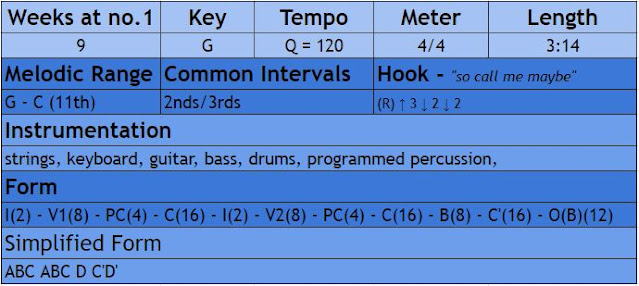
June 23rd - August 18th, 2012:  "Call Me Maybe" by Carly Rae Jepsen goes on an 9 week rampage at no.1!


"Call Me Maybe" Overview


 The form is straightforward and does everything good pop songs usually do.  We see 8 measure verses followed by a 4 measure pre-chorus.  The chorus is a whopping 16 measures, the same 8 measure segment repeated.  There's also an 8 measure bridge in the middle that gets recycled as the outro.

There is a cool wrinkle in the 3rd chorus, C'.  There, the first 4 measures see the rhythm section and vocals drop out.  They come in for the last 3/4 of the the section, which gives the entire part a slightly different feeling.  The last bridge is followed by 4 measures of delays, noise and effects that gradually slow down until the last beat.  

The intro is a simple string figure that blurs the true downbeat until the bass drum drops on beat 1 of the verse.  The section repeats after the first chorus and is easily felt after the beat has been established. It's a nice buffer to reset for the next presentation of verse and chorus.  

Chord Progressions

"Call Me Maybe" starts out with violins chugging eighth notes on G and D, acclimating the ear to the key of G major.  When the verse drops, a quiet guitar comes in and changes everything though, outlining a harmony that will permeate the entire tune.
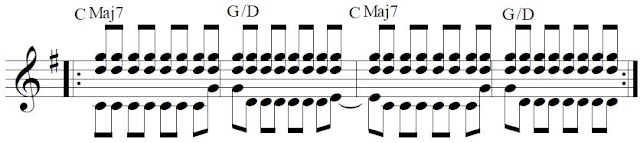
Verse Chord Progression

CMaj7 results from the C in the guitar, the G and D in the strings and the repeated B's found in the melody.  While This could be seen as G/C, we get more information regarding C later on so it seemed fitting to include it as such here.  If you're playing guitar, the C chord makes the most sense for this part as well.  In similar fashion, the melody notes and string accompaniment indicate G/D in every other bar.  

Both verses use this basic pattern, resulting in: IV / I

The chorus and bridge expand this idea, adding more information and yielding two additional chords.

Chorus and Bridge Chord Progression

The syncopation, taken directly from the changing note rhythm in the verse guitar part, drives the tune in these sections.  We hear actual chords as the strings shift through the chord tones.

C    G / D   Emin  /  C   G  / D
IV   I / V      vi     / IV    I  /  V

This sequence is nothing new to pop music, centered around I, IV and V with the vi chord thrown in for color.  What's interesting is that the weight of the progression falls on C, the IV chord, not the usual and expected I chord.  You would expect to see V resolving to I (D - G), but it consistently resolves to IV.  It does create an interesting quality to this song that helps it stick out in spite of the simple harmonic movement.

There are a few spices added in during the chorus that elevate it even further.  We see a guitar arpeggio during the second half that moves between G, E and D, a three note grouping that catches all the harmony, one way or another, and contributes a rhythmic pulse.  There is also wild string run at the end of every 8th measure.  It happens very quickly and is more of an effect than an intricate melodic contribution.

Chorus Harmonic Enhancements 

One additional harmonic variation happens at the end of the bridge, both in the middle of the song and in the outro.  There, we see a very brief guitar motive get a massive delay treatment, resulting in echoing tones to create a spacey texture.  The A note, the 9th of G, results in a really interesting color that is short lived yet very intriguing, to my ear.

Post Bridge Guitar Figure

While this song is extremely repetitive, and uses one main harmonic sequence the entire time, it makes the most out of a little.  The verse and chorus, though essentially the same, sound very different with opposing melodic range and rhythms as well instrumental arrangements.  This seems to be a shared characteristics of songs in the general time period (late 2000's to early 2010's).  Basic material is repeated with a revolving door of nuance on the top.  


Melody

Carly Rae Jepsen begins the song low in her range, singing repeated motives that move between 3-2-R in G major, set on top of the C root.  This morphs this melody into those Cmajor harmonic extensions.
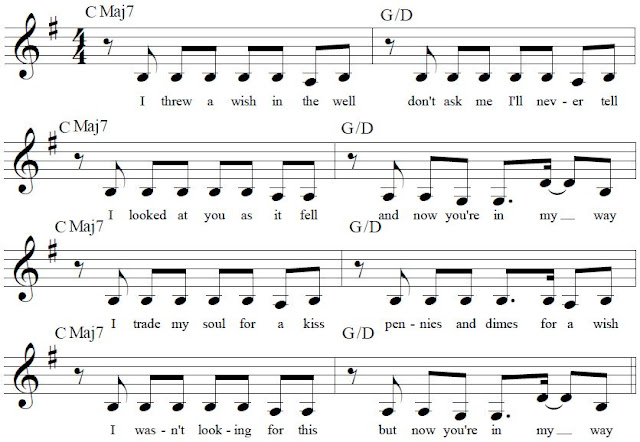
Verse 1

Rhythmic entrances are very consistent and each phrase begins on (1)+.  In measure 4, we get the first glimpse of a rhythmic and melodic figure we will see in the chorus, the dotted 8th syncopation.  

Verse 2 is similar to verse 1, but includes added harmony, a trend that begins in the pre-chorus.  Here, the harmony is mostly up a 3rd, but repeats the D note over the moving A and G.  It finally moves in measure 4, creating intervals of 4th, 3rd, 4th and 3rd, respectively.
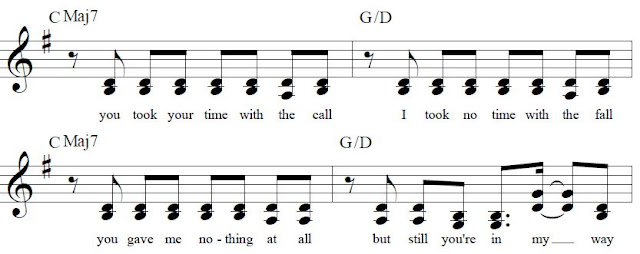
Verse 2, meas. 1-4

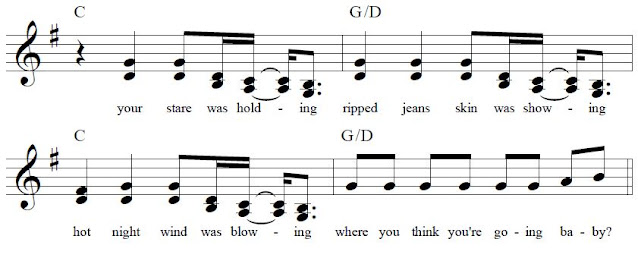
The pre-chorus is a 4 measure refrain that follows each verse.  Rhythmically, it feels very different from the verse, beginning on beat 2 and then accenting beats 1 and 2 in each subsequent phrase.  The vocal melody gets a little higher, in general, working off of D, instead of B.  The harmony is presented in 4th and 3rds, as in verse 2.  Measure 3 has an interesting change with an F# in beat 1, resolving up to G.  It gives the line a little extra motion and keeps the repetitive melody from becoming too redundant.  The last measure features Carly repeating some high G's that lead nicely into the chorus. 
Pre-Chorus

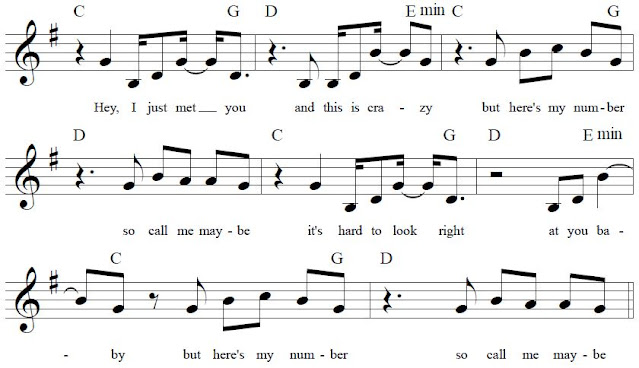
The chorus is certainly the memorable part of this one.  It's 16 measures long, two repeats of a basic 8 measure section.  She repeats the hook 4 times in each chorus.  These stats walk a fine line of becoming too repetitive and redundant, but some sensible arrangement avoids this successfully (9 weeks at no.1 is definitely success!)

The chorus starts with a G major arpeggio, over an actual C chord.  She then sings another G major arpeggio over an actual D chord.  Finally, in measure 3, we hear a C in the melody, confirming suspicions that it was C and not G/C the whole time!?!  In measure 4 we get the hook, R-3-2-R, Do Re Mi in G, over the V chord!  When you break it down like that, it shouldn't sound as poppy and predictable as it does.  I think the trick is using shared chord tones.  G, and B, are shared with G, CMaj7 and Emin.  D is shared with D, G and a logical extension of Emin. All of the pitches work over multiple chords.

Chorus - meas. 1-8

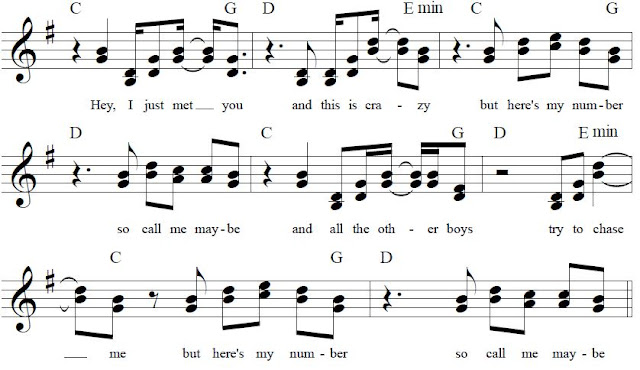
There is a slight variation in measure 6 when she leaps up to another shared chord tone, B, before returning to the same melody as earlier.  Speaking of repeated melodies, there's 8 more measures in the chorus.  Some of the words change and we get an added vocal harmony, once again creating intervals of 3rds and 4ths.
Chorus - meas.9-16

The harmony here is so tightly executed.  Carly sings it herself and the blend in timbre and close voicing comes off as almost unison with healthy overtones.  The added color is just enough to spice up the second half of the chorus, and once again, keep the song from getting too stale and over-played (not this song wasn't overplayed!)

Though the words change, the rhythm and pitches stay the same.  With 4 hooks per chorus, it's no wonder this one gets stuck in your head.....

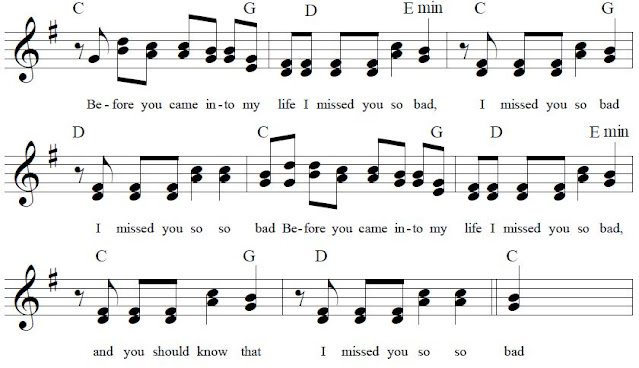
The 8 measure bridge, though it utilizes the same harmonic motion of the chorus, is a good buffer between the first part of the tune and the ending.  It effectively incorporates rhythms and melodies from both the verse and chorus to create a catchy new melody, built on repeated lyrics.    
Bridge

The lower melody line moves, once again, through G major space, this time through G pentatonic, adding in E.  The vocal harmony is almost exclusively in thirds, keeping the close interval and timbre to blend the vocal into one powerful presentation.  We see rhythmic themes reminiscent of the verse, a descending line with shades of the pre-chorus and the harmonic rhythm of the chorus.  

The bridge is accompanied by a guitar melody that further differentiates it as something different.  A brand new rhythm outlines GMaj9, hitting chord tones of the passing chords along the way.  The rhythmic hiccup between measures 2 and 3 is a cool effect that resets the pattern.  

Bridge - Guitar countermelody

This first bridge is immediately followed by the chorus, without words for 4 measures, which creates lots of space and primes you up for the final statements of the hook.  She even sneaks a final "call me maybe" at the end of the last bridge to end the track.   


Lyrics

I feel like there have been many songs that feature innovative ways to get the most out of little source material and then.....the lyrics.  The verses present a rather intense infatuation with a person, repeatedly saying "now you're in my way," as in they cant get past the idea of having this other person in their life.  

Verse 2 presents intense emotion, though slightly cliche, but effective at getting the main idea across:

I beg and borrow and steal
At first sight and it's real
I didn't know I would feel it
But it's in my way

Each verse uses the rhyme scheme: AAAB CCCB

Then the chorus comes in.  All of these intense feelings are cheapened with a series of shy and juvenile colloquialisms: 
And all the other boys try to chase me
But here's my number, so call me maybe 
 
Not to question the sincerity of Ms. Jepsen, but she presents this desperate plea of attraction and desire for companionship and then asks for a callback, maybe?  The wind in my emotional sails just petered out.  She tries to rebound in the bridge, claiming "before you came into my life I missed you so bad, you should know that I missed you so bad."  She's a chorus late and a few dollars short.

I don't know what I expect lyrically from a pop song.  I like the music, I like creativity of the composition but the lyrics kill it for me.  As I have stated before, my opinion is generally contrary to popular tastes.  The public lapped this one up pretty readily.  Relatable lyrics, simply stated, are probably what gives this song the mass appeal.  The hook, "call me maybe," is strong, so despite my feelings, I can see why it was so successful.  Carly Rae herself recognizes the childish "filler" of the lyrics in this Billboard.com article from 2017 regarding the composition of " Call Me Maybe." [3]

Common Threads

What common musical elements do no.1 hits through decades share?  That's one of the mission statements of this project.  After I complete each analysis, I attempt to find some of these common threads.  So far, I have used songs from 2011, 2001, 1991, 1981, 1971, 1961, 1962, 1972, 1982, 1992 and 2002 to inform this list.  "Call Me Maybe" checks a lot of boxes....

Repetitive Melody -  Another extremely repetitive melody added to the archives.  This one repeats melodic ideas and phrases all over the place.  One of my favorite examples of repetition in a melody comes from Madonna's "This Used To Be My Playground" (1992).  That one repeats segments in a crafty way/  "Call me Maybe" is a little more obvious about it.

Hook that Uses Title of the Song - Double check.  We get the hook 12 times!

Stepwise Motion Common in Melody - the verses help this qualify.  There are quite a few thirds in there as well, as she weaves her G pentatonic melody.

+ Use of Vocal Harmony - The harmony in this one is tight.

+ Texture Changes - There are a few different textures.  The verse is thin, with strings and the guitar.  The bass and drums first enter rather subdued and then kick it harder in the chorus.  The bridge ups the anti even more with louder guitars.  There are also the moments after the bridge with the echo guitar and big space.

- Strong motion of V- I - almost....there is a prominent V chord, but it resolves to IV, not I.  

- New Material at the End - there is some noise at the end, but probably not enough  to qualify as substantial new material
  
Chord Count: 4 - CMaj7, C, D, G, Emin - I didn't count D/G, as it is a similar function to plain old D.  I did count the 2 versions of C though....the CMaj7 really is like G/C and feels very different from the proper C in the chorus. 

5/7 common threads is a strong showing for Carly Rae.   In looking back at the chords used, the song still intrigues me in the use of the CMaj7.....


Final Takeaways

I have played this song a few times, years ago, in various cover band situations.  Believe it or not, I remember singers having trouble finding their starting pitch.  After examining the melody, clearly in G major set against a C chord, that is really G/C, I can see why they got thrown off.  As the bassist, I never felt 100% confident playing the tune, partially because I never committed to learning it fully and relied on my sight reading abilities, but I also remember feeling like there was something strange about it.

All these years later, I do like the song.  It is very repetitive and super poppy in every sense of the term, but it's catchy and well constructed.  I'm not sure I could have written such marginally disjointed harmony and melody.  It makes a little more sense why I was never fully confident playing this song, because it pushes against common patterns and slides in just left of center.  

What do you think of "Call Me Maybe?"  Did the harmony every stick out as a little off?  Did the earworm get into your head or did it get overplayed out?  Leave me a comment!

Next time, a recap of all the songs I have explore "on the 1's" and "on the 2's."  I'll take a look at the various common threads and compile all the chord progressions.  I love these data filled recaps to get a sense of how song writing has or hasn't changed through the decades! 


[1]https://reports.hitsongsdeconstructed.com/call-me-maybe/#
[2]https://ew.com/books/2019/12/13/switched-on-pop-excerpt-carly-rae-jepsen-call-me-maybe/ 
[3]https://www.billboard.com/articles/columns/pop/7768166/carly-rae-jepsen-call-me-maybe-interview-greatest-choruses


9/17/20

"Hot In Herre" - Nelly, 2002

 Why are there 2 r's in "Hot In Herre?"  Because Nelly loves double entrendre?  That's the way it sounds when the St. Louis Missouri native says "here" and because it's really hot.....really hot indeed. [1]

What is not a double entendre is the success of this song from Nelly's sophomore record, Nellyville, in 2002.  In addition to being Nelly's first no.1 hit, it won the first Grammy Award for Best Male Rap Solo performance in 2003 (after the category was split to recognize different genders for two years).  [2]  The legacy of the song continues to live on in 2020: as a timeless favorite, nostalgic club classic and even a global warming anthem!?! [3]  I know the guy loves multiple meanings, but I'm sure he wasn't considering global warming in 2002.....was he hanging with Al Gore?

June 29th - August 10th, 2002: "Hot In Herre" by Nelly lasts 7 weeks at no.1!


The only unexpected data in the form is the intro.  12.5 measures works out to be 4 measures in 4/4 followed by a single measure of 2/4 in the first segment.  This is followed by 8 measures of a loop that will repeat for every other section in the song.  Coincidentally, we saw similar intro stats ten years earlier in Madonna's "This Used to Be My Playground."

The rest of the form is standard fare.  Two double verses followed by a chorus makes up two sequences of AAB.  We get a bridge (C) followed by a single verse and double chorus, ABB (fancy inverse!).  The end is a repeat of the bridge, no longer acting like a bridge, but a fitting way to close out the tune with the secondary hook.  

Chord Progressions

"Hot In Herre" uses the same 8 measure chord progression throughout the entire song.  The chord progression is comprised of 4 chords, 2 of which are only different by 1 note.  

The intro actually deviates from the main progression, slightly condensing the longer version:

Intro - meas. 1-5

The lower line, reinforced by the bass plays mostly E, approaching the downbeats with a min.7 D.  The electric keyboard starts with an Emin7 chord, which is a G major triad on top of the E in the bass.  The triad moves down a 1/2 step to F#, still over the E.  We hear F# again, which modulates down again, this time to F.  The cycle repeats in measures 2-4, accenting an Emin triad on beat 4.  The measure of 2/4 creates space before the intro continues for another 8 measures, introducing the primary loop.  

On first blush, I see the intro as:

Emin7   F#/E /      F/E  
i             II     /       bII

I started toying around with other harmonic implications.  The Emin7 could be considered G/E, making G the III.   Thinking about F#/E in terms of B7:  F#, A#, C#, E is F#7, which is V/B....so the F#/E could be V/V?  The chord could also spell BMaj7sus add 9, a highly unusual sub for a V chord.  So the chord could play out as:

Emin7   F#/E /      F/E  
III         V/V  /       bII

In any case, F#/E has a similar pull to Emin/Emin7 that F/E does.   Notes either want to resolve up or down to the closest chord tones by 1/2 step or whole step.  We see an equal distribution of those resolutions when stacked next to one another:

I love the first 5 measures of the intro and more readily connect the song with them than with the 8 measure loop that follows for the next 3 minutes.  It foreshadows all the chords we will hear during the tune and gives a sense of the harmonic motion to come.  It also presents all the material in a slightly different manner than we will see once it gets going.  This is the perfect introduction for the song!

As mentioned, the 8 measure loop uses all the chords from the intro and is repeated until the last note.
Primary Chord Loop

This time, Nelly starts off with Emin, instead of the Emin7 sound, played in a lower octave.  The chords slide between Emin and F/E three times before we heard the Emin7 (G/E), resolved down a half step to F#/E.  The rhythm of the chords, borrow in part from the intro, happens on the + of beat 2 each time.

The lower part, which is doubled by the bass and kick drum, plays the down beat of each measure to solidify the groove.  We hear consistent accents on (3)+ with varying syncopation to fill out beat 4.  

There is also a higher, guitar like chord syncopation woven in.  This part consistently plays a 16th-8th rest-16th figure on beat 3 and beat 2, every two measures.  It comes and goes during the verses and is even exposed at the start of the third chorus.  The higher pitch sits nicely in the balance and it doesn't compete with other syncopations.

The drum groove that accompanies all of this is highly syncopated as well:
drum groove sample

The cowbell, marked with "x", plays an offbeat, Latin like pattern that aligns with the higher chord stabs from above, beats 3 and 2, every two measures.  The bass and snare, marked by the lower downward facing stems, play beats 1 and 2 consistently and double the syncopation on beat (3)+, filling out beat 4 in a few different ways as the tune progresses.  The high hat, stems up at the top, provides 8th and 16ths to lock in the pulse, opening on (3)+ with the other instruments.  

I love when a song has so many rhythmic events occurring simultaneously.  It seems like it would be too busy, but arranged correctly, it works out nicely.  This approach also allows one or two parts to drop out without having the whole thing fall apart.  


Melody
 
The first 5 measures of the intro are really unique.  The keyboard hints at what the song has in store, but never really returns to the pattern verbatim.  Nelly's vocal in the section functions similarly.

Intro Vocal - meas. 1-5


We get a tease of the lyrics as Nelly gives us the forecast.  Melodically, he hints at a common intervallic motion to come, D-E (min7-root), but adds in C#, the 6th of E!  This interval only appears a few other times throughout the song.  It's interesting that he leads with it.

After we hear the looped chord progression, Nelly comes in strong with a memorable first verse:

Verse 1 - meas.1-8

Most of the pitches move between D and E, reinforcing the E minor tonality.  He occasionally makes his way up to F#, though the almost rapid spoken delivery makes that note feel vague.  The melodic theme of the verse is definitely steps moving between root and minor 7.

Rhythmically, measures 1 and 2 share characteristics, as do measures 3 and 4, containing similar entrances and syncopation.  Measures 5 and 6 have more space than previous measures before he kicks on the overdrive for measure 7, winding down in measure 8, once again pounding out D's and E's.

Verse 1 - meas. 9-16

  Measures 9 and 10 retread the (1)+ entrance from measures 5 and 6.  We even get a slight dip to C# in measure 10.  Measures 11 and 12 are very catchy, mostly because they use similar rhythm and he finally changes pitch, going up to the G, the minor 3rd.  In fact, the "bustin' loose" melody is directly borrowed from Chuck Brown and the Soul Searchers 1978 funk classic.  Measures 13-16 return to the D-E theme, introducing a new syncopation on beat 1.  The final pickup into the chorus, once again, features C#.

It's worth mentioning the verse has a lot of "uh's" and "ahhs."  They almost act like a percussion part in their own right, interjecting on up beats, often doubling some of the instrumental parts.  We continue to see this in verse 2, which is similar to verse 1 in length and delivery.  Verse 3 is only 8 measures and consistently delivers rapid rhythmic assaults.

Verse 3

I like the rhythmic structure of this verse, specifically how every other measure measure (except m.7) starts after beat 1 with 8th note syncopation and builds to faster 16th note runs in the next measure.  Nelly starts off with the familiar E-D interval, even visiting G a few times, before he stays on D for the faster passages.  It gives this entire verse a feeling a of anticipation, priming up the listener for the inevitable chorus repeats to end the tune.

In contrast to the longer, faster flowing verses, the chorus comes in with two prominent hooks and a new melodic flavor: 

chorus

Nelly kicks things off with familiar intervals, expanding up the minor 3rd with both interjections and as part of the primary melody.  After 2 measures, we finally hear a new melodic structure and timbre, a response sang by Dani Stevenson.  She alternates between G and F# (over the F/E chord) a few times before going up to the A, a brand new sound for the song up to this point.  Her last note on "off" is a somewhat flat G, or a sharp F#?  It veers close to spoken territory and despite the tonal deficiency, the delivery is perfect for the style and message.....

I do like how this 4 measure segment, repeated twice to yield an 8 measure chorus, contrasts with the longer, less repetitive verses.  The entire chorus is one big hook which stands out even more with the contrasting vocal timbres.  The grunting squeals of delight, introduced in the verse, elevate to even more prominence in the chorus when Nelly interjects five "uh's" on the upbeats, underneath the female vocal.  He is obviously into nudity!

The bridge presents another catchy melody, blending elements of the verse and chorus:

Bridge

We hear lots of 16th note runs, mostly moving from D to an eventual E, accompanied by syncopated "uh's."  Like the chorus, it is very repetitive but does manage to change the words slightly.  We also hear the high G incorporated on "let it hang all out."  This part works well as a bridge and an outro, blending the fast rhythms of the verse and the repetitive catchiness of the chorus.  


Lyrics

The lyrics, like the music, are redundant, simply stated yet intriguing all at the same time.  Nelly pushes the envelope with double entendre and masked slang throughout.  Consider the chorus as a prime example of this:

It's getting hot in herre, so take off all your clothes
I am getting so hot I wanna take my clothes off

 I'm willing to bet everyone has made a similar statement during an extended heatwave.  Logically, it makes sense to shed the extra layers of clothing when the weather is too hot in order to cool yourself and find relief.  I seriously doubt that't what Nelly has in mind though.  

The verses continue to expose his sexual appetite: 

I'm waitin for the right time to shoot my steez (you know)
Waitin for the right time to flash them keys, then uhh

Steez: the quality of being effortlessly stylish or fashionable......we discover the keys are for:

Check it, got it locked at the top of the Fo' Seasons
Penthouse, roof top, birds I'm feedin
   
 "Fo' Seasons" refers to the Four Seasons luxury hotel.  "Birds" could be the British slang for women or Nelly is just expressing his passion for urban ornithology?  He goes on to make a lewd threat:

Cause I feel like bustin loose
And I feel like touchin you, uh uh
And can't nobody stop the juice  
What does "steez" mean again?

My two favorite moments come in verse 3.  First, this question and answer sequence:

I got a friend with a pole in the basement (what?)
I'm just kidding like Jason (oh)  

I imagine the basement pole is a stripper pole?  According the entertaining Genius annotations for this song, "kidding like Jason" refers to the NBA player Jason Kidd.  I'm not sure about his past dealings with strip clubs, but given his past domestic issues, he seems like the kind of guy who may enjoy a shoe show now and then?

And then there's this final statement:
Nelly took a trip from the Lou' to the Neptunes
Came back with somethin thicker than fittin in Sasoons
Say she got a thing about cuttin in restrooms - ohhhhh!

"Lou" refers to St. Louis, Nelly's hometown, and "Neptunes" refers to the track's producer.  "Sasoon," though spelled differently, may refer to the popular line of hair products?  The last line makes me wonder if "lou" could refer to a bathroom, once again using British slang terminology, therefore insinuating the woman wants to cut the line to the bathroom to get an "out of this world" experience with Nelly that results in a viscous, hair gel like product?  Whoah Nelly.....

Common Threads

What common musical elements do no.1 hits through decades share?  That's one of the mission statements of this project.  After I complete each analysis, I attempt to find some of these common threads.  So far, I have used songs from 2011, 2001, 1991, 1981, 1971, 1961, 1962, 1972, 1982 and 1992 to inform this list.  Let's see what "Hot In Herre" contributes.

Repetitive Melody -  The melodic content in the song is repetitive in general.  The entire melody can be summed up with "minor 7 - root movement."  The chorus is also structurally repetitive.   

Hook that Uses Title of the Song - The entire chorus is the hook, which constantly refers to the title.

Stepwise Motion Common in Melody - this tune may have the fewest melody notes of any analysis I have done.  B, D, E, F#, G and A are the only pitches sang, split between two people!

- Use of Vocal Harmony - while there are additional vocals, they do not harmonize any melodies  The background vocals act more like a percussion track than anything.

- New Material at the End - the tune works with little source material.  The end is a repeat of the bridge, which is not often seen in pop song endings.  

- Texture Changes - There are some, but they are minimal.  At most, one of the primary loop elements drops out for a few bars, usually the high pitches syncopated chords.  

- Strong motion of V- I - While F#/E could be considered V, and does resolve to E minor, I wouldn't call it a strong resolution.  

Chord Count: 4 -  Emin7, Emin, F/E, F#/E - minimal chords doesn't always mean minimal musicality.  I like the harmonic motion of this one a lot and feel these chords get a lot of mileage on little source material. 

While there are only 3 common threads, I think the hook and repetitive melody count for double.  They have to be the strongest musical elements of the tune that account for the "extreme ear worm" status this song enjoys, even 20 years after being released. 


Final Takeaways

When I analyzed 1981's "Jesse's Girl," I was reminded of playing the song 20 years ago in a bar band and learning it on the gig, incorrectly.  I have similar memories of learning "Hot in Herre."  I remember being told to "play a groove in E," having never heard the actual tune.  Regardless, I have fond memories of the crowd's reaction, especially when this song was modern and hyper relevant.

I do enjoy listening to this tune.  I love half step motion in harmony, a frequently used movement in heavier music.  While it doesn't come off heavy, it has a dark vibe that I gravitate to.  Musically, the intro is my favorite part and it's interesting that it only occurs as is at the very start of the song.  

Nelly's rap flow is strong.  I like how he uses actual pitches, though limited, to flow through the verses.  When he moves between syncopated lines into 16th note blasts, it's a powerful rush of energy.  The percussive attack of the second and third verses is fun and, without a doubt, gets people up and moving.  While his words are somewhat cringe worthy and even head scratching, they are entertaining and provocative, especially to anyone on a dance floor.

What do you think of "Hot In Herre?"  Does it hold up as a hit worthy of no.1 almost 20 years later?  Leave me a comment!

Next time, the last stop "on the 2's!"  June 23rd - August 18th, 2012 - 8 weeks at no. 1...a juggernaut of pre-teen pop music, at least in my experience, "Call Me Maybe" by Carly Rae Jepsen.  Like it or not, I am interested to see the number of shared musical elements in this one!

[1]https://www.sfweekly.com/music/allshookdown/earworm-weekly-nellys-hot-herre/
[2]http://www.rockonthenet.com/archive/2003/grammys.htm
[3]https://psmag.com/social-justice/how-hot-in-herre-became-a-climate-change-anthem

9/14/20

"This Used To Be My Playground" - Madonna, 1992

Good old Madonna.  Singer, actress, provocateur and pop icon.  She was busy forging her reputation as such in 1992, working on her acclaimed record Erotica.  She also co-starred in a blockbuster movie, A League of Her Own.  The combination of these two elements produced the subject of today's analysis, "This Used To Be My Playground."

Madonna was asked to contribute a song to the movie.  Upon this request, her collaborator Shep Pettibone, wrote a demo for Madonna to work with.  The recording of the final product was tumultuous, and required a quick rewrite of the score while the orchestra waited in the recording studio, threatening a huge price tag. [1]  In the end, we get a no.1 hit single, but it got there in an unlikely manner.

Due to some contract limitations, "This Used To Be My Playground" does not appear on the League of Her Own soundtrack.  Instead, you would have found it on the Barcelona Gold 1992 Olympic soundtrack!?! [2]  Despite this limitation, Madonna hit no.1, breaking her tie with Whitney Houston to become the female with the most no.1's, at the time.

August 8th, 1992:  "This Used To Be My Playground" by Madonna slides into no.1 for 1 week!


The form of this one is simple, yet not without a few quirks.  The intro, led by a keyboard melody, is 8 measures in 4/4 followed by a single measure of 2/4, hence the 8.5 label.  We get cooking right away with the chorus, which for the first two iterations, is immediately followed by a 4 measure post-chorus (PC).  When we hear the chorus later on, we get the 8 measure version, repeated three times in a row with alternate lyrics.

The verses are an unusual 14 measures in length.  They consist of a repeated 4 bar section followed by 6 additional bars.  The bridge is a hybrid of the verse and chorus, using familiar combinations of chord sequences under a string soli.  The song ends definitively with a 4 bar section of new-ish material.  

Breaking this down to a simplified form, it's really just ABAB, interrupted by a short C, followed by repeats of the A section.  This is easy enough to comprehend and a sensical song structure to build from.  As mentioned, it seems to have been tracked live, at least in the strings, which puts it in slightly different air when listening, at least for me.  


Chord Progressions

Like a good thesis statement, the intro provides us a context for all of the harmonic sequences to come. The keyboard presents some thick harmony with a melodic line harmonized in 6ths.  G minor tonality is recognized right away, moving between Gmin and F/G, yielding some lush ballad chords.  

Intro - meas. 1-4

The progression takes us to unexpected territory in measure 4, a place we never return to, going to the parallel G major.  The first 4 measures work out to be:

Gmin  F/G    /  -%-  / EbMaj7   Dmin7   /  Gsus   G
i       bVII    /            / bVI             v          /  I

The next 4.5 measures traverse the same ground, bringing in an additional chord to close things out.  We also see some of the melodic lines shift lower in measure 6, below.

Intro - Meas. 5-9

The progression for measures 5-9 here works out to be:

Gmin  F/G    /  -%-  / EbMaj7   Dmin7   /  Cmin11
i       bVII    /            / bVI             v          /  iv  (vi/Eb)

The chorus emerges out of the 2/4 measure, blurring the tonal center with Ebmaj7.  As Madonna's vocal enters, the pacing slows down briefly before picking up again, weaving in and out of G minor.  

Ebmaj7  /   -%-  / D7sus  / Gmin  /  Gmin7/C   / F  F/Eb   / Bb/D   /  Gmin
bVI       /           /   V        /    i         /   iv (V/F)     / bVII       / III (v)  /   i

There are a couple of lush chords that help provide an atmosphere.  D7sus, D-G-A-C, is a very open sound, functioning like V7 and giving less of a pull to Gmin with 2 common tones (G and D) while A and C both want to resolve to Bb.  There's also Gmin/C, which similar to D7sus, functions like a C7sus, C-F-Bb-D-G...

The C7sus, then, functions like V of F, which is where we end up.  Once there, we get a nice descending line F-Eb-D.  On the D, the Bb triad on top now acts like a D7#9b13, D-Bb-F, which leads back to G minor.  The slow tempo, sparse melody and lush keyboard and string arrangement masque some of the complexity.  In any case, it flows nicely.

The chorus leads directly into a post-chorus, the additional 4 measures after the first two chorus sections.  Here, we retread some progressions just heard and introduce a new cadence.  The C7sus sound of Gmin7/C leads to F, followed by the descending bass line once again.  This time, the D7 hangs in the balance, waiting to resolve back to Gmin....

Gmin7/C   /  F   F/Eb  /  D7    /  -%-
iv  (V/F)   /  bVII       /  V7    /  

As the verse drops, the D7 proves to be deceptive, as we once again return to Ebmaj7.  The 14 measure verse takes a couple of twists and turns, visiting some old patterns and introducing more new sequences.  The first four measures repeat, maximizing descending chord roots G-F-Eb-D:

Ebmaj7 / D7sus  Dmin7 /  Gmin  /  Bb/F   ://
bVI       /  V          v         /  i          / III

In measure 9, things start of similarly before the pacing changes and we get to D7sus two beats early:

EbMaj7  D7sus /  D7sus  Dmin7 /  Cmin11  Cmin7  /  Cmin9  Cmin /  Gmin  F/G  /  -%-
bVI        V        /   V           v        /   iv                         /                          /   i        bVII   /

 The descending note theme returns again, this time on Cmin where the piano plays F-Eb-D-C through the shifting Cmin harmony.  The last two measures return to the opening of the intro, something familiar yet slightly unexpected.  

There are a few spots where the basic harmonic patterns are altered even further.  During the bridge string solo, we see:

EbMaj7  /  -%-  /  D7sus  /  Gmin  /   Cmin11  Cmin9  /  F  F/Eb /   Bb/D /  Gmin
bVI        /          /   V        /    i          /    iv             (v/F)   /  bVII     /  III (v) /    i

The outro also features one last new sequence - Ebmaj7 - Dmin7 - each chord last two measures.  It's an interesting move to end on the minor v chord which gives the song a contemplative and melancholy feeling, perfect for the lyrical content and overall vibe.  


Melody

Despite the altered chord voicing and surprising resolutions, Madonna's melody is straightforward and repetitive.  Chorus phrases consistently begin on (2)+ and use similar rhythms and pitches.  The primary sequence of G-D-C-Bb make up a bulk up these phrases, with each resolving to a chord tone, all shared by Gminor.  Even in measure 6 when she sings repeated A's over the F chord, she ends the phrase on a Bb, -3/Gminor.  She finished off the chorus with a final phrase of D-C-Bb, 5-4-3 in Gminor, now an established melodic sequence.    

Chorus + Post-Chorus 1

The post chorus feels very different, entering on beat 1 and settling on C, a first for the vocal melody up to this point.  That is followed by an ascending G minor lick, leading to D.  The final measure is another G minor phrase, this time higher, G-A-Bb-A-G or R-2-3-2-R.  

The chorus undergoes a mutation the second time around.  We get a short countermelody in measures two and three as well as the addition of harmony, similar to the intro piano line, in 6ths.  
Chorus + Post-Chorus 2

There are a couple of cool spots here, including measure 6 where the harmony gets a whole step apart (C/Bb), both chord tones of F/Eb.  The last measure of the post chorus harmony is buried in the mix but hinges on the familiar D-C-Bb grouping.  

The third chorus marks the start of the long ending, repeated 8 measure chorus sections without the post-chorus.  The words change but the harmony remains, thickening the voicing of the counter melody in the second measure.  The last measure takes the familiar note grouping and syncopates it, giving it a sense of momentum leading into the next 8 measure repeat.  

Chorus 3

 The fourth chorus is similar to the third with additional lyric changes.  As it heads into the fifth and final chorus, we see additional vocals added to the mix.  Included with the moving 9th over EbMaj 7, we get another flash of the intro with the descending line Bb-A-G-F; 5-4-3-2 of Eb.  The sustained F is the minor 3rd of D, furthering the case for the function of D7#9b13 where we see D7sus.
Chorus 4 into Chorus 5


Moving ahead to the verse, we see some similarities with the chorus.  The big phrases enter on beat 3 and using short 8th note runs that resolve on chord tones.  The opening notes, D and F are higher than the start of the chorus.  She then returns to the familiar G-A-Bb-A-G lines we saw in the chorus.  That line is repeated, in part in the next measure, leaving off on D-F, like the opening measure.  Like the chords, the next four measures of melody repeat.  

Verse 1

  In measure 10, we hear a descending line, almost opposite of what came in measure 2 of the post-chorus.  This is repeated again in measure 12, ending on a G in measure 13 as the keyboard takes over, revisiting the feel of the opening measures.  

Verse 2 is very similar to verse 1 and like the second chorus, adds in harmony vocals.  The harmony here follows the theme, a 6th lower.  Some of the entrances are slightly different to accommodate changing lyrics.  The last two measures also feature variations by Madonna, singing Bb-A-G over the last Gminor chord and adding a new melody on "I'll never say," similar to the countermelodies used in the chorus.  

Verse 2

The outro features one additional vocal melody before the song ends.  Chorus 5 uses the syncopation seen at the end of chorus 3, adding in a harmony for "free" on Eb chord tones.  She ends with a descending figure, G-F-D-C, bumping back up for D-C.  The last note, C, is minor 7 of Dmin, a sound we have not head sustained during the same for long periods of time.  
Chorus 5 into Outro

The only other section that hasn't been formally mentioned is the bridge which features the strings playing the melody.  Here, we see some familiar melodic groupings (G-A-Bb) presented with new rhythms and articulation over several chords.  The bulk of the melodic content here centers around these familiar notes and is enhanced with added harmonies and arranging between strings and piano.  It works well as a bridge, breaking up the first half of the vocal sections before we get 3 repeated choruses and the outro.

Bridge


Lyrics

Nostalgia is a strong force.  These lyrics attempt to conjure that feeling in the listener.  In the context of aged baseball players reminiscing about their glory days, it succeeds.  Madonna sets the premise up quite clearly: "this used to be my playground," expanding the description by telling us how it was a safe haven of sorts.  As the verses kick in, she puts emphasis on "used to be," desperately trying to hold on to the past, making us question her current situation. 

The chorus rhyme scheme follows ABCB with the post chorus using its own AAB theme.  The verse consists of 3 sets of ABB rhymes, though the second verse deviates from that in the first stanza.  

The line that may best sum up the lyrical content happens in the 2nd verse:

say goodbye to yesterday
those are words I'll never say

While she is attempting to move on and acknowledge the past is gone, she can't bring herself to do it.  This is certainly a relatable sentiment for most people.  We get a little more context to the entire meaning of the song in the outro with the closing lines of the piece:

The best things in life are always free
wishing you were here with me

In 1990 like year before and years to come, people can easily relate to songs about lost love and friendship.  This last line eloquently and simply states this point.


Common Threads
 
What common musical elements do no.1 hits through decades share?  That's one of the mission statements of this project.  After I complete each analysis, I attempt to find some of these common threads.  So far, I have used songs from 2011, 2001, 1991, 1981, 1971, 1961, 1962, 1972 and 1982 to inform this list.  Let's see how Madonna's 1992 contribution stacks up to that list of common musical elements.

Repetitive Melody -  This could be one of the poster children for this category.  She uses many similar note groupings to construct her melodies and these note groups reoccur in multiple sections and within the same section.  This melody, in other words, is very repetitive.  

Hook that Uses Title of the Song - Probably the most identifiable melodic component of the song, for sure.

Stepwise Motion Common in Melody - Lots of 2nds in this one.  There are a few minor thirds at work in the verse, but 2nds are the dominant interval.

+ Use of Vocal Harmony - the harmony and countermelody are important elements of the melodic presentation.

+ New Material at the End - though short, the outro does include a new chord sequence and melody.  It has been a few analyses since this element has shown up!

- Texture Changes - The entire tune uses similar texture throughout.  Yes, there are background vocals and arrangement elements that come and go throughout the song.  There is, however, this hue surrounding the general production that never lifts.  If anything, the intro has its own unique feel, but that never returns.  

- Strong motion of V- I - While there are several V-i resolutions, the quality of the V chord is ever changing.  When we finally do get a solid D7, it resolves EbMaj7.  Therefore, this doesn't quite make the cut. 

Chord Count: 12 -  Gmin, F/G, Gmin7/C EbMaj7, D7sus, Dmin7, D7, Bb/D, Bb/F, F, F/Eb, Cmin.  There would be more if I had counted all the variations on Cmin.  Either way, 12 chords is a lot to hear in a pop song.  Many of these though, are alterations on a base chord, but serve different functions in the grand harmonic scheme.  


Final Takeaways

  Like so many songs I have worked with, I did not like this one during the first few listens.  The keyboard sounds dated it and the over the top orchestra sound puts it in a sonic landscape I don't readily identify with.  I kept listening though.  What I found was a well crafted song with a surprisingly repetitive melody that works over multiple chords qualities.  

I'm not a Madonna scholar by any stretch of te imagination and had little to no recollection of this song.  Her singing did not blow me away and it's very different from some of the more iconic names I have analyzed in the same time period (Mariah Carey, Christina Aguilera , Brandy & Monica).  Despite all of this, I do like the song.  It has a palpable vibe and the hook is enduring, even if nothing else is particularly memorable.  My wife, my litmus test for many songs, somewhat accurately was able to hum the main hook on a cold ask, guided only by the title.  

I'm aware that Madonna has a legacy in pop music and many accolades to her name.  This song though, aside from the pressures in play when it was written, does not seem particularly reflective of those accolades.  If I continue this project long enough, I will no doubt come in contact with Madonna again.  Hopefully, then, I can hear something a little more exciting in the vocal department.

What do you think of "This Used To Be My Playground?"  Did you remember it from the movie?  Does the sound of the track hold up by today's standards?  Leave me a comment!

Up next time, the journey "on the 2's" takes us to 2002.  The song in question, a powerhouse that even I with my Phish colored jam band blinders on, could not escape.  June 29th - August 10th, 7 weeks at no.1, "Hot In Herre" by Nelly dominates the charts!


[1]https://web.archive.org/web/20110830193214/http://www.sheppettibone.com/sp_erotica_diaries.htm

[2] https://www.deseret.com/1992/8/3/18997770/madonna-s-all-over-the-place-but-her-playground-is-not