Archive

Showing posts with label no.1 billboard hot 100. Show all posts

10/26/20

"Can't Help Falling In Love" (from "Sliver") - UB40, 1993

Chances are you don't remember the plot of the movie "Sliver," starring Sharon Stone, William Baldwin and Tom Berenger.  You do, however, probably remember the song "Can't Help Falling In Love With You."  What lineage....a French love song, "Plaisir D'Amour," composed by a German composer, Jean-Paul Egide Martini (!?!?) in 1784, rewritten in 1961 by George Weiss and company ("Lion Sleeps Tonight," "What A Wonderful World") and recorded by Elvis Presley, only to make it to no.2 on the Billboard Hot 100 in February of 1962.  [1]

Fast forward to 1993.  On the heels of many other popular versions of the tune, UB40's pop-reggae version climbs to no.1 in the U.S., the British group's second no.1.  [2]  The path of this song's no.1 journey is interesting and is reflected in the musical analysis.  This is the oldest source material I can recall appearing on the Hot 100.  George Weiss, a master songsmith, brings this melody to life in an accessible way for pop audiences.   

July 24th - September 4th, 1993: "Can't Help Falling In Love" by UB40 lasts 7 weeks at no.1!  


The form to this song is very peculiar, in terms of standard pop music forms.  The intro is really a statement of the "verse" and "chorus," or A and B.  We get an 8 measure verse with vocals and organ laying down the chords.  We then get an instrumental statement of the 5 measure "chorus."

The "verse" and "chorus" don't quite feel like traditional because each verse contains the lyrical refrain: "I can't help falling in love with you."  The verse is better labeled as an A section and is the primary repeated motif throughout the tune.  The "chorus" is only labeled as such due to repeated lyrics.  It fills the role of a B section, or contrast to the A section.  There is no bridge, so this section almost pulls double duty as repeated "chorus" material as well as the bridge like function, contrasting the A section.

This B section is also an unusual 5 measures long.  It doesn't sound out of place though and the chord resolutions feel natural.  

The final measures tag the refrain and then fade out.  The repetition of the hook to close out the song helps give the song a classic shape, even if the other sections fall outside of that shape earlier in the song.  


Chord Progressions

George Weiss successfully took an antique melody and gave it a makeover with contemporary harmony.  

The intro outlines a straightforward chord progression:

D  A / D  A / G  D / A   / G  A / D  G / D  A  / D
I    V/  I  V/ IV  I / V   /  IV V/  I  IV / I   V  / I 

Lots of I-V resolutions with plenty subdominant color added in.  

When we get into the verse, the bass line colors this progression up a bit more:

Verse - Bass Line

Aside from all the slash chords, the only real change is an E minor replacing the G.   Subbing out a vi for a IV is common sub. I do love this bass line.  It is a solid example of the reggae style and features some great root motion through the slash chords.  

The bassline is accompanied by several layers that fill out the harmony.  Synthy pads lay out the chords over the top while the piano/guitar plays a classic reggae upbeats rhythm pattern.

Chord Rhythm


The chorus takes the standard progression and swerves quite a bit.

F#min  B / F#min  B / F#min   B / Emin11/A / G  A7
iii    VI   /  iii        VI/   iii       VI / ii               / IV  V

The motion from iii to VI gives this section a completely different feel, taking us out of the diatonic realm by one note (D#).  The turnaround back to D blurs the tonality with the Emin11/A.  The chords chunk out Emin while the horns add in A, B and D, over the bass A.  

To further intensify this, the bassline plays C# over the F#min chord and changes the rhythmic approach, adding in these syncopated drops in the first three measures.  In the last two bars, more consistent rhythm propels things right back into the verse.   

Chorus - Bass Line

The tag ends the song on the last 4 bars of the verse.  


Melody

When I first listened to the tune, I remember thinking "this should be a fairly cut and dry melody transcription."  Man, was I wrong.  The pitches were mostly easy to pin down, but the rhythm presented a real challenge.  Ali Campbell's vocal delivery is so loose and relaxed that he is often way behind the beat.  This causes off beat syncopation to come off as triplets, further confused by the fact that he sings purposeful triplets some of the time.  

We get a feel for this right at the top with the organ and voice duet:

Intro (Verse) - meas. 1-8

The entire melody features chord tones, except for bar 6.  This is the bar that becomes E minor after the band kicks in, pronounced by the bass.  E minor and G, of course, are basically the same chord.  Without the bass though, it feels like a G here in the intro.

Ali Campbell seems to be a fan of the whole step above resolving to chord tone, which happens 3 times (meas. 2 3, and 7).  

During the following verses, the melody is harmonized. The harmony jumps around a bit, covering a 3rd higher, then a 4th, then moving in parallel 5ths.  The differing timbres and intervals result in a pleasant sound filled with character.  A cool ornament happens in measure 5, another example of the rhythmic fluidity the singers wade through. 
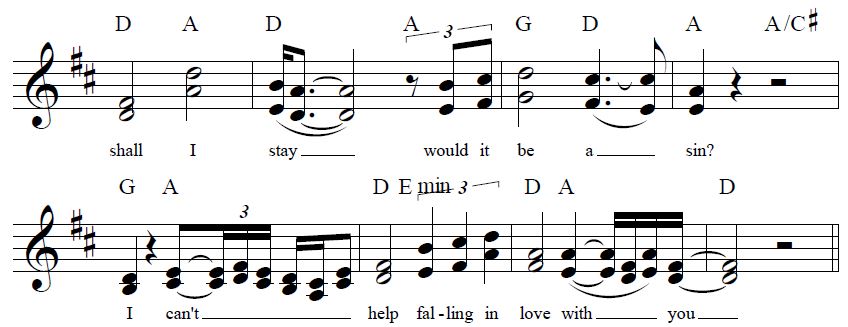
Verse 2

The final verse before the tag has a stuttered vocal figure that may or may not have been purposeful.  Either way, it varies the repetitive verse and helps makes the last, repeated verse feel slightly different.

Verse 3, second time, meas. 1-4

The chorus melody, like the chord progression, takes a wide left turn and we get some completely different conventions.

Chorus Melody with Horns

The rhythm is very choppy on the 16th upbeats, outlining an F# min arpeggio, 5th-R-3rd-5th, with the C# resolving to the root of the next chord tone, B.  The phrase is repeated three times, pushing the momentum forward until the last two bars where things slow down and the cadence evens out and resolves back to D.  The feel here is very relaxed and behind the beat, blurring the rhythm a little bit.  This is particularly strong in the penultimate bar.  The three eighth notes almost feel like a triplet across the bar line, with "be" arriving just after beat 1.  It's completely innocent when listening causally, but proved a head scratcher for me when transcribing.  

The bottom staff, above, represents the horns.  Aside from bars 4 and 5 in the intro statement, this is the first prominent horn feature.  In bars 1-3, we hear similar figures on (3)+ that outline F# min with varying intervals.  The last two measures feature some great arranging with overlapping parts hitting all the signposts of the Emin11 chord.  The rhythm here shifts to being on the beat, another trick to help masque the 5 bar phrase with a clean resolution.  

The horns come back hard in the tagged ending.  Here, they borrow a riff from bass line and deliver some fast staccato double tongue action:
Tag Ending - Melody and Horns

The horns certainly fill up the space left by the vocals.  The thirty second note figure almost answers the triplet vocal melody in fast succession.  They stay on the A, holding back the D major resting place until the next bar.  There, they double the bass line.  After hearing that bass line throughout the entire tune, it sounds natural when the horns double it, even though the line is very busy and highly syncopated.  It ends the tune in grand fashion as it fades out.  

Lyrics

"Can't Help Falling In Love" is high up on the list of greatest love songs.  The lyrics, however, may not as be sweet as you think.  

"Wise men say, only fools rush in
But I can't help falling in love with you"

The narrator is admitting his own stupidity by his inability to stay away from the antagonist love interest.  In the second verse, he even questions his motives, asking "shall I stay, would it be a sin?"  It certainly makes me wonder what else this guy has going on his love life.....

The chorus doesn't give away the resolution to this guy's struggles:

"As the river flows gently to the sea
darling so it goes
Some things were meant to be" 

The river flows to the sea and then disappears?  The river flows into the sea and they become one?  The fate of the protagonist is unclear.  Thanks to the Words And Music And Stories blog for bringing some of these points to light.....it will certainly help me think twice about this song the next time I hear it at a wedding. [3]  

Aside from the mixed messages, the rhyme scheme is non existent.  In the verse, none of the lines rhyme.  Instead, there is some vowel consonance on "wise" and "I," and not as lined up with "fool" and "you."  Coincidentally, the first and second verses have the same vowel construction with "say" and "stay," and "in" and "sin."  The third verse does not follow suit.  

The chorus follows an ABAB rhyme scheme with: "flows; sea" and "goes; be."  

It is a little surprising how few lyrics there actually are.  Excluding the tag, there are 131 syllables in the main body of "Can't Help Falling In Love.".  34% of them are made up of "I can't help falling in love with you."  If you take the repeated tag into consideration, that goes up considerably.  It's amazing that more than 1/3 of the entire lyrical content is the hook.

Common Threads

What are the common musical threads no.1 hit songs share?  In each round of analyses, I try to answer this question by observing like musical elements and investigating their presence in other songs.  So far  this round, "on the 3's," I have analyzed 2013's "Blurred Lines" and 2003's "Crazy In Love."  Will UB40 amend the list with their 1993 contribution?  

Repetitive Melody - Absolutely.  The refrain checks this box in bold.

Polytonal Melody - Melody Utilizes Chord Tones - Unlike the previous hits "on the 3's," this one relies on chord tones.  There is that E min bar where this facet could be challenged, but the rest of the song sticks to chord tones.

Single Repeated Chord Sequence - Two Harmonic Sequences - another song with only two differing chord sequences.  

Multi-layered Percussive Accompaniment - The drums are just kind of "there."

Features Rap/Spoken Vocal - I suspected as we got deeper into the timeline this element would disappear. 

Melodic Bass Line - I love this bass line.  It's not only melodic but percussive as well, almost filling that mutli-layered percussion element all on its own.

Vocal Harmony - Indeed.  I like how the harmony in this one doesn't follow the same intervallic route but jumps around a little bit to create some interest. 

Non-Linear Form - The 5 measure chorus qualifies this category.  I'm still feeling this element out, but "Can't Help Falling In Love's" form gives it a little credence.  

Chord Count - 7 - D, A, G, Emin, F#min, B and Emin11.  The function of the Emin11 (chorus) is different than the Emin in the verse, so I felt it should be counted twice.

5/8 shared elements with "Crazy In Love," which is a surprising stat, considering how different the two songs really are.  The elements that stick out to me are melodic bass line, vocal harmony and non-linear form.  Repetitive melody, as I have noted in every song before this, is either a gimme or a hard requirement for no.1 songs.  The other elements are less prevalent, but happen to be shared by every tune "On the 3's" so far.

Final Takeaways

 When this song came out in 1993, I remember despising it.  Granted, I was just starting out on a lifelong obsession with heavy metal, in particular, Megadeth.  In my early days of watching MTV, I remember watching this video and desperately hoping for something with more edge to follow.  With fresh ears, I like this song quite a bit.  

I read one review that slammed the production and it seems UB40, in general, gets a bad rep as "reggae light," which on its face, shouldn't be a criticism.  Every musical genre has extremes and though the pop elements of UB40 add to that misconception, the bass line in this song alone will quickly challenge that assertion.  I think the band did a great job at bringing out the charm and simplicity of the melody while adding their own voice to it.  Obviously someone agrees, or I wouldn't be talking about it.  7 weeks is a strong showing for any song to last at no.1    

Up next time, "on the 3's" rolls on with a stop in 1983.  July 9th - August 27th, 1983.  8 weeks at no.1...."Every Breath You Take" by The Police dominates the no.1 position on the Billboard Hot 100.  Awesome.  I am a big admirer of The Police and Sting, in particular.  I also know this song made a resurgence in the 2000's.  This should be a fun one.  Stay tuned!  


[1]https://www.songfacts.com/facts/elvis-presley/cant-help-falling-in-love   

[2]https://ig.ft.com/life-of-a-song/can't-help-falling-in-love.html

[3]https://wordsmusicandstories.wordpress.com/2019/03/27/cant-help-falling-in-love-2-analysis/

9/10/20

"Eye of the Tiger" - Survivor, 1982

I remember seeing Rocky III  as a youngster and being enthralled.  If not for the appearance of Hulk Hogan, definitely for the inspiring story of Rocky Balboa.  The entire franchise was appealing to me; drama and violence set to catchy rock and roll.  Rocky I and II used on Bill Conti's "Gonna Fly Now," a cross genre blockbuster that spent a cool week at no.1 in 1977.  In 1982, Sly called an audible and the result would be one of the greatest rock songs ever.

I can't imagine getting a phone call from Sylvester Stallone requesting a song for his new movie because he was moved by my music.  If that wasn't surreal enough, churning out the demo just in time for the film's release and having it become HUGE must have fluffed the surrealistic pillow.  That's more or less the story of how Jim Peterik and Frankie Sullivan of Survivor wrote "Eye of the Tiger." [1]

Of all the songs I've analyzed in this project, this has to be one of the biggest.  If not in terms of record sales, certainly in longevity.  Now I don't go around blasting this in the car, but if it comes on, I'll listen and probably sing along and probably have a physical and emotional response in some way.  If those aren't hallmarks of a good song, I'm not sure what is.  

July 24th - August 28th, 1982: "Eye of the Tiger" by Survivor prowls around the no.1 position for 6 weeks!


The form of this song took me by surprise and is simpler than I gave it credit for.  The intro and outro are the cornerstones of the entire piece.  The intro starts with 4 measures of guitar that build with an ominous piano swell.  The next 16 measures are the main guitar riff that develops with rhythmic variance and added harmony.  Then things simmer down with 2 measures of the guitar pedaling on the root.  This little bumper, denoted as "I" above, is a reoccurring interlude.  The first time it returns, it lasts 2 measures and then doubles before heading into verse 3.  The outro features a similar sequence to the intro, adding in some synth swells before fading out.

Verse 1 is a doubled 16 measure section, with verses 2 and 3 lasting the standard 8.  Each verse is more or less the same, aside from lyrics.

The chorus is varied the third and final time, adding an extra measure on the climax of "he's watching us all in the eye...........of the tiger."  

There is no bridge in "Eye of the Tiger."  This is somewhat surprising, especially when considering the last 80's analysis ("Jesse's Girl" 1981).  The song doesn't really need a bridge though and accomplishes the mission of a kick ass motivational rock song without one.  The intro and outro are perfect bookends to the vocal sustenance.  


Chord Progressions

The iconic intro starts with the guitar pedaling 16th note C's.  We will hear this riff throughout the entire intro and outro, laying a tonal and rhythmic bed for the rest of the band.

Guitar Ostinato


As this rolls on for four measures, an ominous swell ushers in the first sense of tonality, the R-min7 motion in the famous power chord guitar riff.  This eventually leads to the Ab, or bVI chord, a staple in minor chord progressions.  Note the slight change in rhythm 6th measure below, off set by an eighth note.  

Intro Guitar Riff

After we hear the power chorded riff, the guitar changes roles and add harmony, filling out the chords:

Riff with harmony

The three chords presented in the intro will constitute the entire verse progression, through shifted around.  The intro works out to:

Cmin  Bb Cmin /    Bb Cmin /  Cmin  G   Ab  / (Ab)
i        bVII   i    /    bVII  i      /    i         V bVI /

The verse stabilizes and reorders them to:

Cmin   /   Ab   /  Bb   /  Cmin
i          /  bVI  / bVII /    i  

The bass plays an interesting role during the verse.  In the intro and through the first half of verses, it thumps quarter notes on a repeated C, flourishing with C minor licks every 4 bars.  In the second half of the verses, chord roots are followed and slightly different flourishes and articulations are incorporated.
Bass - verse sample

Verse 2 features background guitar harmonies that add a little spice to the familiar part. The tail end also features an adventurous flourish from Stephan Ellis, one of Survivor's revolving bassists.  The guitars sustain an Eb and G, shifting chord tones over Cmin (-3/5) and Ab (5/7), then drop down a step to line up with Bb (3/5).  It certainly has the 80's twin guitar feel.

Verse 2 - guitar harmony + bass fill


Moving along to the chorus, we get more of the same, this time enhanced with some slick syncopation and the addition of 2 new chords.  The guitar and piano interplay during the chorus looks something like this:
Chorus - Guitar and Piano Redux

The chord progression works out to be:

Bb    Cmin /  Fmin   /  Eb/G   Bb   / Fmin    /  Cmin  Bb
bVII   i      /   iv       /  III/V    bVII/  iv         /     i       bVII

Fmin  /  Eb/G     Bb  /  Fmin   Eb/G  /  Ab
iv      /   III/V   bVII /   iv        III/V  / bVI

Adding the minor iv chord into the mix gives the part a completely different feel.  Even though it's built around minor chords, it feels brighter than the verse thanks to the higher guitar chords.  The Eb/G almost acts as a Bbsus as the guitar's Eb resolves to D over the Bb in the bass.  I have heard this song hundreds of times and never bothered to really analyze what was happening in this section.  It is a great balance to the rest of the tune.

The last two measures feature a harmony with the vocal on the ascending lines, a third lower, doubled by guitar and bass.  The walk up F-G-Ab creates a perfect tension until the classic release "of the tiger."  


Melody

While the famous guitar riff is no doubt an important melodic statement in the song, let's look at the vocal melody.  The first time we hear Dave Bickler (who also sang "real men of genius" from those early 2000 Budweiser commercials!), he enters on beat 2, singing two words that most people know, "rising up."  

This double verse is well crafted, repeating rhythmic and melodic themes.  The first two 4 measure phrases begin on beat 2 with a similar pitch and rhythm patterns.  Throughout each phrase, the rhythm is altered but the pitch choices are similar.  G-Bb (5th and -7) over Cmin, G, F and Eb (7, 6 and 5) on Ab, F, Eb and G (5, 4 and 6) over Bb and a chord tone resolution in the 4th bar on C minor, Eb or G.  

Comparing the first 8 measures with the second 8, we see more repeated patterns, specifically the quarter note triplet figure in measures 6 and 14.
   
Verse 1

Each verse follows this basic melodic structure.  I like how it maintains the same character but leaves plenty of room for variation, driven by the lyrics.  Every note is delivered with confidence and strength, very fitting to the musical style and message of the song.

The chorus begins with a subtle syncopation shared with the piano, entering on the + of beat 3 with the repeated dotted 8th figure.  The structure of most of the chorus is similar to the verse, sticking to note groupings for each chord.  Every F minor chord features repeated Ab's (-3) walking down through G and F to Eb (-3, 2, R, -7).  The 2nd and 6th measures use Eb, F and G, R-2-3 for Eb and 5-6 for Bb, similar intervals as in the verse.  
Chorus

The end of the chorus has the climax to the song and one of the hooks "and he's watching us all in the eye of the tiger."  This part kills on a few levels.  First, the ascending line that moves up two steps then down one until reaching the top C is a familiar pattern and very dramatic.  The way the F minor scale (F, G, Ab, Bb, C) works over the shifting chords adds to the drama.  When it the C is held over Ab, now the 3rd, it has the intense open quality.  The band tacet on beat 3 an the prolonged completion of the phrase, "of the tiger," is just a classic moment.    

Lyrics

While the lyrics to "Eye of the Tiger" are not very poetic or profound, they are motivational, especially if your name is Rocky Balboa and you're training to fight Clubber Lang in a championship boxing match.  

For a song to be universally motivational, the language has to be to the point without much room for interpretation.  Survivor does a good job of telling the story about a beaten person developing "the eye of the tiger" and "rising up to the challenge of their rivals."  The chorus gives this sentiment particularly well!  

Apparently, the original version of the song only featured two verses and Stallone requested a third verse. [1]  If this story is true, then according to Lyric Genius, verse 2 may be the additional verse, directly influenced by the movie. [2]  In reality, the whole song seems to be written directly about the plight of Mr. Balboa; Everyman's journey from poverty to prosperity, if you will...

The verse rhyme scheme follows ABAC.  The C line, in fact, is "survive" three times and "alive" once.  Note the use of "survivor" in the chorus as well.  Any band who can regularly reference their own band name is okay by me.  I mean Iron Maiden has a song called "Iron Maiden" and Black Sabbath has a song called "Black Sabbath."  Not that this song shares the band's name, but a little self promotion isn't a bad thing. 


Common Threads

Are there common musical elements shared by no.1 hits throughout the decades?  That's what I'm hoping to find out.  For every analysis, I compiled some potential shared elements and investigate how they are utilized in various no.1 songs.  Building off the list from last time, with Gilbert O'Sullivan's "Alone Again (Naturally)," let's see how "Eye of the Tiger" fits in:

Repetitive Melody -  'Eye of the Tiger" has a lot of repetition.  The main guitar riff, the vocal melody from verse to verse, as well as chorus to chorus, along with melodic conventions within each section use repetition liberally.  

Texture Changes - While they are few, the texture changes are prominent.  The isolated guitar playing a single note is an enduring texture for this song and rock music in general.  The sparse entrance of the rhythm section stabbing out the chord melodies is another classic sound, reminiscent of "stop rhythm" choruses in blues music.  Then there is the pulsing verses contrasted with the brighter choruses, complete with octave guitars....lots of texture changes here for sure.    

Hook that Uses Title of the Song - I couldn't even make up my mind which "eye of the tiger" hook was more catchy!

Stepwise Motion Common in Melody - Steps and minor thirds have the "Eye of the Tiger."  The verses and chorus definitely rely on 2nds.

- Strong motion of V- I - We see lots of bVI -i resolutions, common for songs in a minor key.

Hold Overs
- Use of Vocal Harmony - no background vocals!  The second one in 9 analyses.

- New Material at the End -  While the coda may seem new, it's the same as the intro

Chord Count: 6 - Cmin, Bb, G5, Ab, Fmin, Eb/G - I lumped the power chords in with their triadic brothers.  After hearing this song my entire life, I expected less chords.  6 is a solid number for a relatively straightforward tune.

For such an iconic song, I'm not surprised to see some of these commonalities.  The melody is repetitive, built on diatonic steps with lyrics that are easy to relate with.  The end result is a catchy tune that elicits feeling from the first note.  


Final Takeaways

"Eye of the Tiger" has to be included on a list of songs I learned to play early in my musical training.  I took a life changing course in high school called "instrumental workshop" that offered non-band instrumentalists an opportunity to play in a rock band setting.  There was a class book filled with classic rock songs every young player should get the chance to play and not surprisingly, "Eye of the Tiger" was there.  Funnily enough, it was always considered "hard," mostly due to the clunky rhythm of the chorus.

As an elementary school music teacher, this song comes up regularly.  When kids reach upper elementary and their parents expose them to Rocky, they request the guitar toting music teacher (me) to serenade them with Rocky's training music.  It is also adaptable to play on recorder, a genuinely fun melody on that instrument (B  BAB   BAB   BAG).   Funnily enough, in all of my experience with the song, I have been playing it wrong for all those years!  It's nice to finally know exactly what they are playing in the main riff and chorus.  Sorry for getting it wrong all those years Survivor!

Given my experience, I half expected to be tired of it heading into this analysis.  While I don't plan on rocking out to it in my "off" time, I was happy to learn it in this context and even enjoyed it.  For an almost 40 year old song, it has aged well.  It has intensity, nostalgia, a relevant message and a catchy melody you can't help singing along with.  While it may be lacking a bridge or any serious variation from section to section, it serves its function well.  What more could you want in a motivational rock song that makes you want to kick life's ass?  

What do you think of "Eye of the Tiger?"  Does it hold up as a no.1 hit?  I am the only musician who has been playing it incorrectly for 20 years?  Leave me a comment!

Up next time, we head to 1992, the next stop "on the 2's."  August 8th, 1992, snugly nestled between the 5 week run of Sir Mix-A-Lot's "Baby Got Back" and the monumental 13 week run of Boys II Men's "End of the Road," we get a one week flash in the pan.  "This Used To Be My Playground" by Madonna.  I have been strictly adhering to songs no.1 in the first week of August.  Madonna's entry sneaks in between two very well known songs.  I am unfamiliar with this one, so given my track record "on the 2's," I could be in for a pleasant surprise?   

[1]https://www.tennessean.com/story/entertainment/music/story-behind-the-song/2015/02/14/eye-toger-jim-peterik-rocky-sylvester-stallone/23316471/

[2]https://genius.com/2086242

9/8/20

"Alone Again (Naturally)" - Gilbert O'Sullivan, 1972

 One of the greatest joys this project has given me is exposure to new music, new to me, anyway.  When I looked up the no.1 hit around august of 1972, I was completely unaware of Gilbert O'Sullivan and was impressed with a 4 week run at no.1.  Upon further digging, I discovered that a week after being dethroned (by Looking Glass's "Brandy"), it climbed back to no.1 for two more weeks!  

In 1972, Roberta Flack's "The First Time I Ever Saw Your Face" stayed at no.1 for 6 consecutive weeks, the longest running no.1 that year.  To put this into a little context, earlier in the year, "American Pie" by Don McLean hit no.1 for 4 weeks.  Other notable entries in the no.1 position that year included "Lean On Me" by Bill Withers, "Heart of Gold" by Neil Young and "Let's Stay Together" by Al Green.

I'm trying to convey that fact that"Alone Again (Naturally)" was in fine company.   When I first listened to it, it seemed dated, but in a good way.  Gilbert O'Sullivan's sound reminds me of Burt Bacharach meets The Beatles, another complimentary comparison.  As I continued to listen, I became obsessed with the delicate balance of complexity and simplicity.  Musically, this one is a bit of an outlier.  It is, however, a killer song!  Hopefully I can figure out how this obscure classic reached such popular heights on a musical level.

July 29th - August 19th; September 2nd - 9th, 1972: "Alone Again (Naturally)" by Gilbert O'Sullivan lasts 6 non-consecutive weeks at no.1!


Looking at the form, it's strikingly simple.  Each verse is a 16 measure cycle.  The way each A section is structured reminds me of a jazz standard, repeating the changes and the same melody each time with little variation, aside from lyrics.  After two verses, we get a 6 measure bridge that leads to the back half of the tune. There, we find two more verses, one of which features a guitar playing the vocal melody, before the song tags the hook.   

While there is no formal chorus, each verse contains a refrain: "alone again, naturally."  This refrain is even heard in the guitar solo verse and is used as a fitting ending.  I'd like to think the simplicity of the form, along with easily understood and relatable lyrics provides a balance to the complex chords and melody that comprise each section?

In a way, I see similarities with "In The Year 2525" by Zager & Evans from 1969.  That featured 11 verses with no chorus: AAA or strophic form.  While "Along Again" does contain a short bridge, the A section is the main attraction.  This type of song composition is surprising to see in a pop song, and I am continuously surprised as I learn more about Gilbert O'Sullivan.  UPI (United Press International) gave him a "Shlock Rock Trophy" and called him "the worst potential influence on the direction of pop music since Tiny Tim" in the wake of his success. [1]  While I actively disagree, it does affirm my suspicions that, despite success on the charts, this song must have seemed strange to listeners in 1972.


Chord Progressions

Why do I keep referring to this song as strange and obscure?  Get ready.....it's all in the harmony.  The 4 measure intro gives us a small taste of what's to come:

F#     /  A#min7  / G#min C#7b9  / F#6  F#
I       /   iii           /  ii           V         /  I

Very rarely in pop music does a iii chord resolve to ii.  Usually, we get iii - IV or iii - vi.  The b9 sound on the dominant chord sticks out as a little dissonant, usually reserved for resolving to a minor chord in the home key.  Instead, we get a major 6 chord.  When the vocal comes in, the first two measures repeat, then things go way out!  Below is the full 16 measure A section:

Verse (A) Chord Changes


  In the third measure, we begin a ii-V sequence to G#min (ii), moving through some half diminished chords.  This is a very unusual sound in pop music and is comes off quite dissonant.  While it strangely works with the gloomy lyrics, it is certainly surprising. (The A#min7b5/C# chord could also be viewed as a C#min6, resulting in v/F# or even iv/G#min).  When we finally arrive at G#min7, that gets altered to G#min7b5 (half diminished).  If you think of G#min7b5 as B minor 6, that acts as the iv chord, moving back to F#.  You could also think about it as the ii min7b5 of F# minor.  When it resolves, we get F# major instead of the more appropriate minor.  Either way it feels like home. 

Measures 7 and 8 keep evolving with an chromatically ascending inner voice: F# - F# + - F#6; C# - D - D#.  While this is just the glorified I chord, if you look at where we are going, they take on different function.  Measure 9 rests on A# minor.  To get there, F#+ could be considered the V of D# (A#,CX (D) root and 3rd); D# minor and F7 are iv and V of A# minor.  These two bars provide some interesting voice leading to get us back to the iii chord, now the second time we've resolved there.

Measures 9 through 12 rehash measures 1-6, only they move more quickly through the changes.  When you hear them the second time, they sound less dissonant, especially when we hear the last 4 bars of the progression, a familiar iii-VI-ii-V pattern in the home key.  With 10 chords in the verse alone, I think we may have a new contender for "most chords used in a pop song."  I'm not sure Tiny Tim's music can boast that kind of chord volume!

The bridge of the song modulates to A major, a minor third higher.  There we see a 6 measure section:

A    /   E  / G#min7b5  C#7b9 / A   D#min7b5 / C#maj7   / G#min7  C#b9
I     /  V   /  ii/vi            V/vi   /  I     ii/III          / III             /  ii/F#       V/F#

The bridge continues to use half diminished chords to get to new places.  Like the verse, the III chord (C# major) is used as a resting point. The last two measures sneakily get us back to F# with a good ol ii-V.  

Verse 3 - arrangement highlights

The last verse uses the same 16 measure progression but adds in a tag over the last two measures.  To get there, he goes through another round of iii-VI-ii-V.  Below, I pulled the melodic bits from the arrangement to highlight the progression.  The arrangement is nicely split between strings, horn and flutes.  


Melody

16 measures is rather long for a pop melody.  There are certainly 16 measure sections, usually composed of smaller repeated chunks.  That is not the case here.  There are repeated rhythmic cells as well as melodic motifs, but they are spread out in a way where repetition is not glaringly obvious.  For this analysis, we will look at the first verse.  

Right away we hear 16th notes that gradually become more syncopated.  In the first two measures, chord tones are used with rhythmic anticipation into the next bar.  Measures 2-4 expand on this with more rhythmic variance and a killer descending line from E to G natural, major 3rd of D#7.  

Verse 1 - meas. 1-8

Measures 5 -6 repeat melody chunks, B and G#, chord tones over the shifting G#min, root and minor 3rd.  Measures 7-8 expand this, now using F#, G# and A# in similar rhythms; root, 2nd and 3rd of F#.  An ascending line brings us up to the F7, touching chord tones all the way.

Measure 9, below, continues the repeated note motif, this time with A#, B# and C#, root, 2nd and minor 3rd of A#min.  Measures 10-11 return to the descending line we saw in meas.3-4, this time only getting as low as G#.  Measure 12 is unique, touching on 4th, minor 3rd and minor 7 of G#min7b5.  The lyric "remaining" also sounds very low after all the high crooning.
Verse 1 - meas.9-16

Measures 13 and 14 are similar to the opening measures of the section, taking less time to get to the high note, E# (F).  We then hear the hook, sequences of 2nds and 3rds with a huge leap down a minor 7th in between.  The very last measure is a sample of the impressive guitar arpeggios that permeate each verse.  There, the guitar descends through the scale, A#, G#, F#, E#, arpeggiating the F#6 chord along the way.  

The bridge uses some familiar conventions like 16th note syncopation and descending scales through chord tones.  While it sounds different, it is similar in character.  Notice how the "what do we do" line has a similar feel and syllable count to "naturally."

Bridge


 The bridge is the most "out" with a suspension to the 4th over the A chord and the b9 and b7 usage in the 4th measure over the C#7b9; still chords, but less obvious ones than the verse.  Other than that, notes are generally resolved pleasantly and in an expected way, even if the harmony is moving very unexpectedly.  

Summarizing this mammoth melody, the most unifying factor is use of chord tones.  Given the dissonant harmony, I think that's the only way the melody could work. Rhythmically speaking, this melody gets around.  We see almost every 16th-8th syncopation you can think of....except 16th-8th-16th.  There are many spots where the same pattern repeats a few times before it gets varied.  It is a wonder it works so well.  The element that makes it work has to be:

Lyrics

Songs that hint at suicide have a certain aura.  They are usually dark and depressing, loved or hated, depending on your emotional capacity and tolerance.  "Alone Again" goes there quite a bit, capping it off with a more universal feeling of loneliness.  While the lyrics do fit the music quite well, it's still surprising to me that this song was so popular.

Verse 1 flirts with suicide after being left at the wedding altar.  The second verse presumably continues this tale of woe with the narrator contemplating the existence of God. The final verse deals with losing aging parents.  Heavy stuff all the way through, delivered with a melancholy matter of factness.  

The rhyme scheme is complex.  First off, the verse is so long and lines blend together so often, it's hard to get a sense of properly segmented phrases.  There are also many internal rhymes that further muddle the mixture.  Here is verse 2 with the rhymes underlined. 

Looking back over the years
And whatever else that appears
I remember I cried when my father died
Never wishing to hide the tears

And at sixty-five years old
My mother, God rest her soul
Couldn't understand why the only man
She had ever loved had been taken

Leaving her to start with a heart so badly broken
Despite encouragement from me
No words were ever spoken
And when she passed away
I cried and cried all day
Alone again, naturally
   
  There is a hint of AABBA that gets disrupted the 2nd time with "taken."  The third chunk then adds AABBCCD, with "naturally" acting as the refrain and un-rhymed line.  The other verses are similar in this approach.  

I implore you to read the lyrics while listening to get a full sense of how well they compliment the music.  Maybe that's to blame for the song's success.  There is a somber feeling that comes from listening, that despite the apparent unpleasantness, smothers you like a dark warm blanket.  You know it's sad but it doesn't stop you from wanting more.  Way to be Gilbert O'Sullivan!


Common Threads

For the past 7 song analyses, I have compiled a list of common musical elements in each no.1 
hit.  Last time, I looked at "Breaking Up Is Hard To Do" by Neil Sedaka from 1962.  Let's see how "Alone Again" figures into some of these commonalities:

Repetitive Melody -  This one barely qualifies.  As noted, the primary 16 bar melody borrows from itself on several occasions.  It is also repeated 4 times throughout the song.  Note, this is not the type of repetition pop songs usually employ.  Generally, we hear phrases repeated throughout a section.  This is certainly different, but repetitive none-the-less. 

Texture Changes - again, this one is barely sliding in.  The arrangement features strings, flutes and French horn adding background pads and melodies throughout.  We also hear classical guitar arpeggios ripping in the background.  While each verse has these elements, they are varied in intensity from verse to verse.  The guitar solo verse provides an actual texture change.   

Hook that Uses Title of the Song - yes, though the "hook" is relatively weak in terms of strong melodic hooks.  It's really the only candidate for hook as it repeats five times, like a good refrain should.

Strong motion of V- I - There are many resolutions of V-I.  There are several other resolutions, but it technically qualifies.

+ Stepwise Motion Common in Melody - While there are other intervals used, 2nds are mostly dominant in the melody.  

- Use of Vocal Harmony - no background vocals!  This is a first in 8 analyses.

(hold overs: - new material at the end -  the hook gets the tag ending)

Chord Count - 14 - F#, F#6, F#+, A#min7, A#min7b5, D#7b9, G#min7, G#min7b5, C#7b9, A, E, C#Maj7, F7, D#min7b5 

We have a new winner!  Wow, that's a lot of chords.  Last time, "Breaking Up Is Hard To Do" took the lead with 12 chords.  This one is going to be tough to beat!

I have to say there are more common threads than I initially expected.  For as strange as the harmony is, there are many strong cadences, a trend more prevalent in older decades.  The melody, though lengthy, is repetitious, which is somewhat expected.  Repetitive melody has been an enduring common thread through every analysis I have done.    


Final Takeaways

This tune hit me hard.  I certainly did not expect to admire it so much.  It was a thrilling challenge to transcribe with every chord change becoming an exciting discovery.  In a rare move, I listened to the entire record, Back to Front.  It has some charming moments, even though the 70's sound is a little grading after a while.  "Alone Again" is the album closer.  I'm not sure if that was a ploy to get people to listen all the way through or not.  In any case, I was happy to learn about Gilbert O'Sullivan and his music.

I'm still taken aback by the harmony.  In perusing my end of round recaps, no song has the same complexity.  The closest might be "Magic" by Olivia Newton John from 1980.   But that one had a definite verse and chorus and repeated dissonant harmony enough that it sounded "normal."  I became obsessed with playing and singing that one on my acoustic guitar.  It's safe to add "Alone Again" to my playlist of "obscure no.1 hits."

One explanation for "Alone Again's" rise to the top may be the state of the world at the time.  Tom Breihan's "The Number Ones" series does a nice job of summarizing the toils of the early 70's.  He also touches on a lawsuit involving good old Gilbert and Biz Markie......Gilbert won in case you were wondering. [2]

What do you think of "Alone Again (Naturally)?"  If you were alive when the song came out, do you remember the mass appeal?  Are you surprised it made no.1 twice and was tied with the longest running no.1 single from 1972!?!?  Leave me a comment!

Up next time, we continue to the assault "on the 2's," travelling to my birth year, 1982! July 24th - August 28th, 1982: "Eye Of The Tiger" by Survivor!  I know this one quite well and look forward to diving into the transcription!  This should be a fun one to add to the catalog of no.1 hits through the decades! 


[1] https://www.superseventies.com/1972_2singles.html

[2]https://www.stereogum.com/2034341/the-number-ones-gilbert-osullivans-alone-again-naturally/franchises/columns/the-number-ones/

9/2/20

"Breaking Up Is Hard To Do" - Neil Sedaka, 1962

 "Breaking Up Is Hard To Do" is one of those titles that has made it's way into the subconscious lexicon of song titles, much like the opening line of Bobby Lewis's "Tossin' and Turnin'."  Prior to this analysis, I was familiar with the name, but not with the tune, though my wife belted it out with surprising accuracy on a cold ask.

The early 60's were an interesting time in music where influences from the 40' and 50's were still relevant, but waning in the rock and roll assault that was underway.  Neil Sedaka and Howard Greenfield's doo-wop number riffs on sounds of the past, pepped up with call and responses and longing pleas for reunited love.  The poppy hit, released a few days before July 4th, 1962, gained quick traction and shot to no.1 about a month later.  [1]  

What's most impressive is this song's massive shelf life, thanks to a different version in 1975.  The slower, jazzier reboot, with an alternate intro, reached no.8 on the Hot 100, a fairly unique accomplishment for any song.  The charm of this 1962 version is undeniable though, and brings a few common threads of no.1 hits through the decades to light.

August 11th - 18th, 1962: "Breaking Up Is Hard To Do" by Neil Sedaka hits no.1 for two weeks!


This is a great example of classic pop song form.  If you exclude the intro and outro, we see AABABA, an extended version of a 32 bar form typical in jazz.  The intro and outro bookend the form with a doo-wop treatment of the verse (A).  Like many songs covered in this project, this form has a few twists, notably the extra measure at the end of the chorus (B) that leads back to the verses.  The final verse goes the opposite way and cuts a measure off to lead into the outro.  We get a full 8 bars of the outro before it quickly fades. 

When labeling this tune, a few issues came to mind.  I rehashed my inner struggle with "refrain," which is often used to describe a repeated section like the chorus, or a single line that reappears.  The refrain here is certainly "breaking up is hard to do," as it pops up in each section.  I also questioned the label of "chorus."  Usually, the chorus is a repeated section that contains the hook of the song and ends with closed harmony, resolving to the tonic.  The chorus here doesn't really feel like a chorus.  It harmonically functions like a B section (with a key change), per the simple form.  I ended up going with "chorus" only because it repeats the same lyrics and harmony each time.  

I started to research the intricacies of form and came across this paper about song form that raised some interesting questions.  Pages 3-6 offer explanations on basic terminologies with insights I haven't thought of.  It's worth checking out the first few pages. [2]    


Chord Progressions 

Keeping in step with classic song form, we get a classic chord progression in the doo-wop style.  Borrowed from jazz, this progression is found across multiple styles of music.  The intro reveals this variation:

B  G#min / E  / -%2%- /  -%2%- /  B E / B
I   vi        / IV /             /              /  I IV / I 

I expect to see the V chord leading back to I every time, but if you listen closely, it doesn't happen.  The vocal melody undoubtedly moves there, but the rhythm section doesn't follow.  I'm sure most people don't notice, but it is a cool auditory illusion, in a way.

The verse takes the above progression and varies it slightly:

B  G#min / E   /  -%2%-  / B  F#/A#  / G#min  / C#7         F#7  / B
I    vi       / IV  /               /   I  V         / vi             /II (V/V)     V    / I

The above progression is even varied further in the first verse only, giving an entire measure to both C#7 and F#7 before getting back to B in verse two.  

In a nutshell, I-vi-IV-V progressions are very common in popular music.  "Breaking Up..." takes that and gives it a slight twist by not fully getting to the V chord and adding in the ii-V-I, going to V/V instead of ii for the strong pull to V and I.

The chorus section uses more familiar progressions, transposed across a few different keys.  The 8 measure section plays out to be:

Bmin7 E7 /    -%-      / Amaj7  /     Amaj7      / Amin7  D7 /     -%-     / Gmaj7         / F#7
  ii       V  / (of bVII) /  I           / (bVII of B) /    ii         V   /  (of bVI) /  I (bVI of B) / V/B

He starts in Amaj with a series of ii-V's.  Amaj changes to Amin to set up ii-V's in G.  After getting to G, a half step resolution to F#7 brings us back home to B.  This whole progression is pulled directly from countless jazz standards and works well as a contrast to the A section, venturing to new keys while maintaining a similar character.

During the chorus, an acoustic guitar provides some Jobim-esque arpeggios that give it a nostalgic feel and smooth character.  The last two bars feature an ascending tremelo  line from the string section.  This is such a classic accompaniment I had to transcribe it:

Chorus - guitar and strings (last system)

Each time, the guitar arpeggios are slightly different, yet they maintain key intervals: minor 7 resolving to major 3rd.  There is also the 16th note figure in measures 1 and 5, mixed way back but giving the slightest rhythmic bump.  The tasteful string run at the end, moving stepwise through the changes, is the perfect punctuation to end the section.  


Melody
The intro establishes the verse harmony without completely giving away the melody.  What we get is a bouncy doo-wop figure in 3 part harmony.  Neil provides the lower melody with female backup singers harmonizing above him.

Intro/outro

 Looking at the lowest note, we see lots of roots and 3rds, as well as the hint to the F#7 chord in measures 2, 4 and 6.  We also get a little taste of the refrain, "breaking up is hard to do," which also happens to be the hook.  This refrain is actually presented several different ways throughout the tune.  Here, Neil's melodic path goes: (5) ↑ 2 ↓ 2 ↑ 4 ↑ 2 ↓ 2 ↑ 2 ↓ 2.  Keep this in mind as we encounter the same phrase in subsequent sections.

The first verse follows with a 3 beat pickup (shown below), which fits in the empty space in the last measure above.  The harmony arrangement changes considerably with Neil providing two part harmony on the lead melody as well as his part from the intro, minus the ladies.  His background vocal is the same up until measure 5, which is seen in the stem down notation:

Verse 1

The lower voice acts as the melody, blending seamlessly with the higher harmony.  We see lots of chord tones that move up and down in steps, resolving down a minor 3rd, E to C# in the second and 4th bars, fueling the fire to the phantom F#7 chord.  The descending line in measures 5 and 6 effectively shifts the melody from the lower line to the upper line.  If you were to sing only one of the lines with a guitar or piano, you reach a point where the opposite line sounds like the proper melody.      

In the first verse, the refrain moves  (3) ↓ 2 ↓ 2 ↑ 3 ↓ 2, leaving off on C#, 5th of the F#7 chord (finally!).  This is the only place in the tune we hear this arrangement as the chords move faster through the last two measures elsewhere.

The second verse is mostly the same as the first, changing rhythmically throughout the first 4 measures.  This verse feels lighter, with more space between phrases:

Verse 2

At the end, the refrain is different yet again and reflects, in my opinion, the hookiest of the hooks, resolving on the root: (3) ↓ 2 ↓ 2 ↑ 2 ↓ 2.  The lower harmony here is a little tricky, getting to the root an eighth note before the higher harmony.  The last measure above contains a great drum fill to kick in the B section, or chorus.

When the chorus comes in the first time, we hear a single line, shifting the texture from the multilayered vocals of the verse.

Chorus 1

The section kicks in with a B minor scale up to the 5th before it moves in steps over the next three chords.  Over the Amaj chord, we get a partial arpeggio (C# and E) before returning to the F# and E notes from before, now acting as 5th and 6th of the Amaj.  In similar fashion, E and D move through the chords in the next two measures.  Over the Gmaj7, we hear a B Phrygian scale (the third mode of Gmajor) that morphs to F mixolydian (B major) as the F#7 chord sounds.  This modal interchange is very cool and works perfectly with the modulating theme of the section.

The second time the chorus happens, there is a call and response between the female singers and Neil.  Melodically and harmonically it's mostly the same, varying some rhythm, like the first two verses did.  I should also mention yet another variation on the refrain.  From "breaking up is hard to do," in the key of A, we hear: (4) ↑ 2 ↑ 2 ↓ 2 ↑ 2 ↓ 2 ↑ 2 ↓ 2.  This has a very similar intervallic structure to the proper hook, but feels considerably different thanks to the starting note and harmonic variation:

Chorus 2

Also of note is the added harmony in the penultimate measure, a repeated F#, root of the chord.  It creates some close intervals, hearkening back to the opening of the verse.  


Lyrics
 
It didn't occur to me, until I read this article, part of a great series by Tom Breihan at StereoGum (he's reviewing every no.1 song on the Hot 100 ever...he started in 2018 and is just now reaching the mid 80's! [3]), that this song about heartbreak and loss is pretty darn cheerful.  

There are some emotional lines, that in a vacuum, seem like they would accompany some much darker music:
Don't take your love away from me
Don't you leave my heart in misery

I beg of you don't say goodbye
Can't we give our love another try?

All of this heavy emoting is somewhat negated by his worst-case scenario: feeling "blue."  I suppose people had less to worry about in the 60's on a broad global scale?  Feeling blue is the worst!  

Every verse, and chorus, follows the rhyme scheme of AABB.  Nothing tricky here, just straightforward rhyming in a cute little package.  


Common Threads

What musical elements do no.1 songs across decades have in common?  Over the course of these analyses, I have compiled a list of elements present in each, adding or subtracting elements as needed.  Picking up from "Tossin' and Turnin' (1961)" let's see what musical elements have endured.

Repetitive Melody -  The meat of the melody is very repetitive, built on repeated chord tones moving in steps.  

Texture Changes - For sure.  We see the intro texture of female singers with Neil.  The verse has three versions of Neil.  The chorus has one Neil and then Neil answering the background singers.  Lots of texture changes afloat, and that's just with the vocals!  

Hook that Uses Title of the Song - We haven't seen a lyrical refrain like we do here since maybe "Close To You (1970)" or even Taylor and Lady Gaga's 2020 contributions.

Strong motion of V- I - The elusive F#7 resolves to B, even when it doesn't get played!

Use of Vocal Harmony - Lots of stacked harmonies in this one with multiple groupings of singers. 

- Stepwise Motion Common in Melody This could be counted twice for the stepwise motion in the harmony part!

(hold overs: - new material at the end -  this one repeats the intro at the end.)

Chord Count:  12 - B, G#min7, F#/A#, E, F#7, C#7, Bmin7, E7, Amaj7, Amin7, D7, Gmaj7 - for such a poppy and "light" tune, there are a lot of chords!  This is the most chords seen since I've been counting.  


Final Takeaways

I really enjoyed this one.  It has a fun vibe, despite the emotional subject matter.  Doo-Wop is a style I'm not terribly familiar with or fond of.  This one makes me curious about more doo-wop, which I bet I could enjoy in small doses.

I was particularly intrigued by the chorus section, both in function and form.  The section would be called a B section if this were a jazz lead sheet.  I have always been confused when non-jazzers try to pinpoint one part of  jazz chart as "the chorus," mainly because the entire form, AABA, would be considered a chorus.  In pop music though, these terms are common and this part is only the chorus because it repeats the same lyrics and harmony both times.  And speaking of the harmony!  A series of ii-V's moving down through foreign keys to come back to the home key is done tastefully.  The guitar accompaniment is a highlight for me and is filled with little nuances that make it feel special.  

I did briefly listen to Neil Sedaka's 1975 arrangement of this song.  I was not hooked right away.  It is also very jazzy and the hook brings with it some strong nostalgic value.  Neil Sedaka is one of those names I have heard numerous times but probably couldn't name any of his songs.....I'm not sure I can name another one aside from "Breaking Up...."  It was nice to put a sound to the name.

Up next time, continuing "on the 2's," we go back to 1972. July 29 - August 19, 1962...a 4 week run at no.1.  "Alone Again (Naturally)" by Gilbert O'Sullivan.  Whew....now we're venturing into completely uncharted territory, pardon the pun.  The artist's name sounds somewhat familiar but I'm mostly clueless.  You never know what you're gonna get in the 70's!


[1] https://www.songfacts.com/facts/neil-sedaka/breaking-up-is-hard-to-do

[2] http://www.gfpm-samples.de/Samples13/appenfrei.pdf

[3]https://www.stereogum.com/category/franchises/columns/the-number-ones/